Showing posts with label gender stereotypes. Show all posts

Thursday, September 28, 2017

UK crackdown on gender stereotypes in advertising shows up Australia's low bar

File 20170801 22136 rtzif

From next year, TV advertisements that play on gender stereotypes, or that mock people who fail to conform to them, will not be permitted by the UK’s Advertising Standards Authority.

The kinds of ads that have been flagged as inappropriate include those that depict men as incompetent at doing basic household or parenting chores, or that show a whole family leaving a giant mess for mum to clean up.

The authority has said ads that belittle people for not living up to gender norms – such as a KFC advertisement that implied a man suffering from anxiety was not masculine – have “costs for individuals, the economy and society”.

A UK KFC ad from 2014 suggests it’s not manly to listen to your
girlfriend.

Attempts to counter the prevalence of gender stereotyping in the popular media are popularly dismissed as “social engineering” designed to alter “natural” behaviours for each gender. However, the stereotypes we see represented in advertising are already ideologically motivated by centuries of gender inequality.

Gender is a social construct and we have the power to shape and revise what is considered masculine and feminine. And the media we consume – particularly advertising, which we see continuously – are particularly powerful in shaping what we think is “normal” and acceptable for men and women to do.
Think of the ubiquitous television ads in the 1980s for Tip Top bread, with their “good on ya Mum” slogan. The smiling mothers presenting sandwiches to their children conveyed that women are the default parents and that satisfaction for women should stem from caring for others.


Tip Top ad from 1983.

Australia has laws that apply to discriminatory advertising, including the Racial Discrimination Act and state and territory anti-discrimination acts. Apart from this, the industry is largely self-regulated. The Australian Association of National Advertisers has its own code of ethics.
The code forbids any advertisement that:
… discriminates against or vilifies a person or section of the community on account of race, ethnicity, nationality, gender, age, sexual preference, religion, disability, mental illness or political belief.
It also marks out “exploitative and degrading” sexual representations as unacceptable.

Australia has largely moved beyond acceptance of extremely objectifying advertisements for products with no inherent connection with sex. A prime example was the seductive “Chiko chick” who promoted the Chiko roll while posed on a motorbike from the 1950s.

However, self-regulated advertising criteria that merely forbid outright illegal discrimination or “degrading” sexual content set the bar especially low.

Other countries, such as Sweden and Spain, have made concerted efforts not only to avoid gender stereotyping in advertising but to counteract it. For instance, toy catalogues produced by Toys R Us and Toy Planet have drawn international attention for their depiction of both boys and girls playing with dolls, trucks and tools.

This kind of gender neutrality is not intended to discourage girls or boys from playing with the toys traditionally associated with their gender. Instead, it aims to make it acceptable for them to choose from any of the available options.

When you consider that debates about child-care costs are still usually framed in terms of whether it is financially worth women returning to work, it is clear the way we socialise children into seeing child care as women’s responsibility flows all the way through to major issues of employment and gender equality.

Gender stereotyping in advertising is not just problematic because of limiting representations of girls and women and the reassertion of their role in the home. In addition, the ways boys and men are depicted as useless at basic domestic tasks makes them out to be simpletons.

There are countless examples of “dumb dads” in ads. Think of the father in a Glade advertisement who is consistently befuddled by an automatic deodorising spray.

A banned Verizon ad from the US portrays the dad as being ‘stupid’.

Part of the strategy of advertisers in their representation of “dumb dads” may be to flatter mothers who do the majority of domestic work and grocery shopping.

However, these ads – which usually have a heteronormative orientation – also reinforce the status quo and culturally absolve men from responsibility to contribute to unpaid household labour, privileging their employment and recreation.

One way to consider advertising and other forms of popular culture is as a mirror that reflects our social norms, beliefs and values. If this is true, then advertising could be absolved of responsibility for reproducing gender stereotypes in that it is as progressive or regressive as the society in which it is produced.

Crucially, advertising and other media are not only reflectors of our culture. They also have the power to produce and influence values and norms.

The ConversationWith this in mind, the sooner we regulate advertising to encourage the depiction of a world we’d like to inhabit, the sooner it is likely to eventuate.

This article was originally published on The Conversation.

Thursday, December 3, 2015

There is no "War on Barbie": Toys, Gender Inequality and Domestic Violence

Uncredited image
Last week  marked White Ribbon Day in Australia, a focal point for the male led campaign to end violence against women. On the same day, a Senate inquiry into the relationship between children’s toys and entertainment and the gender stereotypes that contribute to domestic violence was announced.

Predictably, the inquiry was instantly deemed “a war on Barbie”. It was also an opportunity to label the Greens, who initiated the inquiry, as kooky for linking Tonka trucks with Australia’s family violence crisis.

Both the federal government and the opposition were eager to uncouple themselves from any suggestion that they might begin policing toy boxes. A spokesperson for Labor leader Bill Shorten remarked that any notion of “a clear link between toys and domestic violence is absurd”.

Last year, the Greens supported the No Gender December campaign, which encourages families to be open-minded when choosing toys to place under the Christmas tree. The campaign highlights how toys are marketed in ways that segregate play along gender lines.  Most toy shops erect an invisible Berlin Wall that largely keeps girls in the pink, sparkly zone and boys in the sector of camouflage-toned action.
Sam Humphreys: It's a Matter of Trust project

The suggestion that children’s toys, books, or films might have any connection with the beliefs children internalise about gender and the kinds of adults they become rankles many people. We commonly take exception at the idea that anything that formed part of our beloved childhood could be anything other than innocent and delightful.

It is time that adults “grow up” and stop ridiculing the idea that the cultural products we make for children are influential and can have both positive and negative impacts.

Parents tend to accept that young children might be swayed by advertising for junk food, depictions of smoking, alcohol or drug use as desirable, or TV or movies that are infused with swearing. Children are consistently absorbing cultural cues about how to behave and act. As a result, parents might restrict their children’s exposure to things they see as harmful, or at least help children negotiate what is socially acceptable and healthy for their own wellbeing.

When it comes to the negative influences of gender stereotyping in moulding how girls and boys feel that they can act as kids and as adults, we inexplicably change tack. These are only innocent or trivial toys or cartoons. And children won’t be thinking about adult concepts like the gender pay gap or domestic violence in any case.

The Reducing Violence Against Women and Their Children report, released this month,  demonstrates that young people have already formed views about gender relations and violence. It shows that when presented with hypothetical scenarios, boys as young as ten years old think that female victims of domestic violence are at fault; girls tend to blame themselves. Why would children already blame women for domestic violence if they were not absorbing ideas from the cultural around them?

Individual toys do not transmit troubling beliefs about violence directly, but the gendering of toys is a reflector of, and a contributor to, the gender inequality that produces domestic violence.

Critics of the inquiry propose that Barbie and other traditional toys marketed for boys or girls have been available for decades, as if to suggest that popular practices cannot possibly be wrong. They also ignore the coexistence of gender inequality with these and other superficially innocuous traditions throughout this period.

There is no social engineering in the suggestion that we should examine how the marketing of toys and children’s entertainment might bolster gender inequality. No one is proposing restricting the interests or freedom of children to choose. Rather, we must remove the limitations on children that are deployed through gendered marketing.

Toys that are categorised for girls are often related to domestic chores, fashion or babies, mirroring the ongoing expectation of women’s disproportionate contribution to housework and childcare. While boys’ toys involve construction, adventure, or warfare. Gender inequality is entrenched in the way that toys that are marketed for girls are unacceptable for boys or else they will be mocked because what is feminine is unimportant, frivolous and incompatible with being a “real” boy or man.

The gendered marketing of toys is not the direct reason why one in six Australian women has experienced domestic violence. Yet we cannot expect that “raising awareness” and simply telling men to respect women and monitor each other will make any meaningful difference to the long history of violence against women. It is time we looked seriously at where gendered inequality originates and is cemented to understand how we might shift the power imbalance at the core of violence against women.  

Tuesday, March 31, 2015

Talking Princess Culture on Life Matters, Radio National

To coincide with the release of Disney's new Cinderella film, I was a guest on Radio National's 'Life Matters' last Friday. I joined host Natasha Mitchell in a talkback session on the subject of girls and princess culture, along with Samantha Turnbull, author of the Anti-Princess Club series of books and children's author and school principal John Marsden.

Listen in to the podcast for a variety of perspectives on what wanting to be a princess means, not only for girls, but for boys too.

Monday, December 8, 2014

Barbie for Boys? The Gendered Tyranny of the Toy Store

“I didn’t encourage my daughter to play with Barbie dolls and dress up in flouncy fairy costumes, but she just gravitated toward them.”

When confronted with the idea that gendered marketing and stereotypes have a substantial impact on children’s play, many parents make claims such as this that suggest that girls have an innate predisposition to acquire pink, glittery toys.

Not only do many parents deny that gender stereotypes shape what kinds of toys children feel allowed to play with, but so too does our Prime Minister. On hearing of the No Gender December campaign, which encourages people to consider what kinds of toys they are buying in the lead-up to Christmas, Tony Abbott dismissed it as “political correctness”. We must, he argued, “let boys be boys, let girls be girls”.

No Gender December, and similar campaigns such as Let Toys Be Toys, nevertheless suggest that the gender stereotyping of toys restricts children’s creativity and development. They also argue that the separation of toys for girls and boys contributes to gender inequality by marking off certain pursuits, careers, and tasks as unsuitable for one gender or the other.


Letting children “be” boys or girls implies that there is a natural set of likes and dislikes for each gender that are unaffected by the culture in which we live. Behind this view is the sense that toy preferences are rooted in biology, such that only girls are drawn toward baby dolls because they are driven to nurture, while boys will be attracted toward active toys such as guns.

There are several problems with this viewpoint. First, to take one type of toy as an example, very young boys seem equally attracted to dolls. Cordelia Fine’s Delusions of Gender refers to a study that measures young children’s reactions to dolls, finding that boys only begin to reject dolls around the age at which they can be taught that dolls are intended only for girls.


If we were able to create an environment in which limiting cultural views about gender were not presented to children through the media, advertising, or enforced by their peers or parents, then in all likelihood many boys would continue to show an interest in dolls beyond infancy, as some still do regardless of these factors. That would truly be letting “boys be boys”.

Indeed, such an attempt to counter the effects of gender segregation in toy stores is already in progress in Sweden.

In 2012, Top Toy, the franchise holder for Toys R Us in Sweden, produced a catalogue with a girl shown deftly working a Nerf gun, a small boy cradling a baby doll, and both a boy and girl playing with a doll’s house. International media reports about the catalogue reacted along predictable lines, suggesting that gendered separation of toys mirrored children’s natural preferences and that the concept of gender neutrality was bizarre and artificial.

Nevertheless, Toys R Us Sweden has only continued to move towards gender neutrality in its stores, with the physical layout being transformed such that typically masculine and feminine toys are intermingled throughout the aisles.

Second, these supposedly “natural” preferences for particular kinds of toys or colours shift according to what our culture believes appropriate for children and what the toy industry finds profitable.
We know, for example, that the “pinkification” of girls’ toys is a relatively recent phenomenon, in part motivated by a desire to improve sales by rendering the most innocuous of toys unusable by siblings of different sexes.

Similarly, where Lego was once imagined as a relatively unisex toy that encouraged creativity and developed fine motor skills, in recent years a separate line intended for girls, which involves less freedom to construct, has become a bestseller.


We place great strength in the idea that the kinds of toys that children play with helps to determine the kind of adults they will become, especially in terms of how appropriately masculine or feminine they will be. Even children know enough to act as “gender police” if a boy or girl attempts to play with a toy outside the accepted items for his or her gender.

The No Gender December campaign notes that:
It’s 2014 – women mow lawns and men push prams but while we’ve moved on, many toy companies haven’t.
Yet some of the main markers of gender inequality refuse to budge in countries including Australia. The majority of housework and childcare is still performed by women, even as more women are in paid employment than ever before. High-paying industries and senior positions within most fields remain dominated by male employees, while feminised occupations, involving caring or working with children, remain low paying.

The segregation of toy aisles is a reflection of a society in which gender inequality is normalised and children are taught to understand that the disparity between male and female social roles is inescapably natural.

While making it easier for girls who want to romp adventurously to do so and for boys who want to show an interest in clothing to play with Barbie won’t single-handedly correct gender inequality, it will help to minimise the internalising of gendered limitations during childhood. It also won’t stop girls being girls or boys being boys.


The Conversation
This article was originally published on The Conversation. Read the original article.

Friday, April 25, 2014

The History of Gendered Children's Books ... And Their Segregating Present

Includes "Gulliver", "Robin Hood" and
"Robinson Crusoe"
Scholars of children’s literature are accustomed to defending the field on the odd occasion when introduced to someone who jokes about how frivolous and pointless it must be as an area of research. Yet when an article appears in the media which suggests that children’s books should be altered to ensure that they are more inclusive of all children, it inevitably provokes the interest of tens and even hundreds of thousands of readers. For something supposedly trivial, children’s books seem to be of great personal significance to a large number of people.

Last month, Katy Guest, literary editor at the Independent on Sunday, announced that the paper would no longer review “gender-specific children’s books”. This didn’t mean that books like Anne of Green Gables or Harry Potter would be barred from review. Guest made specific reference to the recent rash of books that segregate boys and girls and don’t leave open the possibility that girls might be interested in pursuits that are stereotypical for boys and that boys might also want to read about what are considered girls’ interests. These are not simply books with boy or girl protagonists, but the type of books that are colour coded in pink or blue and which are often published in pairs, such as Usborne’s Illustrated Classics for Boys (“stories of action, adventure”) and Usborne’s Illustrated Stories for Girls (“stories about mermaids, fairies, princesses and dolls”).
 
Includes "Heidi", "The Wizard of Oz" and
"The Secret Garden"
Around 200,000 people read Guest’s original article and responses were so numerous that she was compelled to prepare a list of answers to the most common expressions of outrage. The article offered support to the Let Books Be Books campaign, which is part of a broader push to end gender segregation among children’s toys.

I also agree that girls and boys should be encouraged to choose from every kind of story imaginable. But, then, a lot of my research concentrates on books and magazines that were published specifically for girls during the late nineteenth century and early twentieth century. Don’t I actually like the concept of books written and published for girls? And if girls’ and boys’ books have been around for so long, then what’s wrong with these recent books targeted at one gender?

The History of Gendered Children's Books and Magazines
A Little Pretty Pocket-Book (1744)
The earliest illustrated children’s books published in Britain by John Newbery in the mid eighteenth century, such as A Little Pretty Pocket Book (1744), were intended for both boys and girls. The book’s subtitle indicates that it was "Intended for the Amusement of Little Master Tommy and Pretty Miss Polly". Children were just beginning to be recognised as a distinct readership, separate from that of adults, as evidenced by the debut of The Children’s Magazine in 1800. Previously children who were fortunate enough to be able to read would usually only be catered to through children’s pages in family magazines, religious tracts, catechisms, primers and chapbook adaptations and abridgements of popular novels like Robinson Crusoe and Gulliver’s Travels.
 
Little Folks (1871-1933)
Most nineteenth century magazines for young children, such as Aunt Judy’s Magazine, Little Folks, Chatterbox and Kind Words for Boys and Girls, were aimed at both boys and girls. Concerns about properly gendered behaviours were not marked for young children. For instance, small boys often sported their hair long and wore dresses until the age of breeching (usually after a boy turned four and before he was eight). Young children could then be treated as a relatively undistinguished mass in books and magazines.

In the eighteenth century, adolescence was generally incorporated within the concept of childhood. Yet in the late nineteenth century, girlhood emerged as a distinct phase of development separate from that of early childhood, which, as I've mentioned, tended to encompass both sexes. Consequently, as children grew older, it became common to encourage them to read books and magazines specifically written for boys or girls. New, niche publications targeted at boys and girls flourished in this period due to reduced printing costs and rapidly increasing literacy rates. 

From Newbery’s first books, young people’s reading was understood as having the purpose of combining “instruction with delight”. As expectations for men and women with regard to education, work and family were so starkly different, the instruction girls and boys required as they approached adulthood came to be  understood as needing to diverge. For instance, in 1879 the Religious Tract Society began publication of the long-running Boys’ Own Paper and followed with the even more popular Girls’ Own Paper from 1880.

Girl's Own Paper (1880-1956)
Men and women were also understood as different kinds of readers, with women more likely to be characterised as wasting time reading frivolous material, such as novels. As a result, girls’ publications, such as the Girl’s Own, were especially conscious of presenting appropriately moral stories that encouraged girls to be dutiful and self-sacrificial. Edward Salmon, a nineteenth century commentator, put it this way: Girls’ literature is intended to “build up” women, as boys’ literature is meant to “build up” men. Books for each gender, according to Salmon, have very different purposes:
"If in choosing the books that boys shall read it is necessary to remember that we are choosing mental food for the future chiefs of a great race, it is equally important not to forget in choosing books for girls that we are choosing mental food for the future wives and mothers of that race."  
Salmon knew that Victorian girls often read boys’ books and periodicals as well, but did not disapprove of their covert reading. Even adults of the era were aware that exciting adventure stories, which were reserved for boys' publications, held appeal for girl readers whose stories were often loaded with moral lessons and were confined to domestic settings. This tendency continues today in that children's novels with boy protagonists are often assumed to appeal to all young readers but girl protagonists are generally thought to only appeal to girls. (Although recent Young Adult fiction with girl protagonists, such as Suzanne Collins’s The Hunger Games and Scott Westerfeld’s Uglies series, is widely read by both sexes.)

Gendered Books Today
Pink mania for girls
What does all this mean for the debate about gender-specific children’s books? In her original article, Guest speculates that part of the reason for the contemporary push for segregating toys and books along gender lines is sheer greed from manufacturers “forcing parents to buy twice as much stuff”. At their core, however, children’s books, films and television exist to achieve much the same things as John Newbery charged his illustrated children’s books with in the eighteenth century. Our culture produces targeted books, films and television to entertain children, but also to socialise (or “instruct”) them in the prevailing views of how to behave, what kinds of people are valued, and what kinds of people they should seek to become as adults.

In the nineteenth century, very young children were seen as occupying a comparatively genderless stage of life. As a result, the books and magazines that were written for them tended to see young girls and boys as capable of enjoying the same things and requiring the same kinds of didactic messages about how children should behave. It was only when children grew older that enforcing gendered expectations became crucially important and necessitated that books and magazines be tailored to girl or boy readerships.

As the Pink Stinks and Let Toys Be Toys campaigns attest, the past two decades has seen increasing gender stereotyping of children’s toys, even for very young children. We seem to be even more anxious about children remaining within very narrow sets of expectations of what they should grow up to do as men and women. This comes despite progressive attempts in the 1970s, driven by second-wave feminism, to encourage children to play and dress in ways that weren’t highly gendered. In her research on Sears’ toy catalogues, Elizabeth Sweet found that in the mid 1970s “very few toys were explicitly marketed according to gender, and nearly 70 percent showed no markings of gender whatsoever. In the 1970s, toy ads often defied gender stereotypes by showing girls building and playing airplane captain, and boys cooking in the kitchen.”
Stereotype breaking toy catalogue from Sweden's Leklust
And yet now that women are highly educated and the majority of mothers are also in the workforce, toys and books specifically aimed at girls are focused more than ever on the tasks of looking pretty and domestic duties such as cooking and cleaning. The hypergendering of both children’s books and toys looks more like part of an ongoing backlash against feminism in which limiting stereotypes (both old and new inventions like the sparkly, tulle fairy princess) for both boys and girls serve to restore a neat, predictable gendered order. As families negotiate the difficulties of raising children with two parents at work and situations in which women might out-earn their male partners, a return to clear-cut gender divides is something that seems culturally reassuring and comfortable. After all, without our willingness to embrace the gender divide in children’s toys and media, corporations and marketers would have no one to sell their pink, glittery vacuum cleaners to.   

Friday, May 31, 2013

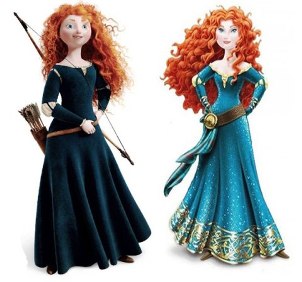
A Battle for an Unconventional Princess: "Saving" Disney's Merida

Left: Merida as she appeared in Brave (2012) and
Right: a  promotional image from Merida's induction
into the Disney Princess range.
Why would over 240,000 people feel compelled to sign a petition asking a multi-national, mass media corporation to alter the design of an animated film character as she appears in their merchandise, including clothing and dolls? In the past three weeks, A Mighty Girl, a site that promotes books, movies and toys that celebrate "smart, confident and courageous girls", has promoted the "Keep Merida Brave" campaign. Those  who have signed the petition are disappointed that an unconventional girl heroine, who is confident wielding a bow and arrows yet uncomfortable in a fancy dress, has been homogenised in order to enter the Disney princess stable. (The Disney princesses are a lucrative merchandising phenomenon, until now based on the characters of Ariel [The Little Mermaid], Aurora, [Sleeping Beauty], Pocahontas, Snow White, Mulan, Rapunzel, Belle, Jasmine [Aladdin], Cinderella and Tiana [The Princess and the Frog].)

Everyone from Jon Stewart to Brave writer and director Brenda Chapman  has criticised aspects of Merida's makeover, including her noticeably thinner build, her dress's lower neckline (indeed the very choice to place her in the more formal dress that she despises in the film), the use of make-up, taming of her unruly hair, and, most significantly of all, the removal of her bow and arrows. Here is one "princess" heroine who does a little more than wait for her prince to come, and yet in her leap from film to Disney's merchandise machine, she has lost most of the qualities that made her distinctive.

Merida merchandise in the Disney store,
Manchester, England
It is astonishing to see so many people mobilise, even if only via an online petition, to preserve what they see as a more inspiring role model for girls in popular culture. There will always be comments that call debates about the representation of girls and women a "first-world problem". However, the view that endless depictions of passive girls and women in fiction plays at least some part in limiting options for them in reality has gained widespread acceptance.

While Brave was not quite a Disney production, in that it was produced by Pixar Animation Studios, Disney has owned Pixar since 2006. Though Pixar may have found a way to present a heroine who breaks convention (although in some fairly typical ways, such as through her fiery red hair, the signifier of "different" yet beautiful girl heroines since Anne of Green Gables), it is unthinkable that the homogenising force of the Disney Princess entity would not take some steps to make Merida conform to its brand.

Merida as a baby-face doll for young girls and sparkly
gold sandals from the range
The photograph above, which I took yesterday in the Manchester Disney store, shows a shirt that depicts something closer to the film's original image of Merida. The slogan that accompanies it describes her as "boldly beautiful". The adjective that describes Merida is "beautiful": her appearance is her most important quality. She is unique in that, as the adverb indicates, she is beautiful in a way that is bolder than the likes of Cinderella or Belle, but she's not sufficiently different to be "beautifully bold". Like other princesses in the range, Merida needs to be adapted to sell items like wigs (also available for Rapunzel) and shoes (like the sequinned sandals shown above). These items relate to transforming a girl's appearance in a way that a Merida set of bow and arrows do not. Merida's bow and arrows were not available in the store I visited in England, yet they are currently sold out at the Disney online store for America. The Merida tiara, puffy, sequinned pale blue dress, which bears no resemblance to Merida's preferred dress, and gold gladiator sandals (intended for girls to "embark on a courageous fashion adventure") seem to be in plentiful supply.
Merida dolls in two styles of dress.
Though Merida dolls in both the plain and more ornate dress are available in UK stores packaged with sets of bows and arrows, the overwhelming direction of the Disney princess juggernaut has been toward a particular vision of princesses, even as it has made superficial moves to accommodate diversity. Mulan and Pocahontas may have been granted admission into the pantheon of princesses, yet there are no costumes for these princesses to be found on the US Disney site (however problematic they might be if they did exist there). You can find a Mulan headband, complete with orchid leaves, and a Pocahontas jewellery set, but there is no way for girls to emulate these characters in the same way as they can dress as Cinderella or Rapunzel (who has several costume dresses, both regular and "wedding" edition).

It is still clear that a Disney princess means one particular model or ideal of being feminine, which originated with Snow White in 1937. Individual characters in recent films may break convention in some ways, such as The Princess and the Frog's Tiana, who aspires to own her own restaurant, yet the Disney princess- as an object to be consumed- minimises difference and unique qualities as an integral part of maintaining a brand.

While Disney has clearly been taken by surprise by this social media campaign, it is hard to imagine that the world of Disney princesses will ever expand to fully embrace a natural-faced girl heroine with a drab dress and messy hair. An average appearance and focus on skill rather than beauty is not the dream that Disney sells to small girls and, presumably, their mothers. While the campaign to keep Merida as she appears in Brave shows strong public support for different fictional role models for girls, the ongoing popularity of the generic Disney princess shows that she will be hard to dislodge from her throne.

Saturday, April 27, 2013

MasterChef Offers a Slice of Sexism

This article was published in today's Age newspaper.


We don’t switch to reality television when we want to expand our minds, but their frivolous pleasures do not mean that these shows are beyond criticism and public debate. In the past week, the teaser promotion for the new series of MasterChef Australia has drawn international attention for its sexism.

The offending ad pitches the upcoming series of the cooking program as a battle of a sexes, with the infantilising title of “Boys vs Girls”. The contestants are segregated on pastel gender lines with the women wearing pink and the men blue.

A volley of stereotypes relating to women’s and men’s respective abilities are traded as the teams trash talk. Women are “better at presentation”, for instance, because they’re “used to grooming” themselves. While the quality that “all the top chefs in the world” share is that “they’re all men”.  The women face off against the men raising their pink oven mitts like boxing gloves, while the men wield baguettes like batons.

Yet the repeated national broadcast of limiting views that suggest women are naturally suited to tirelessly producing meals for the family while men are destined to elevate cooking to a sophisticated art form has been defended by some online commentators. Indeed, the counter-response to criticisms of the MasterChef ad shows just how complicated it has become to critique sexism in popular culture.

From both within and outside the feminist cause, we are told to ignore the reinforcement of sexist attitudes in the media because there are more worthy battles to fight. Proponents of this argument point to violence against women and female poverty as “real” causes to which outrage should be more rightly directed. Last month, for instance, Helen Razer described the Destroy the Joint feminist social media movement as a kind of “dessicated...masturbation”. She argued that such campaigns about sexism in popular culture mean  that “we are spending our climaxes in tiny online moments when, really they are due elsewhere...”

Another common argument, which has been used frequently in support of the MasterChef ad, is that sexism sometimes arrives in the form of harmless jokes. Maudlin feminists are simply barging in to interrupt good-natured humour as self-appointed fun police. For those who subscribe to this view, there are innate gender differences that mean that men are incapable of doing two things at once (“A woman can multi-task”) and that women cannot complete most endeavours as well as a man (“When a man puts his mind to a job, it always turns out better”), and hilarity ensues from pointing out these fundamental truths.

Nevertheless, it is crucial not to separate the worst outcomes of sexist societies, such as violence against women, from the cultural ideas we take for granted that support them. The widespread propagation of ideas that women are inherently inferior and are primarily valuable because of their appearance and ability to perform domestic work contributes to the existence of the “more important” problems confronting women. While we need to agitate for political change to continue the process of lobbying for substantive equality in the workplace, reproductive rights and protection from violence and poverty, these victories will only come alongside transformations in how men and women are understood by our society.

This is not to say that MasterChef’s Stepford wives dancing with shopping trolleys have a direct impact on the treatment of women. Yet the continued acceptance of gender stereotypes as fact, and even as subjects of amusement, continues to imprint the belief that gender inequality is the result of natural differences rather than discrimination. An ad that was humorously playing with these stereotypes, rather than reinforcing them, might show a male contestant alongside a tiered stand of delicately iced cupcakes or would depict a woman bringing her tongs into the sacred realm of the masculine barbeque. Instead MasterChef gives us the uncomplicated view that biology determines whether we can bake or char-grill.

The show promises entry into an industry in which the majority of chefs are male for various reasons, including the incompatibility of restaurant working hours with the family responsibilities that primarily fall to women. The male hosts and judges are the resident experts on the profession.

One of the female contestants on the sexist ad spuriously claims that “the average woman cooks over 1,000 meals per year” in the home. Yet we understand that this kind of cooking is not regarded with the same esteem. Two of last year’s female “Professionals” contestants were repeatedly relegated to dessert duties, though they were not specialists in this area, while men took command of the mains, showing the entrenched view that a man’s work “always turns out better”. With real-world discrimination against women in professional kitchens, as in other prestigious male-dominated industries, MasterChef’s decision to exploit baseless gender stereotypes is thoughtless rather than entertaining.

Friday, December 14, 2012

Why Toys Matter: The Doll and Oven Debate


The new model of Hasbro's Easy-Bake Oven
Even if the end of the Mayan calendar cycle doesn't bring forth the apocalypse, a shopping centre in the days just before Christmas resembles something close to the end times. Many poor souls are buying up toys for their children or child relatives, the happiness of their innocent hearts depending on the right purchase. The world toy market in 2010 was worth over 83 billion US dollars, with 2.6 billion spent in Australia alone. 

Last month I gave a talk at Melbourne Free University about sexism in popular culture. In one brief sentence I mentioned the popular Lego Friends range for girls. The question time of almost half an hour afterwards was almost entirely consumed by debate about the girls' Lego. I talked about Prime Minister Gillard's media representation and popular culture's fixation on women's appearance and sexual desirability, but the audience was most fascinated by toys. We  have all played with toys as children and continue to interact with them if we have our own children or grandchildren: toys are ubiquitous. They are also often seen as having no broader significance or importance (i.e. not important enough to warrant serious discussion). Yet attempts to influence the kinds of toys that are sold, their colours and marketing so as to minimise gender stereotyping always attract negative responses about social engineering that seeks to upend innate gender differences.

The 'old-school' Easy-Bake Oven in its Betty
Crocker incarnation
In the past month, an American girl named McKenna Pope has petitioned Hasbro to manufacture an Easy-Bake Oven that her four-year-old brother, Gavyn, who likes to cook, can use without feeling like a traitor to his sex. The Easy-Bake has been sold since the 1950s and enables children to actually cook small treats, formerly through a light bulb that generated heat and now via an electrical element inside. Though it has always been explicitly marketed to girls, as advertisements and packaging from past models make clear, the oven used to look much like a regular household oven. The new model gives up verisimilitude for pink and purple colouration, giving off the signal, along with the girls featured on the packaging, that this oven is not a toy for boys. McKenna's petition now has 43,000 signatures and some leading chefs have put together a video in support of the cause, all championing the idea that cooking is something that both boys and girls should be able to enjoy. And so should Gavyn feel able to whip up some cookies, but the total saturation of male chefs featured in the support video suggest that perceptions about home cooking being a role for women has not impacted upon the prevalence of men in the more respected realm of professional chefs. With this employment reality in mind, the pinkified Easy-Bake Oven seems more about hemming girls in than stultifying the ambitions of boys.

While many seem supportive of the idea of toy ovens for both sexes—after all most chefs are men, and many celebrity chefs are quite coarse, like Gordon Ramsey, so it's not as if cooking is seen as inducing effeminacy—a Swedish toy chain's recent gender-neutral catalogue has been reported with a greater degree of scepticism. Sweden is the model nation with its aims to minimise the effects of gender stereotyping, and not to mention its progressive laws on prostitution, which criminalise the buyers of sex, not the sellers. The Egalia pre-school in Stockholm caused an international fuss when news of its aims to reduce the effects of social expectations of gender were reported in the media.The school encourages children of both sexes to play with all kinds of toys and the teachers do not use gender-specific pronouns, but refer to children as "friends" or use a gender-neutral term borrowed from Finnish, "hen".
A page from the Swedish Toys R Us catalogue
Top Toy, the franchise holder for Toys R Us in Sweden, was given training and guidance by the country's advertising watchdog for the gender discrimination it perpetuated in its catalogues, which replicated the standard segregation of toys along gender lines. This nudge encouraged the chain to produce their latest catalogue with a girl shown deftly working a Nerf gun, a small boy nurturing a baby doll, and both a boy and girl playing with a doll's house (though the boy is perched precariously near the end of the house where a male doll appears to be luxuriating in a spa). When the UK's Daily Mail reported on the catalogue, it placed "gender-neutral" in scare quotes, presumably to emphasise the ridiculousness of such a concept, and described the toy retailer as "forced" to show boys and girls playing with all kinds of toys, as if such representation went against all that is logical and natural.

Unlike the Easy-Bake Oven, which may prove a gateway to an acceptably male career in the male-dominated restaurant industry, boys cuddling baby dolls and rearranging the furniture in a doll's house were presumably seen as perverting the natural order, in which girls are meant to desire these things because they will become mothers and homemakers. Though young boys seem equally attracted to dolls, as Cordelia Fine's Delusions of Gender explains with reference to studies that have measured young children's reactions to them, they are taught that it is only girls who may play with them. "Action figures" like G.I. Joe are distinguished from "dolls" that are about fashion and make-up, like Barbie and Bratz, and mothering, like Baby Born and Baby Alive.
'Lottie', Arklu, 2012
'Black Barbie', Mattel, 1980
 
As  Dolls are understood as central to girls' play alone, and hence some parents and professionals are concerned by the unnatural proportions of the likes of Barbie, who was modelled on the German Bild Lilli (an adult novelty, moreso than a children's toy). A new doll named Lottie, who resembles a nine-year-old girl, rather than an adult woman or a baby, has been released by a UK company, Arklu, and has been praised as "a healthy alternative" to Bratz, Barbie and Monster High. Lottie has a flat chest, does not appear to be wearing make-up, has normally proportioned legs and wears typical girls' play clothing, rather than focusing on high fashion or a sexy appearance. Lottie is probably not the type of nine-year-old who is going to grab hold of a Nerf gun, however. In addition to two dolls dressed for playing in the garden, two of the incarnations come clothed in ballet and horseriding outfits, while another is wearing a party dress to wear to a masked ball. "Lotteville Festival Lottie" has black skin, though as with Barbie's "Colored Francie" who debuted in 1967 and "Black Barbie" of 1980 and onward, her features are still those of a white girl. (Colored Francie was made using the head mould of the regular white Barbie.)

As the examples of the Easy-Bake Oven and boys playing with dolls show, we place great strength in the idea that what kinds of toys that children play with helps to determine the kind of adults that they will become, especially in terms of how appropriately masculine or feminine they will be. Another clincher for this argument is the recent release of "Breast Milk Baby", a doll that enables girls to play at breastfeeding and which comes complete with a function that enables it to make suckling sounds. Predictably, some have seen the idea of breasts being used for their primary function of feeding children through doll play as "sexualising" girls while others have emphasised that we should be normalising breastfeeding to girls to ensure that breastfeeding rates do not continue to fall.

Wednesday, February 1, 2012

Lego Friends Video

It's heartening to see that the criticism of the Lego Friends range for girls is rolling on. The following video, produced by Feminist Frequency, draws together some intriguing Lego ads from the 1980s onward that show the company's attempts to produce a range to entice girls to enter the world of Lego. It is dispiriting to realise that the collective picture of these attempts is that girls want to make jewellery, click together simple pieces that have pre-determined outcomes and fantasise about princes.

I'm looking forward to part two of this series, which promises to take us on a historical tour of advertisements for Lego featuring boys, including Zack the Lego Maniac.

Saturday, January 14, 2012

Transgendered Girls, Toys and the Great Girl Scout Cookie Boycott

There have been quite a few stories about transgender girls in the news, not least of which on the controversy front has been the story of an American Girl Scout who opposes the inclusion of transgender girls within the organisation and is calling for a cookie boycott in protest.

I first began thinking about transgender girls after reading a Boston Globe article about twin boys, one of whom is now a trans girl. Without denying the existence of transgendered children and adults, I found some of the ideas presented in the article problematic. My feelings were especially pronounced in light of the recent discussion of the new Lego "Friends" range for girls and the gender segregation of toys.

The article about the Maines twins begins as follows:

Jonas was all boy. He loved Spiderman, action figures, pirates, and swords.

Wyatt favored pink tutus and beads. At 4, he insisted on a Barbie birthday cake and had a thing for mermaids. On Halloween, Jonas was Buzz Lightyear. Wyatt wanted to be a princess; his mother compromised on a prince costume.

Though Wyatt went on to express a clearer sense that he was a girl, as she identifies now as Nicole, it bothered me that toy preference was being used as a marker of gender dysphoria. While clearly identifying with the accoutrements of the gender the child feels that they truly are means feeling an affinity with the stereotypical markers of that gender, such associations suggest that there is likely something significantly unusual about a child who strays outside accepted norms with the toys or clothes that he or she likes. Though we need to support transgender children, we also don't want to encourage rigid separation of children's play according to gender by suggesting that if boys like typically "feminine" toys or girls like typically "masculine" toys that it indicates something wrong.

A 2010 research paper that sought to consider whether there is an innate preference in infants for particular colours and shapes, suggested that all children prefer dolls to cars at 12 months (this was measured by how much the infants looked at a particular toy). Once the boys in the study were about a year older, however, they seemed to prefer cars over dolls, whereas girls retained their preference for the dolls. The authors conclude that these difference "may arise from socialization or cognitive gender development rather than inborn factors." So, essentially, as boys get older they are gradually encouraged by their parents and the media they consume to ditch the dolls and start their Matchbox collection.

Clearly there is a percentage of children who have gender identity issues who need to be better accommodated and treated (some of the stories of trans boys and girls on the Mermaids website, the UK organisation for gender-variant children, are sad reflections of intolerance). Nevertheless, all children are being affected by the increasing gendering of childhood play, which seems to pathologise difference and diversity. Though Nicole's interest in Barbies and tutus was indicative of something more, it should not be a cause for alarm if a boy wishes to play with dolls or if a girl is more interested in a chemistry set than setting to work with a replica iron. UK toy store Hamley's has recently removed the "gender apartheid" of its separate boys' and girls' floors for toys (coded pink and blue) in a way that will hopefully allow children more scope to choose toys that interest them, rather than confining them to a limited selection according to what boys and girls are supposed to like.

I would suggest that the insistence of pushing children into their "right" gender also contributes to the bigoted attitudes that transgender children experience from their peers and adults. If you've not yet seen it, the video of an American Girl Scout, Taylor, expressing concern about Girl Scouts USA's decision to allow trans girls to enter the movement, shows her received ideas about the threat of transgendered people.


As a fan of Girl Guide history, I'm in support of the concept of a girls' and women's only organisation that encourages leadership and self-reliance, and, like Taylor from California, I would be disappointed to see boys being admitted. Nevertheless, Taylor is reproducing discriminatory attitudes about transgendered people that cannot see beyond strict binaries of biologically male and female. Taylor's YouTube video, which has sparked no shortage of discussion on feminist sites, is also embedded at a site called Honest Girl Scouts.

The site is purportedly run by current and former women of Scouting who disagree with the organisation's apparent conduct of sex education and support of a woman's right to choose (or pushing "pro-lesbian, pro-abortion role models"). In some ways the site is laughable ("FACTOID: Did you know that radical feminist Betty Friedan, founder of NOW (National Organization for Women) and NARAL (National Abortion and Reproductive Rights Action League) was on the National Board of GSUSA for 12 years?") but in others, especially the use, and perhaps production, of Taylor's video, it is disturbing. Specifically, it appears as if they have used a girl as a conduit for their discriminatory views.

On the Bitch magazine Facebook page, where the cookie boycott story was posted, Taylor was quite often attacked and was labelled a "creep". I would argue that the real creeps are those who are behind these campaigns to discriminate against gays and lesbians and transgender men and women in Scouting. It is a shame that such an articulate and intelligent girl has been encouraged to put forward these views, and that an organisation that is attempting to be progressive is being fractured by those who cannot fathom why reducing discrimination for this minority of children is a good thing.

Scouting was originally founded to accept children of all religious persuasions, so, despite some worrying statements at time from founder Robert Baden-Powell, at heart the aim was to be open to all kinds of young people. Perhaps girls might have even remained part of the original Scouting scheme in England if Edwardian social norms had not been so concerned about girls being too "boyish" and the presence of girls "softening" boys. I would hope that the society in which we live - a century after Scouting began in America in 1912 - will not reproduce outdated notions of what each gender should be by supporting the opposition to trans girls being part of Girl Scouts America.

Wednesday, January 19, 2011

Anecdotal Delusions of Gender

I've begun reading Cordelia Fine's Delusions of Gender, which is an accessible critique of how the neurosciences naturalise gender norms. In the humanities, we're aware of the conception of sex as biological and gender as a cultural construct, with scholars in children's literature on the lookout for how boys and girls are socialised into their genders through books and films. I was, however, unprepared for Fine's book. It pummmels the reader with scientific or psychological study after study to show how these cultural ideas of gender norms can alter the way women perform on maths tests and change the opinions of employers as to a candidate's suitability for a job. Women sometimes have to perform harder to achieve the same thing as a man, but we rarely recognise this. As the book remarks, Ginger Rogers did everything Fred Astaire did, only backwards and in high heels.

It was strange timing that I found myself at the local cricket nets just as I was becoming righteously indignant over some of the studies described in Delusions of Gender. I witnessed my own microcosmic example of Fine's thesis in action. A small boy, of perhaps 8-years-old and with prodigious batting and bowling ability, was being coached by his father. The father was no slouch, delivering some very fast balls to the boy, including some with a real cricket ball (which is a particularly hard missile to be hit with, especially as a child). The boy's sister, who was clearly a few years younger, was the enthusiastic retriever of balls, with dedication to speeding up the flow of the practice. Nevertheless, she was repeatedly growled at for getting in the way of the serious business of turning this grade three child into the next Australian opening Test batsman.

I must admit that she was occasionally pemitted a turn to bat with a miniature bat and the odd bowl of the ball, but the attitude of the father showed that he was in no way serious about developing her skills in case he might like to fashion her in to a cricketer to fulfil his seemingly unfulfilled sporting dreams. The real attention and pressure was on the boy to do well, and the father seemed pleased when the little girl made the occasional request to play on the nearby swings instead. Now they could get on with the real business of the day.

To top it all off, and oddly enough, the little girl had thought it necessary to bring along a long blonde wig (somewhat matted) to the cricket nets. I'd seen it sitting on the ground alongside the spare balls and wondered what on earth it was doing there. At a critical point in the practice, she asked if the father might help her to put it on. You can imagine how enthused he was at this prospect, and he begrudgingly delayed the ascent of his son by one minute when he finally plonked it on her head in a haphazard way. When we left the nets as darkness fell (this practice wasn't going to end just because the sun had set), the girl was taking one of her begrudged turns with the bat, with the blonde wig on her head, making the task that little bit more difficult. She would have to do the same as her brother, in one fraction of the practice time, with little fatherly enthusiasm and encouragement and while wearing a wig that sometimes blocked her sight.

Monday, August 11, 2008

Fairy and Princess Indulgence: When Wishes Shouldn't Come True


Monica Dux, a fine former Melbourne Uni-ite, has written a piece in today's Age about the madness that is the pre-school girl obsession with fairies and princesses. Called "Girls Can't Thrive in a Puff of Pink" she muses on why fairy princesses abound at every pre-school turn. As she points out, there's certainly nothing wrong with young girls who genuinely covet pink frippery breaking it out for special occasions or dress-ups, but why do we see so many fairy princesses tagging along for the weekly grocery shop? It's not like the lone boy who insisted on going along to Safeway in his Spiderman pyjamas, there are fairy-ballerina-princesses, complete with wands, at every suburban Westfield Shoppingtown at this moment.

As the poor baby above, weighed down by an oversized crown that she doesn't seem to particularly want there, suggests, this trend perhaps is a reflection of parental attitudes to femininity rather than the children themselves. If girls do begin to desire wings and tiaras, it seems that it is often because we have told them that they should. This is not a new cultural effect, as we've been through the "why are girls given toy ironing boards and kitchenettes while boys get power tools and earthmovers" discussion many times before. I wonder if the fairy and princess obsession is borne out of parental consideration of their child as unique. There is a well-known tendency in children's literature for child protagonists to discover that they are "special". A heroine (or hero)'s uninteresting regulation parents prove not to be her own and the story reveals that she actually has royal lineage or a special magical quality. Just think of Harry Potter discovering that he is really a wizard and can escape (at least for most of the year) dull (and abusive) suburban life with the Dursleys.

Many children have the fantasy that they are just biding time with an ordinary Mum and Dad before their supernatural or magical parents make themselves known. Are the parents of these little princesses and fairies enacting a slightly different form of this typically childhood fantasy? One in which their daughter is actually a princess. A real princess can't be displayed in public in a tracksuit, but must be shown off in a highly feminine, impractical-for-toddlers outfit.

I visited Disneyland Paris last month and was surprised to see so many little girls making their visit to the park dressed in Disney Princess dress-up gowns. Perhaps it was one occasion where a little indulgence would not be inappropriate but I wonder how far the fantasy is indulged and for whose benefit. I can hear the mums of my mother's generation saying "don't be ridiculous" if their girls demanded to go to the shops in a fairy costume. I can't help but thinking it's parenting style rather than girls themselves that are primarily responsible for fairy rings sprouting across suburbia.

As a footnote, the child in the top-right photo is part of a kind of anti-princess photoshoot.