Alice was first brought to life by Lewis Carroll, but she's sparked imaginations and been immortalised on screen many times since.
Join film critic and author Alexandra Heller-Nicholas in conversation with Dr Michelle Smith (Monash University) and Dr Dan Golding (Swinburne University of Technology) as they discuss these 'electric' Alices and the unique representations of girlhood across time, space and media, exploring historical significance, contemporary potency and what Alice might mean in the future.
To coincide with ACMI's Winter Masterpieces exhibition "Wonderland", which focuses on Alice's representation in the moving image- from magic lantern slides to Tim Burton's film- I was invited to prepare a video essay on screen Alices. In the video, I talk about Alice from her first silent film appearance, her use in psychedelic counter-culture and anti-drug propaganda, and Dr Pepper ads, through to the fascination with Alice in Japanese popular culture and her darker incarnations in video games.
Earlier this year I introduced a Cinemaniacs screening of Return to Oz. Here's a transcript of my talk.
Return to Oz is a strange film.
It’s a strange film given what would now be accepted as a children’s film. It’s
a strange film for a Disney film. And it’s a strange film to follow the
overwhelming cultural legacy of MGM’s 1939 Wizard of Oz film.
Reviews that followed Return to Oz’s 1985 release could not
reconcile expectations of what a big-budget sequel to the cheery, sentimental
musical Oz should be with the dystopian film with no dancing munchkins and no
dance numbers but plenty of frightening new characters and a new framing story
that placed the beloved Dorothy in a mental institution poised to receive a
dose of electroshock therapy.
Roger Ebert: “Somebody should have
thought at the very first when they were starting out with Return to Oz, somebody should have had this thought: 'It oughta be
fun, it oughta be upbeat, it oughta be sweet, it oughta be wondrous. It
shouldn’t be scary'.”
Gene Siskel: “Kids under six are gonna get nightmares from this picture. Kids
over six, they’ll just have a bad time at the movies.”
Labyrinth (1986)
The film is typical of
a different era of filmmaking for children in the early to mid-1980s, in which
darker themes, genuine terror, and traumatising deaths of innocent characters
were not seen as beyond the emotional comprehension of young viewers. Think of The Dark Crystal, Labyrinth and
the heart-rending demise of the horse Artax in The Never-Ending Story. But even in this context, the film is
unusual, and this contributed to Disney effectively disowning the film by
contributing minimal marketing and merchandising effort. You won’t find a trace
of some of the most iconiccharacters of
all time –those from the world of Oz - in Disney parks or products, unlike its
treatment of its legacy from the animated Alice
in Wonderland from 1951.
So what is the story of Return to Oz? How did such an unusual children’s
film come to be made on such a big-budget and then be almost disowned by
Disney?
Walter Murch with Fairuza Balk (Dorothy) on set
The root of the weirdness of the film begins with Apocalypse Now, the logical place to start when you want to make a
Disney children’s film. Walter Murch was the sound editor and designer on the film; he was
developing an impressive reputation and gaining deep respect within the
industry. At the same time, Disney was going through a creative lull with a
number of commercial failures and was scouting around for new directorial
talent. They approached Murch, asking him what kind of film he might be
interested in making and he mentioned that he had always loved L. Frank Baum’s
series of Oz books.
The original Oz book series by L. Frank Baum
In
an amazing coincidence, Disney happened to own the rights to 11 of the Oz books
and were receptive to the idea of capitalising on these rights before the
copyright period on the books would soon expire. Of course, these were the
rights to the story as it appeared in the books only, not the visual depictions
that MGM had derived for their film. So, for instance, in Baum’s original books
Dorothy wore silver shoesbut these were changed to ruby for the MGM film to take
advantage of technicolour with red standing out in colour. Indeed, Disney had
to pay for the right to use the trademarked ruby slippers in Return to Oz. Dorothy’s braids are the
only other element borrowed from the MGM film.
Dorothy as she was originally
illustrated with silver shoes
In total there were 14 Oz books,
and the series was continued by Ruth Plumley Thompson for a further 21 books,
so there was actually no shortage of material that could have been plundered
for sequels to the MGM film. Very early on, Baum and others recognised how adaptable the
stories were to the stage and screen. The first Oz book was published in 1900,
and by 1902 musicals began in Chicago and it was then translated to a Broadway
hit. Baum’s first infatuation had
been the theatre and he invested a great deal of money in the production of
elaborate musicals.He
financed the first attempt to film Oz with The
Fairylogue and Radio Plays in 1908, which mixed live actors, magic lantern
slides and Baum himself appears on stage interacting with the characters on
stage and screen. Even though performances sold out throughout Michigan,
Chicago and New York, it cost more money to produce than could be recouped.
Baum with the cast of The Fairylogue and Radio Plays (1908)
Baum
thenfounded the Oz Film Manufacturing
Company to adapt his films and in 1914 released the first silent film version
of The Patchwork Girl of Oz. It was not a financial success and after
it failed to live up to expectations when exhibited by Paramount Pictures in
New York they refused to accept any subsequent Oz films, or indeed any others
from Baum’s company. Baum’s company nevertheless went on to make The Magic Cloak of Oz (1917) and His Majesty, the Scarecrow of Oz/The New
Wizard of Oz released after his death in 1925. Baum
lost the rights to The Wonderful Wizard
of Oz as well as other books in the series when owing money to a creditor due
to his numerous failed ventures.
This explains how Walt Disney was able to acquire the
rights to 11 Oz books in 1954. He wanted to create an adaptation of The Patchwork Girl of Oz for the Disneyland
television show. Disney thoughtthe screenplay was good and wanted to
make a feature film using the Mouseketeers from The Mickey Mouse Club with Annette Funicello as Ozma, but the film
did not eventuate and two of the intended songs were performed on the Disneyland television show. Like the 1939 film, you can see the
influence of the vaudeville stage tradition on this musical number and how the
planned Disney Oz film would have developed in the same way. Return to Oz sidesteps that
tradition and returns to Baum’s books for source material. While the absence of
the settings and characters from The
Wizard of Oz, the film felt like it was departing from what Oz was supposed
to be for many reviewers and audiences. However, it actually combines two books
from the Oz series, Ozma of Oz and The Marvellous Land of Oz.
Ciudad Encantada: one of the locations scrapped from the film.
Hadrian's Villa
Return to Oz was going to be a very different film that took advantage of developing
special effects technology to reproduce all of the Oz characters- rather
than dressing people in costumes- and pre-production took a long time. By Autumn
of 1983, $6 million had already been spent. New Disney boss Richard Berger shut down
production in November 1983, six weeks before filming was due to start in
London as anxiety grew about the film’s $27 million budget and the potential for costs to blow out further. They were even contemplating canning the film despite having
poured a lot of money into its development.
Producer Paul Maslansky was instructed
by Disney to give an assessment of whether it would be possible to cut at least
$5 million from the film’s budget. It is tantalising to consider how the film
might have looked if not for this substantial hack into the money available for
location shooting, mechanical effects, the creatures and Claymation. The Deadly
Desert sequence was going to be shot on location in Sardinia and Algeria. The
scene where Dorothy and Tik Tok are trapped by the Wheelers was to be filmed at
Ciudad Encantada (Enchanted City) north of Madrid. The Nome King’s throne room
going to be shot at Caserta near Naples while Hadrian’s villa outside Rome would double as Mombi's palace. There was also going to be two weeks of shooting
in Kansas. With the cuts, all of these locations shoots were cut and 80% of the
film was to be shot on soundstages at Elmstree Studios outside London (where Star Wars and The Empire Strikes Back were filmed). The Kansas scenes from the
beginning of the film were shot on the Salisbury Plains near Stonehenge. While
shots of the ruins of Oz were created using miniatures.
For those of you have seen the film, it will make sense when I say that it was
the characters of the Cowardly Lion, Scarecrow and Lion who suffered from the
budget cuts. The Lion was one of
the first things to be cut. There were supposed to be three heads constructed for
close-up, medium shots (the one produced) and a light stunt head. The crew were not
allowed to make a duplicate costume, only spare legs and feet. Nevertheless,
he’s arguably a more successful look that the Scarecrow who had a minimally
articulated cable-operated head that looks unconvincing in close-up scenes. The Tin Man was supposed
to be created with a marionette-style puppet and opticals but this was going to
be too expensive so they were forced to create something in which a small
person could sit inside to perform some basic movements. Deep Roy- who rode
the racing snail in Neverending Story and
was the Oompa Loompa in Tim Burton’s Charlie
and the Chocolate Factory— operated a rod inside the torso. It was such a
crude set-up that Roy’s legs hung down out of the Tin Man’s body and in plain
view, which is why he is always seen behind another character in the scenes in
which he appears!
How Tik-Tok walked revealed
Nevertheless, regardless of these restrictions, some of the creatures and
effects are startling for the pre-CGI period.More finances and
effort were directed into creatures such as the chicken, Billina;
and the mechanical man, Tik Tok, who was operated by a full-sized man concealed
within the torso. However, they may appear to us now, the Wheelers scared the
bejesus out of a generation of 80s kids. Originally ice and roller skaters
were hired to assume these roles with the expectation that skating skills
would translate to rolling along on wheels taken from wheelchairs. It turned
out that no pre-existing ability prepared anyone to move as a Wheeler and so 17
people had to train specifically for the task including a man who had had his feet amputated.
The inexplicable terror of a Wheeler
Special effects designers from The
Dark Crystal and Greystoke worked
on the film, along with Zoran Perisic who invented the Zoptic method,
an in-camera front projection system that was used to make Superman
fly in the 1980s films. The Claymation work in the film is extremely innovative in its replication
of movement in stone, particularly given that the Nomes as imagined in Baum’s
work were traditional miniature men-shaped gnomes. The process of the Nome King
transforming into the form of a man was also made extremely difficult by the
fact that filming occurred in London but the Claymation studio was location in
Oregon.
Return to Oz bubblegum cards
The financial limitations and their
effect on the look of the film were not the only major challenge faced during
film. After seven weeks of shooting, Murch had a breakdown during the shooting
of the scene in which Mombi changes her head. According to Maslansky, Murch was
extremely confused and said to him “I don’t know where we are in the picture”.
He was lost in terms of how the film pieced together and went to lie down in
his office. With 500 people on the payroll, thoughts immediately turned to a
list of other potential directors.
Return to Oz comic
However, because of Murch’s reputation and
previous work with other industry luminaries, there was an almost immediate
remarkable response from within the film-making community. Within an hour George Lucas called from Japan and agreed
to come immediately to England to help Murch get back on his feet. Murch had
worked on THX1138 and American Graffiti. According to Maslansky, 20
minutes later Stephen Spielberg called and said he would come to the studio the
next day. Shortly afterward, Francis Ford Coppola phoned to say that it was his
birthday the next day and that he would be in London. Lucas took over filming for the week, shooting the scenes with the flying Gump until Murch could recover.
Reportedly, he urged Disney to keep Murch on the film with the reassurance that
he would personally finish the film if it did not work out. While the film has
obviously become a cult classic, and was ahead of its time in embracing the
type of dystopian vision of Oz that has become more common in TV series such as
Tin Man and the novels Dorothy Must Die, the experience of
directing was clearly not for Murch. He has not directed another film, although
he is one of the most respected sounds designers and editors in the industry.
Japanese Return to Oz figures
Disney had flip-flopped on the film
numerous times, studio heads had changed multiple times during pre-production,
the budget was slashed, and then on the film’s release very minimal support was
leant to its marketing. In an era in which product tie-ins and cross-promotions for
children’s films were becoming extremely important, the film has an unusually
tiny amount of merchandise associated with it comprising of books, a comic, and
a promotion for Smuckers jelly involving hand-puppets. The only figurines produced were made for the Japanese
market. In Disney’s terms it was something of a failure. And for those who came
to the film expecting a light-hearted musical, it was also a failure.
I saw the
film on its release when I was six years old with my grandfather. I can still
remember how odd it felt to have to manage his disappointment as he kept saying
“that’s now how the yellow brick road is supposed to be—all broken”. Of the
generation that would have seen the MGM film on its release, Return to Oz made no sense and was even
disturbing. But to me the darkness of the film seemed more magically real than
Judy Garland’s cheerful land of Oz and it has stayed with me in more ways than
one.
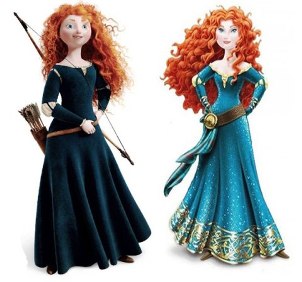
Left: Merida as she appeared in Brave (2012) and
Right: a promotional image from Merida's induction
into the Disney Princess range.
Why would over 240,000 people feel compelled to sign a petition asking a multi-national, mass media corporation to alter the design of an animated film character as she appears in their merchandise, including clothing and dolls? In the past three weeks, A Mighty Girl, a site that promotes books, movies and toys that celebrate "smart, confident and courageous girls", has promoted the "Keep Merida Brave" campaign. Those who have signed the petition are disappointed that an unconventional girl heroine, who is confident wielding a bow and arrows yet uncomfortable in a fancy dress, has been homogenised in order to enter the Disney princess stable. (The Disney princesses are a lucrative merchandising phenomenon, until now based on the characters of Ariel [The Little Mermaid], Aurora, [Sleeping Beauty], Pocahontas, Snow White, Mulan, Rapunzel, Belle, Jasmine [Aladdin], Cinderella and Tiana [The Princess and the Frog].)
Everyone from Jon Stewart to Brave writer and director Brenda Chapman has criticised aspects of Merida's makeover, including her noticeably thinner build, her dress's lower neckline (indeed the very choice to place her in the more formal dress that she despises in the film), the use of make-up, taming of her unruly hair, and, most significantly of all, the removal of her bow and arrows. Here is one "princess" heroine who does a little more than wait for her prince to come, and yet in her leap from film to Disney's merchandise machine, she has lost most of the qualities that made her distinctive.
Merida merchandise in the Disney store,
Manchester, England
It is astonishing to see so many people mobilise, even if only via an online petition, to preserve what they see as a more inspiring role model for girls in popular culture. There will always be comments that call debates about the representation of girls and women a "first-world problem". However, the view that endless depictions of passive girls and women in fiction plays at least some part in limiting options for them in reality has gained widespread acceptance.
While Brave was not quite a Disney production, in that it was produced by Pixar Animation Studios, Disney has owned Pixar since 2006. Though Pixar may have found a way to present a heroine who breaks convention (although in some fairly typical ways, such as through her fiery red hair, the signifier of "different" yet beautiful girl heroines since Anne of Green Gables), it is unthinkable that the homogenising force of the Disney Princess entity would not take some steps to make Merida conform to its brand.
Merida as a baby-face doll for young girls and sparkly
gold sandals from the range
The photograph above, which I took yesterday in the Manchester Disney store, shows a shirt that depicts something closer to the film's original image of Merida. The slogan that accompanies it describes her as "boldly beautiful". The adjective that describes Merida is "beautiful": her appearance is her most important quality. She is unique in that, as the adverb indicates, she is beautiful in a way that is bolder than the likes of Cinderella or Belle, but she's not sufficiently different to be "beautifully bold". Like other princesses in the range, Merida needs to be adapted to sell items like wigs (also available for Rapunzel) and shoes (like the sequinned sandals shown above). These items relate to transforming a girl's appearance in a way that a Merida set of bow and arrows do not. Merida's bow and arrows were not available in the store I visited in England, yet they are currently sold out at the Disney online store for America. The Merida tiara, puffy, sequinned pale blue dress, which bears no resemblance to Merida's preferred dress, and gold gladiator sandals (intended for girls to "embark on a courageous fashion adventure") seem to be in plentiful supply.
Merida dolls in two styles of dress.
Though Merida dolls in both the plain and more ornate dress are available in UK stores packaged with sets of bows and arrows, the overwhelming direction of the Disney princess juggernaut has been toward a particular vision of princesses, even as it has made superficial moves to accommodate diversity. Mulan and Pocahontas may have been granted admission into the pantheon of princesses, yet there are no costumes for these princesses to be found on the US Disney site (however problematic they might be if they did exist there). You can find a Mulan headband, complete with orchid leaves, and a Pocahontas jewellery set, but there is no way for girls to emulate these characters in the same way as they can dress as Cinderella or Rapunzel (who has several costume dresses, both regular and "wedding" edition).
It is still clear that a Disney princess means one particular model or ideal of being feminine, which originated with Snow White in 1937. Individual characters in recent films may break convention in some ways, such as The Princess and the Frog's Tiana, who aspires to own her own restaurant, yet the Disney princess- as an object to be consumed- minimises difference and unique qualities as an integral part of maintaining a brand.
While Disney has clearly been taken by surprise by this social media campaign, it is hard to imagine that the world of Disney princesses will ever expand to fully embrace a natural-faced girl heroine with a drab dress and messy hair. An average appearance and focus on skill rather than beauty is not the dream that Disney sells to small girls and, presumably, their mothers. While the campaign to keep Merida as she appears in Brave shows strong public support for different fictional role models for girls, the ongoing popularity of the generic Disney princess shows that she will be hard to dislodge from her throne.
Yesterday I visited Disney's 'Dreams Come True' exhibition at the Australian Centre for the Moving Image. It was a different experience to the recent Tim Burton exhibition in that it was not packed to the point of queueing to view display cases. In fact, I was surprised by how few people were wandering about the exhibition on the Thursday late-night opening given Disney's domination of children's entertainment in the 20th century.
I know all that is wrong with Disney, from the sweatshop clothing to the dubiousness of the race, class and gender politics of many films. And then there's the pinkified Princess commercial juggernaut. I know that traditional tales have been plundered from a range of cultural traditions and have had the complexity and challenging elements vacuumed right out of them. I know that The Little Mermaid really ends sadly with her turning to foam on the sea. I know that fairy tales are not always about dreams coming true. But in Disney animated features dreams do come true and gruesome story elements are neatly traded for anthropomorphosised animal helpers.
The exhibition focuses on the fairy tale features from Snow White and the Seven Dwarfs (1937) to the most recent adaptation of Rapunzel, Tangled (whose heroine seems to take more visually from a Bratz doll than the traditional Disney princess). Despite all of the critical lenses I could wear, I was still a helpless victim of nostalgia from the first section of cels from Snow White. (I always preferred her because she was dark-haired, unlike the usual parade of fair-haired virtuous maidens.)
There were some surprising snippets of information revealed throughout the exhibit, including unused sketches of Maleficent from Sleeping Beauty with an ominous pet panther and footage of a deleted scene from Snow White in which she instructs the seven dwarfs in the most polite way to eat soup, like an animated June Dally-Watkins.
Apart from a few sections of video (such as the soup sequence and an intriguing look at the multi-plane camera used to add depth to painted backgrounds presented by Walt himself) and some maquettes, it was a largely "wall-based" exhibition. Well, apart from the welcome presence of fairy tale books sourced by Disney in Europe that were used as visual references by his animators. A broader exhibition encompassing other animated films and shorts and the Disney theme parks would no doubt have appealed to a larger audience, but perhaps it could never be contained within any viable exhibition space.
With physical progress through the exhibit, which was ordered chronologically, came a sense of declining magic in the animation process. Cels were no longer hand-inked by the 1990s and the laborious and fascinating techniques of old are gradually being superseded by computer animation. It seems telling that this change in production coincides with the decline in popularity of the Disney-fied earnest fairy tale musical. Disney has signalled its intent to leave fairy tales aside in future animated features, but perhaps rather than a turn away from these stories, Disney might be wise to return to more authentic versions of them, complete with enough shock and awe to compete with contemporary children's entertainment that does not promote the Disneyfied idea of childhood innocence, dreams always coming true, and the homogeneity of 'dreams' as simply a desire for a girl to be married.
I couldn't have asked for better inspiration to follow up my last post about the low status of girls' stories, than news about Disney's next animated feature, Tangled. The LA Timeshas reported on the film's title change from Rapunzel in order not to alienate boy viewers. The President of Disney and Pixar animation reportedly remarked, ""Some people might assume it's a fairy tale for girls when it's not. We make movies to be appreciated and loved by everybody." Of course, if a story is for or primarily about girls that rules out interest from boys, but stories about boys are seemingly "loved by everybody" regardless.
There are some changes to this filmic version that suggest a surface modernisation of the heroine. Much like Princess Fiona in Shrek, apparently "the demure princess is transformed into a feisty teen." Those who've given a few moments thought to analysing that film (well, at least students in a subject I teach at Deakin University have), find it easy to see the "feisty" heroine is still rendered subservient in needing to be rescued by her prince, by her natural role as the one who cooks and cares for others and her obsession with ensuring that she fits the standards of physical attraction required by her suitor.
It remains to be seen how Rapunzel fares as a heroine, but the hero "bandit" named Flynn Rider sounds like he will be injecting the right amount of masculine protection-and most importantly, action sequences- into the mix.
Scarily, this perception that "girls' stories" alienate boys is having an affect on which movies ever make it on to the screen. The complex Hans Christian Anderson story "The Snow Queen", which I loved as a child (and which includes both a strong girl and boy in its narrative), is reportedly now on the scrap heap because the studio has had "too many" girls' films in its schedule. So the simple presence of the word "queen" is too feminine? Or is it because it's about a girl who saves a boy? Would Beauty and the Beast be made today with its overt reference to a girl in the title and no action hero inserted to balance out the puffy dress quotient? Not that I'm a fan of the puffery, just irritated by the universalising of stereotypically masculine traits and the segregation of femininity.
Catmull believes that the recent Disney animated film The Princess and the Frog suffered at the box office because of its overt call to girls: "Based upon the response from fans and critics, we believe it [box office takings] would have been higher if it wasn't prejudged by its title". There are numerous other factors to consider here, including the film's use of traditional hand-drawn animation, which has clearly been struggling against CGI children's films in the past decade. On another front, The Princess and the Frog was the first to feature an African-American heroine. Already it had to challenge the perception that only girls watch girls' stories and, in addition, that white children are only interested in reading about or seeing white characters like themselves.
And so the box office takings of this film have a flow-on effect on the belief that stories about girls are only for girls, and stories about non-white characters are not for the white middle-class only serving to reinforce the homogenous norm even more rigidly than before.