Showing posts with label clothing. Show all posts

Friday, May 31, 2013

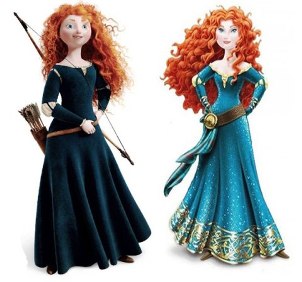
A Battle for an Unconventional Princess: "Saving" Disney's Merida

Left: Merida as she appeared in Brave (2012) and
Right: a  promotional image from Merida's induction
into the Disney Princess range.
Why would over 240,000 people feel compelled to sign a petition asking a multi-national, mass media corporation to alter the design of an animated film character as she appears in their merchandise, including clothing and dolls? In the past three weeks, A Mighty Girl, a site that promotes books, movies and toys that celebrate "smart, confident and courageous girls", has promoted the "Keep Merida Brave" campaign. Those  who have signed the petition are disappointed that an unconventional girl heroine, who is confident wielding a bow and arrows yet uncomfortable in a fancy dress, has been homogenised in order to enter the Disney princess stable. (The Disney princesses are a lucrative merchandising phenomenon, until now based on the characters of Ariel [The Little Mermaid], Aurora, [Sleeping Beauty], Pocahontas, Snow White, Mulan, Rapunzel, Belle, Jasmine [Aladdin], Cinderella and Tiana [The Princess and the Frog].)

Everyone from Jon Stewart to Brave writer and director Brenda Chapman  has criticised aspects of Merida's makeover, including her noticeably thinner build, her dress's lower neckline (indeed the very choice to place her in the more formal dress that she despises in the film), the use of make-up, taming of her unruly hair, and, most significantly of all, the removal of her bow and arrows. Here is one "princess" heroine who does a little more than wait for her prince to come, and yet in her leap from film to Disney's merchandise machine, she has lost most of the qualities that made her distinctive.

Merida merchandise in the Disney store,
Manchester, England
It is astonishing to see so many people mobilise, even if only via an online petition, to preserve what they see as a more inspiring role model for girls in popular culture. There will always be comments that call debates about the representation of girls and women a "first-world problem". However, the view that endless depictions of passive girls and women in fiction plays at least some part in limiting options for them in reality has gained widespread acceptance.

While Brave was not quite a Disney production, in that it was produced by Pixar Animation Studios, Disney has owned Pixar since 2006. Though Pixar may have found a way to present a heroine who breaks convention (although in some fairly typical ways, such as through her fiery red hair, the signifier of "different" yet beautiful girl heroines since Anne of Green Gables), it is unthinkable that the homogenising force of the Disney Princess entity would not take some steps to make Merida conform to its brand.

Merida as a baby-face doll for young girls and sparkly
gold sandals from the range
The photograph above, which I took yesterday in the Manchester Disney store, shows a shirt that depicts something closer to the film's original image of Merida. The slogan that accompanies it describes her as "boldly beautiful". The adjective that describes Merida is "beautiful": her appearance is her most important quality. She is unique in that, as the adverb indicates, she is beautiful in a way that is bolder than the likes of Cinderella or Belle, but she's not sufficiently different to be "beautifully bold". Like other princesses in the range, Merida needs to be adapted to sell items like wigs (also available for Rapunzel) and shoes (like the sequinned sandals shown above). These items relate to transforming a girl's appearance in a way that a Merida set of bow and arrows do not. Merida's bow and arrows were not available in the store I visited in England, yet they are currently sold out at the Disney online store for America. The Merida tiara, puffy, sequinned pale blue dress, which bears no resemblance to Merida's preferred dress, and gold gladiator sandals (intended for girls to "embark on a courageous fashion adventure") seem to be in plentiful supply.
Merida dolls in two styles of dress.
Though Merida dolls in both the plain and more ornate dress are available in UK stores packaged with sets of bows and arrows, the overwhelming direction of the Disney princess juggernaut has been toward a particular vision of princesses, even as it has made superficial moves to accommodate diversity. Mulan and Pocahontas may have been granted admission into the pantheon of princesses, yet there are no costumes for these princesses to be found on the US Disney site (however problematic they might be if they did exist there). You can find a Mulan headband, complete with orchid leaves, and a Pocahontas jewellery set, but there is no way for girls to emulate these characters in the same way as they can dress as Cinderella or Rapunzel (who has several costume dresses, both regular and "wedding" edition).

It is still clear that a Disney princess means one particular model or ideal of being feminine, which originated with Snow White in 1937. Individual characters in recent films may break convention in some ways, such as The Princess and the Frog's Tiana, who aspires to own her own restaurant, yet the Disney princess- as an object to be consumed- minimises difference and unique qualities as an integral part of maintaining a brand.

While Disney has clearly been taken by surprise by this social media campaign, it is hard to imagine that the world of Disney princesses will ever expand to fully embrace a natural-faced girl heroine with a drab dress and messy hair. An average appearance and focus on skill rather than beauty is not the dream that Disney sells to small girls and, presumably, their mothers. While the campaign to keep Merida as she appears in Brave shows strong public support for different fictional role models for girls, the ongoing popularity of the generic Disney princess shows that she will be hard to dislodge from her throne.

Thursday, August 16, 2012

Girls, "Tramps" and "Hookers": Target and the Girls' Clothing Debate

Target leopard print girls' shorts
We hardly ever hear public fretting about what boys are wearing. No railing about whether a boy is dressing in clothing that is not "age appropriate" or that might entice paedophiles. Yet the subject of what girls are wearing, as the recent media attention given to Target's clothing line for girls attests, is one that many parents feel strongly about. The debate began when a school teacher and mother, Ana Amini, posted the following message on Target's Facebook page:
''Dear Target, Could you possibly make a range of clothing for girls 7-14 years that doesn't make them look like tramps … You have lost me as a customer when buying apparel for my daughter as I don't want her thinking shorts up her backside are the norm or fashionable.''

Amini's comments resonated with tens of thousands of parents who "liked" her post or added their own supportive responses. When the social media backlash became a news story, a chorus of parents agreed that many of the clothes on the racks in Target for girls aged from seven to fourteen resembled those of "hookers" and "prostitutes".

The outrage spawned many opinion pieces. Dannielle Miller rightly pointed out that we shouldn't be shaming girls by labelling them "trampy" regardless of what they might be wearing, while others emphasised that it is adults who place any sexualised connotations on clothing choices. The heroine of my undergraduate years, Helen Razer, and Clementine Ford both offered up stories of their own girlhoods in their calls for the virtual lynch mob to calm. Together the articles suggest that for some time girls have innocuously worn revealing clothing, like crop tops or lycra pants, and that girls don't perceive a sexual element to this: it's just like a game of dress-ups.  Razer writes that "kids just see cloth and it is we who see meaning" and Ford proposes that "Clothes can't make children's look 'sexy'. They're inanimate objects." 

I agree with Razer that very young children don't derive significant meaning from clothing—although by the time they hit primary school, you won't find many boys who want to wear skirts or pink in public— but in the age group that is relevant here, from around seven-years-old and upwards, there is a major awareness of the various meanings of clothing. To not see any meaning in clothing, kids would have to be raised apart from our society and culture, with no access to the internet, magazines, advertising, video clips, movies, television or books. 

Branding is just one of aspect of clothing that children understand. I recall desperately wanting a pair of Converse All Stars in grade five but being forced to suffer the indignity of wearing an imitation brand. The shoes were practically identical to the much-longed for Cons, but the logo on the side panel was tellingly different to me and every other kid in my grade. But at least the merciless teasing was reserved for the boy whose family was so poor that he had to wear beaten-up Dunlop Volleys (this was prior to their hipster, ironic reclamation). Even children under 10 know that particular brands are authentic and are "cool" in comparison with generic items or house brands from Big W.

In addition to knowing about how clothing helps to communicate their gender and cultural savvy, girls also understand that clothing plays a part in how attractive or pretty they are seen to be. Cordelia Fine has noted how much more often people compliment young girls on what they are wearing or their prettiness, whereas comments about appearance are rarely delivered to boys. Girls are taught to understand that how they look impacts upon how they are valued. We know that even primary school aged girls are concerned about their weight and understand that being overweight makes them unattractive according to the thin body ideal.

We ought to think about girls' awareness of the importance of being attractive in tandem with the fact that girls are reaching puberty at an increasingly younger age. Breast development—the onset of puberty— is now beginning at an average age of nine years and ten months, according to a Danish study in 2006. Girls absorb from the culture around them what an ideal woman looks like and, as they develop physically, it is unsurprising that they seek to emulate the fashion that is popular for young women, or seen as attractive to boys and men. Girls may have always loved to play with Mum's make-up in the mirror or stalk around in high heels, but the age at which girls actually start wearing these tools that are intended to accentuate feminine attributes seems to be lowering. Or at least mainstream stores like Target seem to offer more clothing that mimics women's fashions without modification for the pre-teen market. So why is it a problem if girls wear all kinds of women's clothing styles? And need this imply sexual readiness to anyone?

What the History of Girlhood Can Tell Us

Richard Westall, Queen Victoria as a Girl
Razer makes a nod to the history of childhood by noting that children were once dressed in the same clothing as adults. Medievalist Philippe Ariès influentially claimed that childhood itself was not "invented" until the modern period, as before this time they were seen, and treated, as miniature adults. (Although there is much debate on this subject, and Ariès' assertion that children were dressed like adults seems to rely on the evidence of family portraits, which is the equivalent of looking at wedding photographs and suggesting that all little boys wore suits in the 20th century.)

Yet, apart from this one comment, the history of how girls appearance has been regulated and how girls are supposed to transition to womanhood have been absent from the discussion. If we look at the policing of girls' dress across the past century and a half, we find that there has always been anxiety about girls being appropriately covered and restrained by their clothing. As I have blogged about previously, make-up was also seen as fraught in the 19th century, especially for young girls who still had their virtue to preserve. (Married women were less susceptible to the risk of damage to their moral character through the sexual associations of cosmetics).

Franz Winterhalter, Queen Victoria, 1842 
When you read girls' books from the nineteenth century, as I do, you'll notice many references to girls "putting their hair up". Young girls wore their hair loose, but when girls of the middle and upper classes reached an age at which they were considered mature enough to be available for marriage they generally wore their hair up in public. This transition carried a great deal of ideological baggage. It was somewhat "trampy" for a girl of marriageable age to continue to wear her long hair loose because of its sensual associations. Just as Islamic women often reserve the sight of their hair for their husbands in the home, so would the proper Victorian woman keep her hair "modest" in public. By putting her hair up, a girl was signalling that she was ready for marriage, but also that she was a good, virginal type. At the same time, a girl might also begin to wear longer skirts. So clearly the protocols for entering womanhood worked to cover more of girls' bodies and contain their sexual appeal, unlike the general movement of today's girls into wearing more revealing clothing and accentuating their sex appeal as teenagers.

These changes in what girls wore and how they styled their hair would usually happen in advance of their "coming out", where they were introduced to "society" and might be presented to suitable bachelors. This would happen at around the age of eighteen, and debutante balls, which were still popular at high schools in Australia until fairly recently, continued some of the old-fashioned traditions associated with a girl "coming out" or being presented to eligible men.

Most cultures have some form of ritual associated with coming of age that marks the transition between childhood and adulthood. In Australia today, most of us don't practice any of the formal rituals that once helped to demarcate girlhood from womanhood and clearly identify the moment of transition. When we see thousands of parents reacting to "short shorts" for girls in Target, perhaps it also owes something to the haziness of where girlhood ends and womanhood begins, rather than solely being a paranoid reaction to perceived paedophilia or sexualisation. I would argue that clothes are more than just "inanimate objects" and that children do understand the meanings that our culture ascribes to them. The confusion among adults, however, about what girls should wear says much about our own uncertainty about girlhood and girls coming of age in a culture that is increasingly fixated on women's sexual attractiveness.

Thursday, April 15, 2010

Over the Shoulder Boulder Holders.. for seven year olds

Controversy over underwear that replicates brassieres for girls too young to have any amount of protrustion from their chests is not new. In Australia in recent years, retailer Target attracted controversy for underwear sets for under-10s that included a bra-like top. Amid discussion of Bratz, Britney Spears and paedophilia, the sets were swiftly withdrawn from the racks in all stores.

The most recent incident of this ilk, which has generated international media interest, concerns UK clothing chain Primark, who were selling padded bikinis, seemingly sized for girls as young as seven. The image above shows the degree of padding, designed to counteract the fact that a triangle bikini just will not sit right on a flat pre-pubescent chest. While girls are reaching sexual maturity at a younger age in the the West- I think I had my first training bra at about age 10- and there may be a need for bras for "early developers", the adding of the padding in this instance seems to reach a new level of disturbing.


Online comments seem to gravitate toward polar extremes. The majority suggesting that such products are lures for paedophiles, and a minority of Mums and women noting that sometimes a small amount of padding in a bra can "smooth" budding nipples, causing less embarassment for girls as they are developing breasts. My negative opinion of this product is not based on fear of men at beaches being delighted by young girls leaping about in padded bikini tops, but rather on how it affects the girls themselves.

Girls and women learn to become acutely conscious of any perceived inadequacy in their appearance as feminine. There is an awkward point in a girls' life when other girls are shaving their legs and those with a soft layer of fluff still in place are the subject of mockery. We learn there are things we must do so that other girls will not tease us (the pressure women learn to apply to one another to push conformity to norms of feminine appearance) and so that boys might think us attractive (the pressure to be desirable to men and the learned satisfaction in achieving this goal). We learn that if we don't meet particular standards of desirability then there are things we can do and products we can apply, so that we do meet them, at least for as long as the make-up stays in place or the spray tan remains visible.

We also learn that there are particular body norms that are deemed attractive. Overweight women are rarely admired in popular culture, and most often the subject of derision. With porn not just a stash of old magazine or a few hidden VHS tapes, but ever-present online professionally produced movies and amateur videos (including those performed live for the viewer), the impossible sexual ideal of skinny woman with gigantic, implant-enhanced breasts travels much more widely and more frequently than ever before. Women who don't meet these usually artificial norms can feel inadequate, or not as sexually attractive. Padded bras usually serve the purpose of filling out a flatter chest, of adding extra bulk to fit an ideal. This may make some women feel more comfortable or feminine. They may feel that they now fit the ideal a little better.

Do we really need to start introducing another anxiety that women experience into the realm of pre-pubescent girlhood? Should seven- or eight-year-old girls be contemplating their lack of chest and thinking that they need a little padding to gain a more womanly silhouette? To introduce the idea that girls are not living up to another feminine ideal so early only further encourages feelings of inadequacy and poor body image that many women suffer from.