Showing posts with label sexual attractiveness. Show all posts

Friday, June 28, 2019

How 19th century ideas influenced today's attitudes to women’s beauty

In the 19th century, a range of thinkers attempted to pinpoint exactly what it was that made a woman beautiful. Newly popular women’s magazines began to promote ideas about the right behaviours, attitudes, and daily routines required to produce and maintain beauty.

The scientific classification of plants and animals - influenced by Charles Darwin - also shaped thinking about beauty. It was seen to be definable, like a plant type or animal species. Increasingly, sophisticated knowledge of medicine and anatomy and the association of beauty with health also saw physicians weigh into the debate.

A look at three significant books that focused on beauty shows several influential ideas. These include the classification of distinct beauty types, the perception of “natural” beauty as superior to the “artificial”, and the eventual acceptance of beauty as something that each woman should try to cultivate through a daily regimen of self-care.


 Classifying beauty types

‘The three species of beauty as affecting the head and face’ in Alexander Walker’s Beauty;
Illustrated Chiefly by an Analysis and Classification of Beauty in Woman (New York: William H. Colyer).
Alexander Walker, a Scottish physiologist, wrote three books on the subject of “woman”. The first was Beauty; Illustrated Chiefly by an Analysis and Classification of Beauty in Women. Here, Walker focuses on women’s beauty because he suggests it is “best calculated to ensure attention from men”. He assumes that men have the power to choose sexual partners in a way that women do not, therefore men have a crucial responsibility “to ameliorate the species”.

Given that one of its key functions is to signal fertility, a woman’s appearance is therefore not a frivolous topic. It is linked to the development of humanity.

Walker defines three types or “species” of female beauty: locomotive, nutritive, and thinking. These types derive from a knowledge of anatomy and each is related to one of the bodily “systems”.
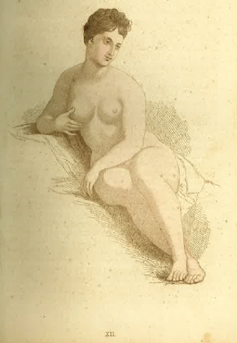
‘Front view illustrating mental beauty’ in
Alexander Walker’s Beauty

The locomotive or mechanical system is highly developed in women with “precise, striking, and brilliant” bodies. The nutritive or vital system is evident in the “soft and voluptuous”. The thinking or mental system is conducive to a figure “characterised by intellectuality and grace”.

Walker’s ideal is the mental or thinking beauty. She has less pronounced breasts and curves and admirable inner qualities that are evident in her “intensely expressive eye”.

Not coincidentally, he understands intelligence to predominate in men. Walker’s ideal thinking beauty is effectively most like his idea of a man in contrast to the locomotive beauty (connected with the lower classes) and the nutritive beauty (primed to have children).


 ‘Firm and elastic’ breasts

Daniel Garrison Brinton was an army surgeon in the American Civil War. He later became a professor of ethnology and archaeology and edited The Medical and Surgical Reporter. In 1870, he and medical editor George Henry Napheys published Personal Beauty: How to Cultivate and Preserve it in Accordance with the Laws of Health.

The book proposes ideal measurements for areas such as the forehead and the most distinctive features of the female body. Breasts are viewed as essential to beauty and the ideal they describe is youthful, with “firm and elastic” tissue that forms “true hemispheres in shape”.

Very specific distances between nipples, the collar bone, and between the breasts themselves are specified, setting out perfect proportions.

Brinton and Napheys claim that few European and American women meet these requirements, owing to the “artificial life” adopted in both locations. Controversially, they remark that such breasts do not exist in America, apart from in “some vigorous young country girl, who has grown up in ignorance of the arts which thwart nature”. The idea that beauty was more often destroyed by “artificial” beauty methods than improved by it was predominant.

Personal Beauty promotes a device for improving the shape of the breast through suction because it meets the criteria for “natural” improvement. It is described similarly to breast enlargement pumps that are sold today as an alternative to breast augmentation.

Brinton and Napheys’ reference to the potential of such a device to “restore the organs in great measure to their proper shape, size, and function” suggests they are referring to breasts that may have lost their fullness and symmetry after breastfeeding.

It is unclear how such a device would not only improve the shapeliness of breasts, but also render them “better adapted to fulfil their functions”. However, the notion that function, which is reliant on health, is essential to beauty helps to support a medicalised understanding of the topic.


Beauty destroyed

This emphasis on health contributes to a tendency to focus on the ways that women destroy their own beauty through clothing, cosmetics, or certain types of exercise. A specific target in this book is the wearing of garters below the knee, which the authors claim is the reason why a “handsome leg is a rarity, we had almost said an impossibility, among American women”.

Tightly-laced corsets, sucked-upon lips, and white face powders are frowned upon for potential harms to health. Yet, as doctors, Brinton and Napheys embrace early manifestations of cosmetic surgery, such as the removal of skin that might hang over the eyes.

A significant point in guiding the acceptability of cosmetic usage is whether such a practice appears natural and undetectable. Imitation itself is not described as distasteful, if it can be achieved convincingly, but “the failure in the attempt at imitation” does inspire revulsion.

As such, a wig that meshes with a women’s age and appearance can be acceptable. In contrast, it is “contrary to all good taste” to “give to the top of the head an air of juvenility which is flatly contradicted by all other parts of the person”.

Personal Beauty focuses on preventative measures for retaining beauty and delaying the visible onset of ageing, rather than remedying flaws once they have taken hold. The book ultimately concludes that if all the measures recommended are undertaken, “there will be little need for the purely venal cosmetic arts, such as paint, powder, patches, or rouge”.


Embracing beauty culture

This understanding of cosmetics as pure reflections of vanity and as separate from beauty practices related to health was gradually challenged by women writers towards the end of the 19th century.
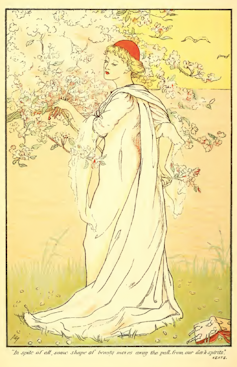
Frontispiece, Mrs H.R. Haweis, [1878] 1883.
 The Art of Beauty. London: Chatto & Windus.

Eliza Haweis wrote about the decoration and stylistic adornment of the home and body in British magazines and a series of books, the first of which was The Art of Beauty (1878). Its premise is that personal beauty and adornment of the body is of “the first interest and importance” for women.
Many beauty manuals warned against any significant attempts to alter the face or body beyond basic health and hygiene. Such practices, as academic Sarah Lennox suggests, were seen as “objectionable — as a hiding of inner truth”. Haweis, however, encourages young women to enhance their beauty and older women to continue to use methods that “conceal its fading away”.

The methods that Haweis advocates reproduce prevalent ideas found in women’s magazines and beauty manuals that discouraged any visible sign of artifice and which championed the “natural”. Hygienic and cosmetic intervention are framed as exposing or fostering physical qualities as they ought to be seen, or providing a delicate “veil” for flaws, rather than attempting to entirely transform them.

However, Haweis goes further than many beauty advisors at the time. Unlike many male writers, she is not opposed to cosmetics. She likens their use in “hiding defects of complexion, or touching the face with pink or white” to adding padding to a dress, piercing ears, or undergoing cosmetic dentistry.

Eliza Haweis


Part of the reason Haweis supports cosmetics and other methods of improving the appearance is because she observes that ugly people are treated differently.
Walker sees beauty as a sign of higher intelligence. Many publications at the time presented a similar line of reasoning in suggesting that mean-spirited and nasty individuals would age horribly.

Haweis, however, is unique in her entertainment of the possibility of ugliness negatively influencing character. She proposes that “an immense number of ill-tempered ugly women are ill-tempered because they are ugly”. She acknowledges that ugliness is in fact an “impediment” and a “burden”, which thereby supports her call to all women to work to improve their appearance.


Beauty today

Our understanding of what makes a woman beautiful is influenced by dominant cultural beliefs and hierarchies. Though Walker’s physiological beauty types were replaced by acceptance of the idea that women can retain beauty into older age or remedy unappealing features, many historic precepts about beauty continue to influence modern beauty culture.

Ideas about “natural” beauty as superior to “artificial” beauty are reflected in cosmetic advertisements and plastic surgery procedures, with a “natural” or “undetectable” look to any product, facelift, or implant being the desired outcome for many women.

Most of all, the idea that beauty is of prime importance to girls and women remains predominant, even as the cultural conditions surrounding marriage, employment, and family have substantially transformed since the 19th century.

Haweis’ ideas about the significance of self-care resonate with contemporary feminists who point to women’s pleasure and empowered use of cosmetics.

We have recently seen the emergence of male beauty bloggers and YouTubers. However, the continued sense that beauty is largely women’s preserve and a unique form of power that requires a continual fight to keep shows how an emphasis on women’s physical appearance is still entwined with gender inequality.The Conversation

This article is republished from The Conversation under a Creative Commons license. Read the original article.

Thursday, October 4, 2012

Video: Girls, Sex, and Popular Culture Talk at the Wheeler Centre

From Prim to Pole Dance: Girls, Sex and Popular Culture

'Girls on Show', A Current Affair, 31 July 2012
The text of my Wheeler Centre talk today.
And a link to an article at the Age online about it and another at the Daily Telegraph and the same piece at the Herald Sun.

Girls' bottoms are a major problem according to several media stories this year. Specifically, girls are revealing too much of their behinds and their wanton disregard for modesty not only puts them at risk of catching a chill during winter, but of luring paedophiles, sex offenders and garden variety guys-who-are-only-after-one-thing out of hiding. The first example of such a story, called "Girls on Show", appeared on A Current Affair at the end of July. As this screen capture shows, the camerawork in this tirade against girls wearing skimpy clothing when nightclubbing, lingered fetishistically over the girls' legs and bottoms, many of which were only barely covered by mini-skirts or hotpants. Celebrity women Ita Buttrose and Charlotte Dawson offered comment on the girls' dress, making some telling observations that likened the girls to "hookers", "tarts" and prostitutes. Dawson, for instance, said "the girls actually selling themselves on the street are much more tastefully dressed than some of these young ladies." While Buttrose explained that provocative dressing was not likely to attract a potential husband: "They might flirt with a tart. They might have sex with a tart. But it's often not the tart that they take home to meet their mother."

This story is not unusual. The language of sex work is frequently applied to what girls and young women are wearing today.  In the UK, Joanna Lumley also recently expressed dismay at young women "dressing like lap dancers".  The most notable recent Australian example was the online following that developed around a mother's complaints about Target's clothing range for girls. Ana Amini wrote on the retailer's Facebook page: ''Dear Target, Could you possibly make a range of clothing for girls 7-14 years that doesn't make them look like tramps … You have lost me as a customer when buying apparel for my daughter as I don't want her thinking shorts up her backside are the norm or fashionable.'' These leopard print numbers, as well as a pair of denim cut-off shorts, were the most common images circulated as evidence of Target's inappropriately sexual, or 'trampy' clothing range for girls.

The focus on how much flesh both pre-teen girls and young women are exposing is understandable in a culture where sexy images of women are visible on every magazine stand, on many billboards, buses and trams, and in popular TV and film. We are ultimately very uncomfortable when the ideal sexy woman crosses paths with the developing girl. Just where is the border between sexual innocence and knowing construction of a sexy appearance? This is a particularly thorny question in a culture where fashion models—the ideal representation of how women should look—as well as the young women who feature in pornography, are often teenagers. The use of 10-year-old model Thylane Blondeau in Paris Vogue posed and dressed as a woman threw some into despair at the crossing of this line, but also highlighted the systematic use of girls as young as thirteen as fashion models for women's clothing and cosmetics.

Where the boundary between girl and sexual woman lies is also problematic when we attempt to divorce activities, such as pole dancing, from their adult connotations. In Canada, the Twisted Grip pole dance studio attracted international media attention in the past month for its "Little Spinners" pole dance classes for girls. The classes were supposedly created in response to requests from mothers with their own poles at home who wanted their daughters to learn to perform on the pole safely. The studio operators emphasised that the classes were about "fitness" and "athleticism" and contained no "sexual moves". But just as the studio's logo on the poster shows a woman in a bikini or her underwear spreading her legs apart on the pole, for most people commenting online, it was impossible to divorce pole dancing from any kind of sexual association when it came to girls as young as five taking the classes.

The awkward tension between what is seen as desirable in women and parental and social expectations of girlhood innocence are  aptly summarised by a routine from comedian Chris Rock. While his jokes occasionally mention his own visits to strip clubs, Rock had a new perspective on the adult industry when his baby girl was born. He comments about gazing down at his daughter in her pram: "My only job in life is to keep her off the pole. Keep my baby off the pole! I mean they don't grade fathers, but if your daughter is a stripper, you fucked up." While, as a society, we seem to want women to be sexually ready and available, we don't want our own daughters launching a career in porn films or taking up a slot at Spearmint Rhino.

No wonder the situation is confusing for girls. The contemporary media landscape condemns them for being too sexual, for wearing revealing clothing and intentionally seeking sexual attention from men. It also manifests worries about younger girls, such as tweens dressed in Target clothing, who might unintentionally convey sexual readiness (although I am careful to caution that what girls or indeed women wear provides no justification for sexual assault). While much of this debate seems new, born out of a hyper-sexualised internet-enabled culture, I want to show that similar anxieties about girls' sexuality were also prominent in the media in the Victorian period in Britain. What I would argue is these concerns about the transition from girl to woman in relation to sex are very consistent across the past century and a half. While the messages we give to girls directly are similar, the key difference today is that sexual images of women surround us where they were once concealed from girls. The messages about sex that we provide to girls are more contradictory than ever, as they are branded "tarts" and "hookers" for dressing in a way that reveals their bodies, but are immersed in popular culture that presents being sexy and sexually available as the foremost qualities of the ideal woman.

The Victorian period spans the reign of Queen Victoria from 1837 to 1901. It is a crucial era for thinking about how girlhood has been shaped because during this time it began to be considered as a distinct stage between childhood and womanhood. Being a girl meant being in a state of transition. Girls also began to be universally educated later in the century, so girls' books and magazines became publishing phenomena, with newly literate girls looking to read stories and articles aimed especially at their interests and publishers and editors seeking to direct girls in the right ways to behave, read, exercise and fulfil their family duty.

The most popular magazine from 1880 was the Girl's Own Paper, which more than 100,000 girls, aged from around 12 to 24, read each week. Its resident Doctor, "Medicus", a pseudonym for Gordon Stables, a former army doctor, regularly wrote on the topics of beauty and clothing, especially corsets, as they related to health. Like most commentators of the era, Medicus thought that being healthy was the route to being beautiful and that cosmetics had negative moral connotations for girls. In 1888, he wrote in a column on beauty: "Well, I declare to you that when I meet young ladies rouged, powdered and pencilled, I wonder if the world is getting worse. For deceit thus carried about openly can have no good effects on the moral character. Many girls moving in what is called good society... are little better than walking frauds, perambulating fibs."

This view in a girls' magazine mirrors a controversy provoked twenty years earlier, in March 1868. Journalist Eliza Lynn Linton published an anonymous article in the Saturday Review called "The Girl of the Period" that caused a stir in other papers. Fascinatingly, "The Girl of the Period" has major parallels with the Current Affair "Girls on Show" story I mentioned earlier. Amid a broader tirade against feminism, Linton expressed disgust in girls who were using clothing, such as tight skirts, as well as cosmetics to emphasise their sexual beauty to attract men. "The Girl of the Period", she wrote:

 is a creature who dyes who hair and paints her face...a creature whose sole idea of life is fun; ...and whose dress is a chief object of such thought and intellect as she possesses. No matter if, in the time of crinolines, she sacrifices decency; in the time of trains, cleanliness; in the time of tied-back skirts, modesty; no matter either, if she makes herself a nuisance and an inconvenience to every one she meets; — the Girl of the Period has done away with such moral muffishness as consideration for others or regard for counsel and rebuke. It was all very well in old-fashioned times, when fathers and mothers had some authority and were treated with respect, to be tutored and made to obey, but she is far too fast and flourishing to be stopped in mid-career by these slow old morals...

Where the modern girl was going wrong, according to Linton, was in her similar "aims and feelings" to "women of the demi-monde", effectively mistresses kept by wealthy lovers. Here is our precedent, 140 years ago, for comparing fashionable girls in the pursuit of fun and entertainment, to prostitutes. "The Girl of the Period" also connects with the idea Ita Buttrose presented about sexy girls not making good wives, but only being suited to one-night-stands. Linton proposed that "the Girl of the Period does not marry easily... [Men] may amuse themselves with her for an evening, but they do not readily take her for life." And let's not forget the resonance of timeless complaints about girls no longer listening to the advice of their parents about modesty.

"The Fast Smoking Girl", The Girl
of the Period Miscellany
, 1869
The uproar Linton provoked about the "girl of the period" spawned a short-lived magazine edited by men called The Girl of the Period Miscellany in 1869 that satirised the latest fashions for young women. This caricature of the fast-smoking girl describes her desire for a frivolous existence at dances and concerts, while wearing the latest clothes and doing "a mild weed on the quiet" as smoking is referred to. Crucially this new type of girl who followed aesthetic pleasure, didn't see herself as one day taking up a subordinate domestic role, but rather, in this poem wants to hook "a rich stupid old husband" who will be the one who "shall obey" her.

Linton's views about girls were widely criticised -- this cartoon from the paper The Tomahawk, for instance, ascribes a degree of jealousy and transgression to the author. Linton's was by no means a consensus opinion. Indeed, when reflecting on the Victorian period, while girls were certainly eager to be modern compared with those who came before them by gaining new freedoms such as higher education and employment, there is no major apparent transformation in morality:

most girls conformed to family and church expectations. In other words, there was no actual crisis of prostitute-like girls in Britain, but only a perception brought about by observation of a minority, or of speculation about morality based on changing fashions and transforming social norms.

The teenage girls condemned for wearing revealing clothing today reflect a long history of young women dressing fashionably and sometimes provocatively to the alarm of adults. So if girls have been criticised for wearing make-up and 'inappropriate' clothing because of their sexual connotations for at least 150 years, why are we seeing such a particular anxiety about this topic in the present moment? And why are younger girls now coming under such sexual scrutiny? Why does a discussion of short shorts for girls even lead to questions of whether such clothing might lure paedophiles, for instance?

'Fatima's Hoochie Coochie',
Thomas Edison, 1896
My answer is that the culture around girls has changed. While today's girl and the Victorian girl have both been exposed to encouragements to avoid too much make-up or wearing revealing clothing, the Victorian girl was almost entirely shielded from sexual images of women. Advertising would not even depict a line illustration of a woman wearing a corset, an item of underwear, until the 1880s and 1890s! While erotic images did circulate among men, they were too risqué and marginalised to influence mainstream popular culture significantly.The first erotic films were not produced until around 1896, and even then the gyrating hips of a belly dancer or a kiss were regarded as scandalous and worthy of censorship. This slide shows a still from the kinetoscope of 'Fatima's Hoochie Coochie' dance from 1896, as shot by Thomas Edison. Though she is fully clothed, Fatima's swivelling hips and chest are intentionally covered with a white picket fence.

In her book Promiscuities: A Secret History of Female Desire, Naomi Wolf suggests that girls become women through the work of two kinds of pressure: "the external—what their culture tells them it means to be an adult sexual female—and the internal—the development of sexual desire itself". If we accept that not much has changed in girls' internal development in a century, apart from the earlier onset of sexual maturation, then we ought to focus on what has changed in the culture that surrounds them.
We continue to insist on girls remaining sexually innocent, through criticism of girls who wear revealing clothing and shaming of teen mothers and sexually active girls as "sluts". But we conflictingly surround girls with messages that suggest being a sexual adult female means being on constant sexual display, being sexually available and compliant, and putting personal sexual fulfilment and comfort  second to meeting a porn-influenced ideal.

These are the messages embedded in music video clips where women are often gyrating in lingerie –without Fatima's white picket fence to shield them. In film and television, where fictional worlds are largely populated by women who are young and attractive (and who may have had surgical intervention to increase their bust size or plump their lips). In advertising, where women's sex appeal is used to sell everything from clothing to ice cream, and in which topless pole dancing mothers who have money shoved into their g-strings by men, as in the infamous Nando's chicken TV ad, are deemed by the Advertising Standards Board as "not incompatible with family values" and by the company itself as "a forthright display of empowerment". In magazines, where female perfection comes courtesy of Photoshop, and, most pervasively, on the internet where millions of pornographic images and videos of women are readily accessible to anyone, including children. Even online criticism of our nation's first female leader often contains jokes about her sexual prowess and attractiveness. According to this logic, there is not a sphere of life where being sexy is not the ultimate achievement of a woman, nor a place where how she looks is not the most important thing about her.

The past century has thankfully seen positive developments in how women's sexuality is regarded and understood. We have learned to acknowledge and accept that women feel sexual desire too, in a way that has made for more enlightened attitudes to sex. Yet, when it comes to girls, the fallout from the sexual revolution has merely left them torn between competing ideals. Our thinking about girls and sex is not as progressive as we'd like to believe. As I have suggested, a number of the major criticisms levelled at today's girls are reminiscent of those expressed about girls in the Victorian era. Though it is now usual for girls to form sexual relationships outside of marriage, our expectations of girlhood sexual innocence still share some of the same ideas at their core about sexual display being akin to prostitution and demure girls making good wives.

However, the culture surrounding girls could not be more different. Victorian girls received a consistent message that virtue was of supreme importance, and the stories and articles they read, as well as the advertisements they saw, reinforced this idea and used morally restrained women as exemplars. Today's girls are being held to account to ideals of sexual innocence while immersed in a culture of examples of adult women who are admired because they are sexy. While there is nothing wrong with girls developing healthy sexual lives and a sense of their own attractiveness, contemporary media and popular culture creates a fraught environment in which they might do so. Being sexy is sold as the path to "empowerment", but also one that only "tramps" and "hookers" choose to take. For as long as we are showing girls that the most important thing about women is their sex appeal, we shouldn't shame them if they try to emulate what our culture tells them is most valuable.

Thursday, August 16, 2012

Girls, "Tramps" and "Hookers": Target and the Girls' Clothing Debate

Target leopard print girls' shorts
We hardly ever hear public fretting about what boys are wearing. No railing about whether a boy is dressing in clothing that is not "age appropriate" or that might entice paedophiles. Yet the subject of what girls are wearing, as the recent media attention given to Target's clothing line for girls attests, is one that many parents feel strongly about. The debate began when a school teacher and mother, Ana Amini, posted the following message on Target's Facebook page:
''Dear Target, Could you possibly make a range of clothing for girls 7-14 years that doesn't make them look like tramps … You have lost me as a customer when buying apparel for my daughter as I don't want her thinking shorts up her backside are the norm or fashionable.''

Amini's comments resonated with tens of thousands of parents who "liked" her post or added their own supportive responses. When the social media backlash became a news story, a chorus of parents agreed that many of the clothes on the racks in Target for girls aged from seven to fourteen resembled those of "hookers" and "prostitutes".

The outrage spawned many opinion pieces. Dannielle Miller rightly pointed out that we shouldn't be shaming girls by labelling them "trampy" regardless of what they might be wearing, while others emphasised that it is adults who place any sexualised connotations on clothing choices. The heroine of my undergraduate years, Helen Razer, and Clementine Ford both offered up stories of their own girlhoods in their calls for the virtual lynch mob to calm. Together the articles suggest that for some time girls have innocuously worn revealing clothing, like crop tops or lycra pants, and that girls don't perceive a sexual element to this: it's just like a game of dress-ups.  Razer writes that "kids just see cloth and it is we who see meaning" and Ford proposes that "Clothes can't make children's look 'sexy'. They're inanimate objects." 

I agree with Razer that very young children don't derive significant meaning from clothing—although by the time they hit primary school, you won't find many boys who want to wear skirts or pink in public— but in the age group that is relevant here, from around seven-years-old and upwards, there is a major awareness of the various meanings of clothing. To not see any meaning in clothing, kids would have to be raised apart from our society and culture, with no access to the internet, magazines, advertising, video clips, movies, television or books. 

Branding is just one of aspect of clothing that children understand. I recall desperately wanting a pair of Converse All Stars in grade five but being forced to suffer the indignity of wearing an imitation brand. The shoes were practically identical to the much-longed for Cons, but the logo on the side panel was tellingly different to me and every other kid in my grade. But at least the merciless teasing was reserved for the boy whose family was so poor that he had to wear beaten-up Dunlop Volleys (this was prior to their hipster, ironic reclamation). Even children under 10 know that particular brands are authentic and are "cool" in comparison with generic items or house brands from Big W.

In addition to knowing about how clothing helps to communicate their gender and cultural savvy, girls also understand that clothing plays a part in how attractive or pretty they are seen to be. Cordelia Fine has noted how much more often people compliment young girls on what they are wearing or their prettiness, whereas comments about appearance are rarely delivered to boys. Girls are taught to understand that how they look impacts upon how they are valued. We know that even primary school aged girls are concerned about their weight and understand that being overweight makes them unattractive according to the thin body ideal.

We ought to think about girls' awareness of the importance of being attractive in tandem with the fact that girls are reaching puberty at an increasingly younger age. Breast development—the onset of puberty— is now beginning at an average age of nine years and ten months, according to a Danish study in 2006. Girls absorb from the culture around them what an ideal woman looks like and, as they develop physically, it is unsurprising that they seek to emulate the fashion that is popular for young women, or seen as attractive to boys and men. Girls may have always loved to play with Mum's make-up in the mirror or stalk around in high heels, but the age at which girls actually start wearing these tools that are intended to accentuate feminine attributes seems to be lowering. Or at least mainstream stores like Target seem to offer more clothing that mimics women's fashions without modification for the pre-teen market. So why is it a problem if girls wear all kinds of women's clothing styles? And need this imply sexual readiness to anyone?

What the History of Girlhood Can Tell Us

Richard Westall, Queen Victoria as a Girl
Razer makes a nod to the history of childhood by noting that children were once dressed in the same clothing as adults. Medievalist Philippe Ariès influentially claimed that childhood itself was not "invented" until the modern period, as before this time they were seen, and treated, as miniature adults. (Although there is much debate on this subject, and Ariès' assertion that children were dressed like adults seems to rely on the evidence of family portraits, which is the equivalent of looking at wedding photographs and suggesting that all little boys wore suits in the 20th century.)

Yet, apart from this one comment, the history of how girls appearance has been regulated and how girls are supposed to transition to womanhood have been absent from the discussion. If we look at the policing of girls' dress across the past century and a half, we find that there has always been anxiety about girls being appropriately covered and restrained by their clothing. As I have blogged about previously, make-up was also seen as fraught in the 19th century, especially for young girls who still had their virtue to preserve. (Married women were less susceptible to the risk of damage to their moral character through the sexual associations of cosmetics).

Franz Winterhalter, Queen Victoria, 1842 
When you read girls' books from the nineteenth century, as I do, you'll notice many references to girls "putting their hair up". Young girls wore their hair loose, but when girls of the middle and upper classes reached an age at which they were considered mature enough to be available for marriage they generally wore their hair up in public. This transition carried a great deal of ideological baggage. It was somewhat "trampy" for a girl of marriageable age to continue to wear her long hair loose because of its sensual associations. Just as Islamic women often reserve the sight of their hair for their husbands in the home, so would the proper Victorian woman keep her hair "modest" in public. By putting her hair up, a girl was signalling that she was ready for marriage, but also that she was a good, virginal type. At the same time, a girl might also begin to wear longer skirts. So clearly the protocols for entering womanhood worked to cover more of girls' bodies and contain their sexual appeal, unlike the general movement of today's girls into wearing more revealing clothing and accentuating their sex appeal as teenagers.

These changes in what girls wore and how they styled their hair would usually happen in advance of their "coming out", where they were introduced to "society" and might be presented to suitable bachelors. This would happen at around the age of eighteen, and debutante balls, which were still popular at high schools in Australia until fairly recently, continued some of the old-fashioned traditions associated with a girl "coming out" or being presented to eligible men.

Most cultures have some form of ritual associated with coming of age that marks the transition between childhood and adulthood. In Australia today, most of us don't practice any of the formal rituals that once helped to demarcate girlhood from womanhood and clearly identify the moment of transition. When we see thousands of parents reacting to "short shorts" for girls in Target, perhaps it also owes something to the haziness of where girlhood ends and womanhood begins, rather than solely being a paranoid reaction to perceived paedophilia or sexualisation. I would argue that clothes are more than just "inanimate objects" and that children do understand the meanings that our culture ascribes to them. The confusion among adults, however, about what girls should wear says much about our own uncertainty about girlhood and girls coming of age in a culture that is increasingly fixated on women's sexual attractiveness.