Showing posts with label Victorian. Show all posts

Friday, October 27, 2017

Toxic Beauty, Then and Now

File 20171026 28041 1ust5n1.jpg?ixlib=rb 1.1
Beauty is still understood as a process of ongoing work and maintenance.
Shutterstock.com
Throughout history, humans have been willing to try almost any method or product to improve their physical appearance. In response, enterprising businesses and beauty moguls have conspired to sell us almost anything — from water to poison — in the guise of cosmetic treatments. While many cosmetic products have eventually proven to have little efficacy, a significant number have also caused physical harm and even death.

Cosmetics and cosmetic surgery are now subject to more stringent regulation than in the 19th century, when lead-based powders and face creams containing poisons were not uncommon. However, even today there are significant serious side-effects and potential dangers from cosmetic procedures, in particular.

For example, it was recently reported that cosmetic injections, such as platelet-rich plasma injections and facial fillers, are leading to a significant number of patients suffering from chronic, and potentially disfiguring, bacterial infections. While these kinds of non-invasive procedures are common, with over $1 billion spent annually on cosmetic jabs in Australia alone, research suggests that almost one-fifth of patients could suffer from such complications.

Of course, even when the greatest medical care is taken, there are still potential questions about the health risks of utilising Botox (Botulinum Toxin Type A) to combat or stave off facial wrinkles. While a large number of people, primarily women, have embraced Botox and believe it to be safe, in 2009 the US Food and Drug Administration added a warning noting that Botox “may spread from the area of injection to produce symptoms of botulism”, such as muscle weakness and breathing difficulty.

Further reading: Safety before profits: why cosmetic surgery is ripe for regulation

Even the most common beauty products still have potential risks associated with them. Consider lipstick, which is placed directly on the thin skin of the lips, readily ingested throughout wear, and reapplied multiple times throughout the day. Manufacturers are not required to list lead as an ingredient in lipsticks as it is regarded as a contaminant, but most contain lead, and some colours in much higher concentrations. An FDA test of 400 lipsticks conducted in 2011 found that every one contained lead. Nevertheless, the FDA advises that up to 10 parts per million of lead is an acceptable level.

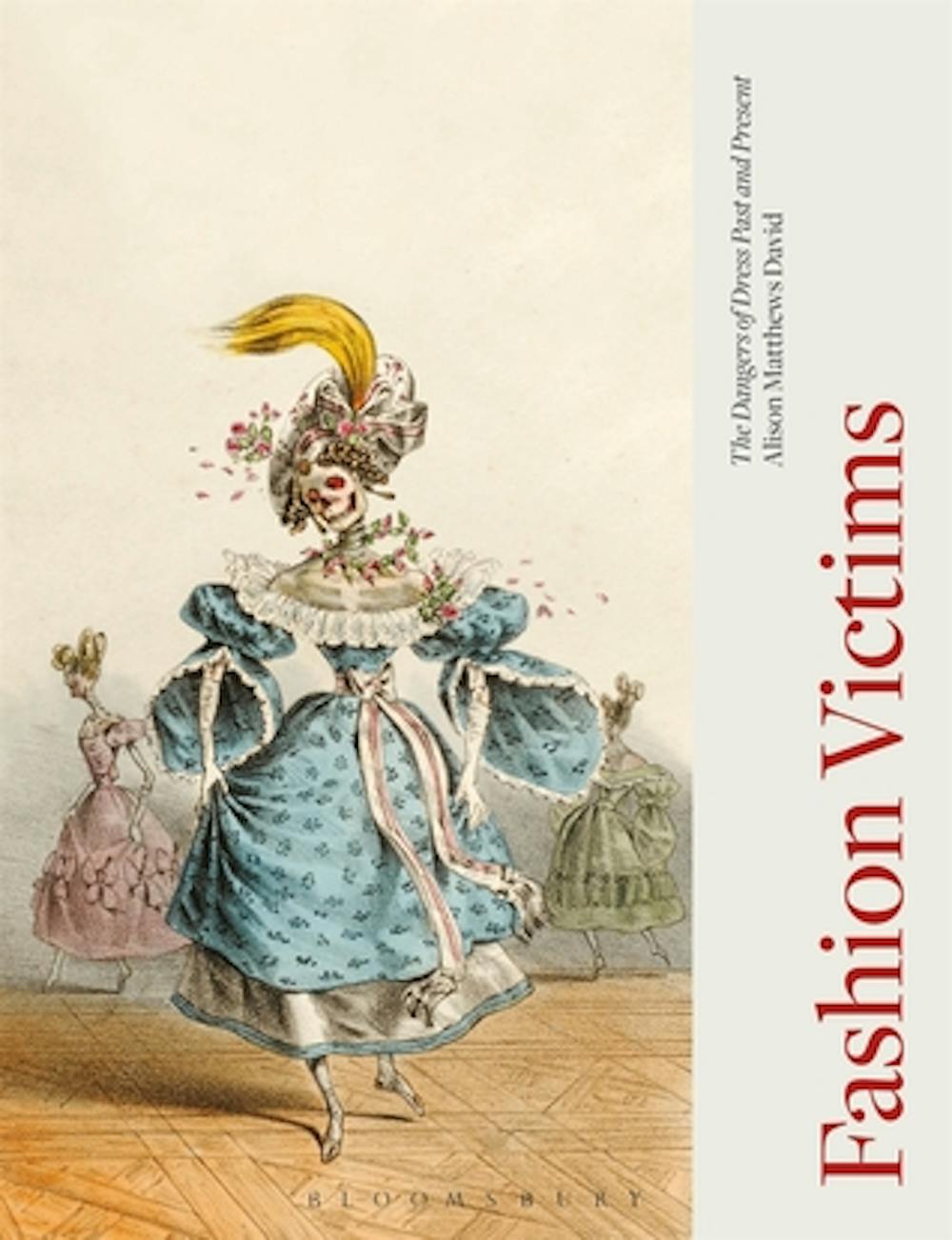
In her book Fashion Victims: The Dangers of Dress Past and Present, Alison Matthews David explains that lead was a popular ingredient in cosmetics for centuries “because it made colours even and opaque and created a desirable ‘whiteness’ that bespoke both freedom from hard outdoor labour and racial purity”.

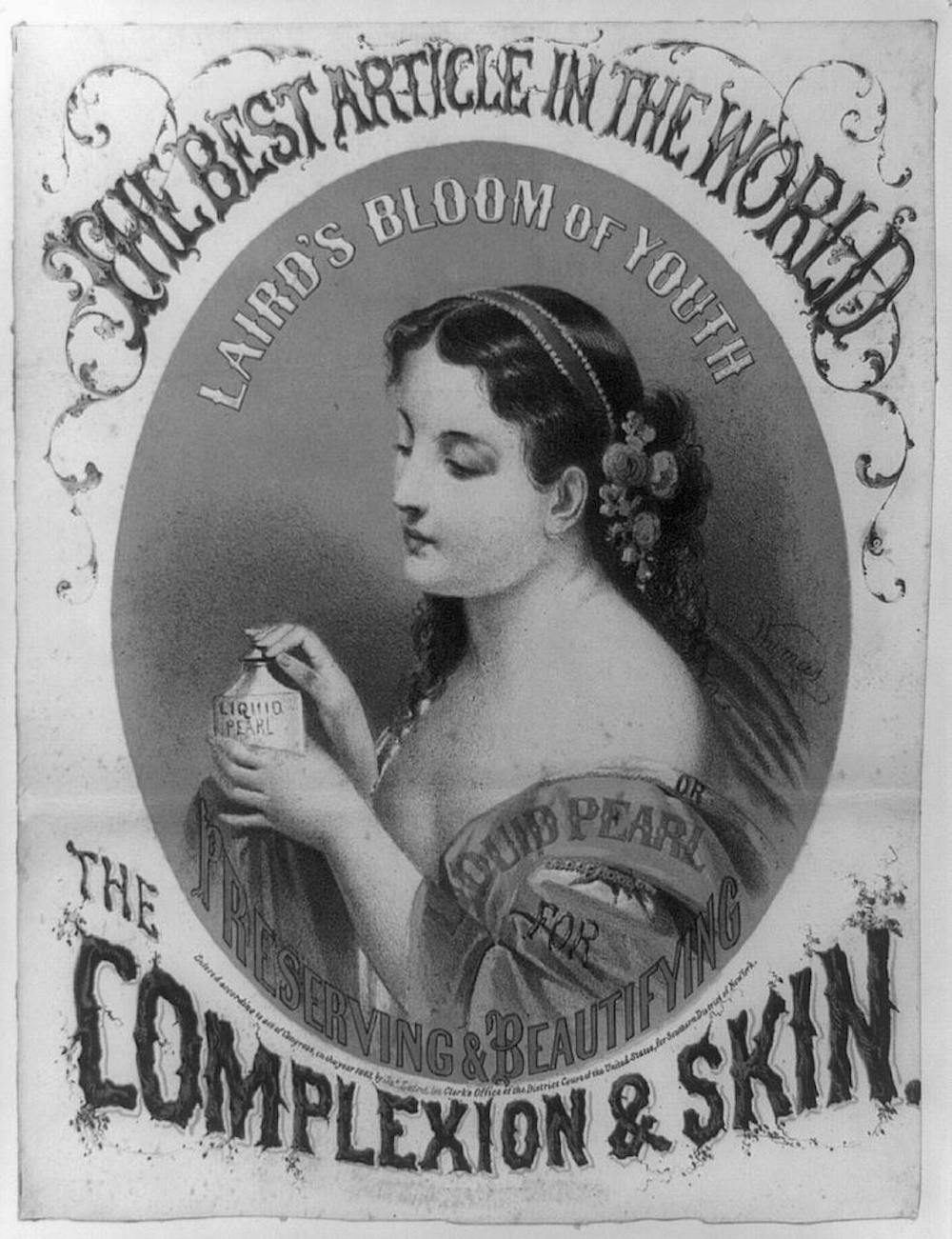
In the 1860s, the American face lotion Laird’s “Bloom of Youth or liquid pearl” promised to whiten skin, helping “ladies afflicted with tan, freckles, Rough or Discolored Skin”. The skin lightener, however, contained such a significant amount of lead that it caused “wrist drop”, or radial nerve palsy, in a number of women.

One woman’s hand had become “wasted to a skeleton”, while a St Louis housewife is recorded as dying of lead poisoning after extensive long-term usage of Laird’s and a home-made preparation containing “white flake and glycerine”.

Ad for Laird's Bloom of Youth, or liquid pearl, c. 1863. Wikimedia images.  
In her book, Matthews David tells how she bought a vintage container of the American face powder “Tetlow’s Swan Down” that dates from the 1870s. It had been marketed as harmless and claimed to use whitening zinc oxide powder to replace once common toxic products such as lead, arsenic and bismuth. She had the powder tested with modern methods and found that it contained “a significant amount of lead”, which could be inhaled as dust during application.

Further reading: High amount of toxic metals in some cosmetics

A dark history

The serious regulation of patent medicines and cosmetics did not occur until the 20th century. This lack of government oversight meant that manufacturers could bottle and sell almost anything without having to verify their claims, subject their products to the rudimentary testing that was available, or clearly label the ingredients.

The key way in which American and British consumers made their decisions about products was based on the claims made and reputations built in extensive magazine advertising, which became prolific in the late 19th century. The period also saw branded cosmetics rise to prominence, with long-established and well-advertised brands, such as Pears’ Soap, providing one of the few indicators of likely quality and safety. Most cosmetic advertising emphasised the purity and healthfulness of products to distance them from well-known examples of harmful creams, powders, and dyes.

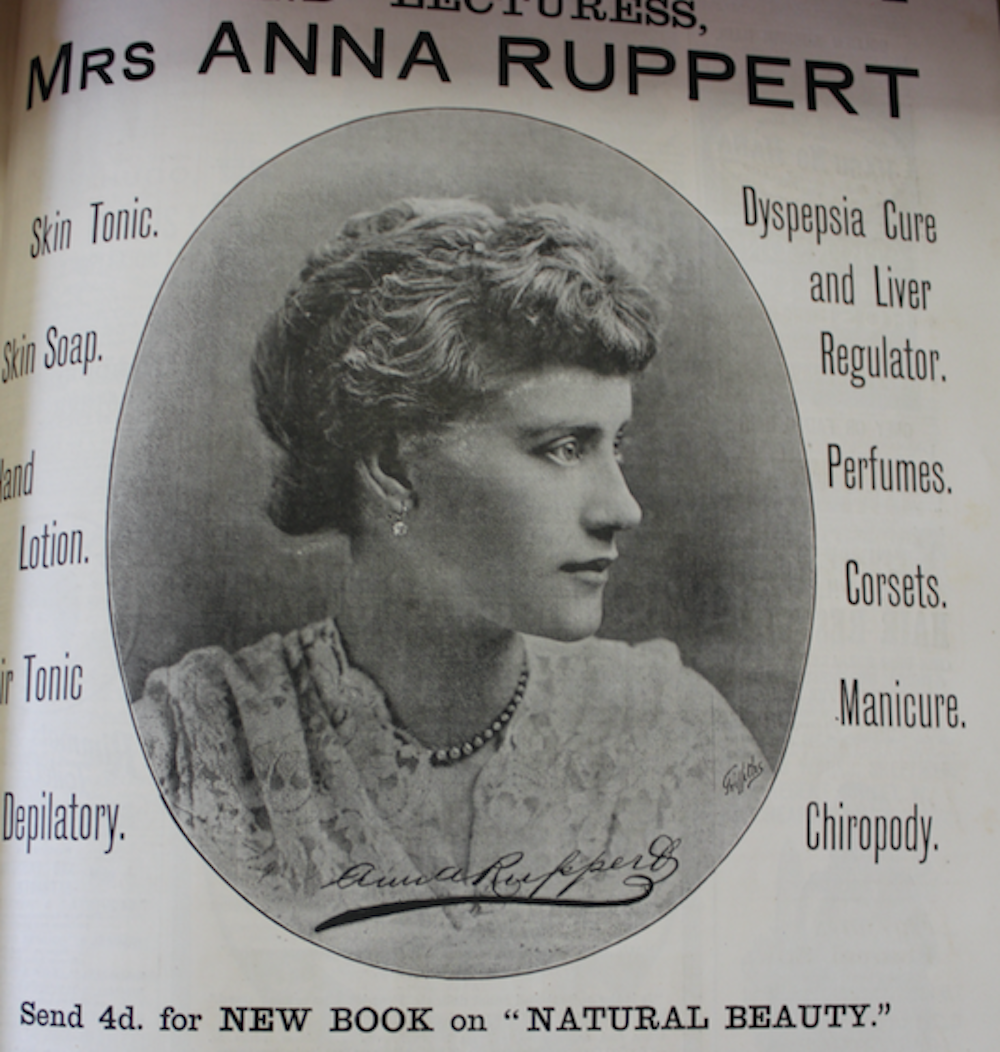
“Celebrated American skin specialist” Anna Ruppert (Shelton) provides a ready example of the spurious nature of some cosmetic advertising and the reality of dangerous tonics marketed as “natural” and therefore healthful in this era. Throughout 1891 and 1892, numerous advertisements appeared in British women’s magazines, including high-quality publications such as The Queen, for lectures to be held in London by a purported American beauty expert.

The ads mentioned Ruppert’s book on “natural beauty”, as well as promoting various products including a skin tonic. Her signature tonic was originally marketed as “Face Bleach” in the United States, tapping into the demand for lighter skin not only from white women, but also African American women. The tonic is described in one Queen advertisement as harmless and invisible: “It is not a cosmetic as it does not show on the face after application”.

However, the reality was that Ruppert’s product was dangerous. After a chemical analysis, the British Medical Journal revealed in 1893 that the skin tonic included the harmful ingredient “corrosive sublimate (bichloride of mercury)”, and it was implicated in the mercury poisoning of a “Mrs K”. As Caroline Rance discovered, that same year, Ruppert was prosecuted for infringing the Irish Pharmacy Act and her reputation was badly tarnished as a result.

Promotional material for Anna Ruppert. Author supplied.
Cosmetics originated in homemade preparations, with long traditions of women concocting their own skin remedies. However, the advice and recipes given in beauty manuals were no guarantee of safety. One British “Treatise of the Toilet and Cosmetic Arts” entitled The Practice of Perfumery from 1870 included a recipe for one of the first depilatory creams, poudre subtile. The ingredients call for half an ounce of “sulpheret of arsenic”, although the author does warn that the preparation is “dangerous” and that “utmost caution” should be used.

Warnings such as this one indicate that the harmful effects of certain cosmetic products were well known. Another manual, Beauty: How to Get it and How to Keep It, from 1885 advised readers to avoid hair dyes because they “are sometimes injurious to the health; those that contain lead or mercury are especially so, and have been known to cause serious illness.” This fear of harmful dyes is reflected in the many magazine advertisements of the period for “hair restorers” that promise to return grey hair to its original shade without the use of “dyes”.

Dangerous home-spun beautifying techniques were also the subject of warnings. For instance, Toilet Hints, or, How to Preserve Beauty, and How to Acquire It from 1883 strongly advised women not to toy with the use of Belladonna berries to dilate their pupils. The use of an extract from the berries could cause blurred vision or even permanent blindness with prolonged use. This beauty guide offered up another, less dangerous, method for adding a spark to the eyes:
If your eyes look dull, drink a glass of champagne rather than touch belladonna.

A gendered culture

Disgraced skin specialist Anna Ruppert wrote in her A Book of Beauty in 1892 that a woman could never neglect her appearance, as even “[t]he most noble beauty, if unattended, will soon lose its charm”. Her comment has several important resonances with beauty culture today.

First, it is still primarily women who seek out cosmetics and cosmetic procedures. Ruppert’s advice to the Victorian woman was that maintaining her looks was vital to maintain a happy marriage. Our modern, postfeminist view is that women now make the “choice” to follow beauty and fashion norms.

Second, beauty is still understood as a process of ongoing work and maintenance. Procedures like Botox can be used pre-emptively to ward off wrinkles and sagging, but it requires continuous usage over time to maintain its effects.

Third, and most importantly, the gendering of cosmetic use means that women are most affected by dangerous products and procedures. As Matthews David points out, cosmetics and dyes continue to be less stringently regulated than products like shampoo and deodorant, which fall under the category of “personal care”.

Further reading: Health risks beneath the painted beauty in America’s nail salons

Several centuries of lax attitudes toward the composition of cosmetics and now non-invasive cosmetic procedures add up to not only a collection of macabre or grotesque stories.
From lead-filled Bloom of Youth to cosmetic fillers being delivered under questionable conditions, the history of dangerous cosmetics shows us the harms that women have suffered to meet expectations of what is beautiful.

This article was originally published on The Conversation. Read the original article.

Thursday, July 20, 2017

Double Standards and Derision – tracing our attitudes to older women and beauty


File 20170630 8231 yjdqi5
Madonna and fashion designer Jeremy Scott
Lucas Jackson/Reuters
Brigitte Macron, wife of French President Emmanuel Macron, is a rare example of an older woman in the public eye who has attracted praise for her appearance. At 64, Macron is 24 years older than her husband, but her healthy figure and youthful style of dress saw her described in Vogue as “rock ‘n’ roll”.
Brigitte Macron. Gonzalo Fuentes/Reuters

While Macron is admired for her penchant for leather pants, women regularly face policing of their clothing and cosmetic choices once they reach the age of 30. Ageing only brings about further restrictions, with few older women who cultivate their appearance successfully negotiating the line between looking acceptably young or upsettingly unnatural.

Madonna, who will turn 60 next year, is a case in point; her attempts to retain a sexy image are sometimes described with revulsion. Piers Morgan described her as “50 Shades of Granny” after her 2015 kiss with Drake. Her famous muscles, which keep her skin taut, were called “monstrously sculpted and bloodcurdling veiny corpse arms” by TMZ as the publication had a dig at her “toyboy” Jesus Luz.

In contrast, Cher, at 71, recently wore a replica of a near-nude costume from 1989 at the Billboard Music Awards and was generally praised as “amazing” and “owning it”.

What is Cher doing to invite praise that Madonna isn’t? And where did restrictive ideas about beauty and ageing come from? When did we decide that there was a particular age at which women might incite criticism or disgust for attempting to look beautiful or desirable?

A closer look at women’s magazines from the 19th century — the era in which modern advertising and celebrity culture were born — reveal the origins of many of our hang-ups about older women and beauty.

In the first half of that century, beauty was understood as God-given or natural. Beliefs in physiognomy also suggested that the inner character of a woman might be visible in her face. In 1849, in an article that commented on the process of women’s ageing, the English magazine World of Fashion and Continental Feuilletons observed:
Neither rouge, artificial ringlets, nor all the resources of the toilet, can retard the relentless progress of that terrible foe to beauty, Time. But every one must have noticed how lightly his hand rests upon some, how heavily upon others … A good conscience is the greatest preservative of beauty. High and noble thoughts leave behind them noble and beautiful traces, meanness of thought and selfishness of feeling league with Time to unite age and ugliness together.
This dismissal of cosmetics is typical of attitudes that saw beauty as a quality that a woman was either born with or not and its loss inevitable. In the final decades of the 19th century, however, women’s magazines transformed this belief.

With the growth of advertising and beauty advice columns, there was gradual acceptance that fading looks should be combated by almost any means necessary. For older women, being visibly made up gradually became more tolerable, though the degree to which the cosmetics might be detectable was a point of contention. Women who foolishly attempted to recreate the charms of their youth were still harshly judged.

Cosmetics and ageing

The 30s were understood as a threshold for women entering middle age and no longer being considered at the peak of attractiveness. An advertisement for Madame Dupree’s Berlin Toilet Soap from 1890 promises “a return to youthful beauty” and specifies that the soap can “make […] a lady of 35 appear but 25”.

A 1904 beauty manual by Lady Jean, Beauty as a Fine Art, is generous enough to suggest that a woman of 40 “is just entering upon a long summer of useful and enjoyable existence”. Yet it goes on to suggest that “anything that threatens to rob her of the outward sign of youth” could be “combated and defied by all reasonable means”.

A Pears' ad showing a woman who is 50 but
supposed to look 17, from June 1 1888,
Myra's Journal of Dress and Fashion,
p. 325

The rise of advertising and consumer culture in the Victorian period saw the birth of thousands of brand-name beauty products. Many promised readers that they could retain the markers of youth: a full head of luxurious hair with no bald spots or grey, a full set of teeth, a trim waist, and a clear and smooth complexion.
Importantly, an overall distinction was made between products that might “preserve” youth, such as soaps, treatments and baths, and those that attempt to artificially conceal aged skin, such as obvious coloured cosmetics.

There was greater acceptance of certain cosmetics such as powder and rouge in the late 19th century. However, lingering views about natural beauty and the unpleasantness of older woman attempting to present themselves as youthful ensured that cosmetic advertisements denied the artifice involved in their products.

Advertisements for soaps, dyes and related beautifying aids emphasised their capacity to preserve what beauty women already possessed. Advertisements for hair restorers claimed (surely erroneously) they could renew grey hair to its original colour without the use of dye. An ad for Rossetter’s hair restorer from around 1880 also claims to give the hair “the lustre and health of youth”.

In small print at the bottom of an undated advertisement for Blackham’s hair restorer, it is acknowledged that their Electric Hair Stain is a dye – but purchasers are reassured that this “cannot be detected”. In a similar vein to today’s attitudes to cosmetic surgery, this claim signals how women had to ensure improvements to their appearance were seen as natural and, ironically, unnoticeable.

Blackham's tonic ad, c. 1895


Soap was the most acceptable of commercial products for preserving youthful skin. Actresses and famous figures often provided written testimonials or directly featured in Victorian advertising. Sarah Bernhardt, a French actress, regularly appeared in beauty advertisements, including for Pears soap and her own rice-based face powder.

Ageing disgracefully

In contrast to frequent advocacy for soaps and home remedies in women’s magazines, the services and treatments of the infamous cosmetician Madame Rachel, Sarah Rachel Levison, provided well-publicised examples of older women who were imagined as foolish and vain for seeking to improve their appearances.

Products provided at her London salon included Circassian Beauty Wash, Magnetic Rock Dew Water of Sahara for removing wrinkles, and Youth and Beauty Cream. In 1863, Rachel published a 24-page pamphlet, entitled “Beautiful For Ever!” It told how she now had the sole right to sell
the Magnetic Rock Dew Water of Sahara, which possesses the extraordinary property of increasing the vital energies – restores the colour of grey hair – gives the appearance of youth to persons far advanced in years, and removes wrinkle, defect, and blemishes, from whatever cause they may arise.

Madame Rachel. Wikimedia images.

The treatment for which Madame Rachel was most famous was known as “enamelling”. This involved the removal of facial hair, cleansing of the skin with alkaline washes, then filling of any wrinkles or uneven facial features with a thick white paste, which sometimes contained lead. This was followed by the application of powder and rouge.
The gullibility of older women in chasing the fountain of youth through cosmetics was amply illustrated in Madame Rachel’s trial for fraud in 1868. Her victim, 50-year-old Mary Tucker Borradaile, was described as an object of pity in the trial.
One of the prosecutors, Montagu Williams, found it hard to believe that Borradaile could have believed she could be made beautiful forever. He later recalled her to be a pathetic figure in her attempts to look attractive despite her years:
She was a spare, thin, scraggy-looking woman, wholly devoid of figure; her hair was dyed a bright yellow; her face was ruddled with paint; and the darkness of her eyebrows was strongly suggestive of meretricious art.
It was recorded that Borradaile had been beautiful in her youth and was particularly noted for her long, golden hair. But, in court, her hair was observed to be unnaturally dyed or artificial. Fellow prosecutor William Ballantine described Borradaile as:
a skeleton encased apparently in plaster of Paris, painted pink and white, and surmounted with a juvenile wig.
According to Helen Rappaport, when Borradaile entered the courtroom to give evidence, there were audible gasps at her made-up face.

‘The absolute loss of empire’

Horror at the cosmetically enhanced older woman continued to be expressed into the early 20th century. In The Art of Being Beautiful from 1902, the supposedly 50-year-old interviewee, the Baroness, advises:
For a woman to try and knock more than ten years off her age is an arrogance for which she is punished by every glance of the passers-by. When she tries as a brunette to make herself into a blonde by the use of unlimited white chalk, she also makes herself grotesque – as unpleasing as a fly that had dropped into a honey-pot. When, as a blonde, she adorns herself with black eyebrows like croquet hoops, frankly she becomes alarming, if not detestable.
The Baroness also remarks that dyed hair does not complement “wrinkled cheeks”, especially when the dye chosen is of an “infantine yellow tint”. Apparently, there were certain signs of youth that older women should not attempt to recapture.

While the Baroness critiqued the older woman who attempted to turn back the hands of time through excessive use of cosmetics, she did advocate for beauty regimens to slow the process of ageing. She described the loss of beauty as “the absolute loss of empire”. “Active preparations” for ageing were encouraged – in the same manner as the fire brigade, army and medical profession might ready for fires, war and disease.

So as women aged, they were confronted with the choice of either accepting the gradual fading of their looks, or being criticised for trying to visibly ameliorate signs of age, attempting the impossible task of trying to stave off wrinkles and grey hair.

Meg Ryan. Mario Anzuoni/Reuters


These double standards are exceedingly familiar. Older women in the public eye are caught in a bind between being seen as excessive users of cosmetic surgery who have made themselves look unnatural, or of having aged or “let themselves go” to the point of no longer being seen as desirable and bankable.
Actresses in their 50s, such as Meg Ryan and Daryl Hannah, regularly appear in photo galleries taking delight in “botched” plastic surgery or marvelling at “trout pouts”.

Conversely, magazines and gossip sites pounced on unflattering photographs of Kirstie Ally, now 66, when she gained a significant amount of weight in 2008, and proclaimed her “washed up”.

While a small number of women in the public eye, like Brigitte Macron, are seen to deftly negotiate these expectations of beauty and ageing, most are set up to fail.


This article was originally published on The Conversation. Read the original article.

Wednesday, May 4, 2016

The Ugly History of Cosmetic Surgery

American advertisement for "non-surgical" nose correction
Reality television shows based on surgical transformations, such as The Swan and Extreme Makeover, were not the first public spectacles to offer women the ability to compete for the chance to be beautiful.

In 1924, a competition ad in the New York Daily Mirror asked the affronting question “Who is the homeliest girl in New York?” It promised the unfortunate winner that a plastic surgeon would “make a beauty of her”. Entrants were reassured that they would be spared embarrassment, as the paper’s art department would paint “masks” on their photographs when they were published.

Cosmetic surgery instinctively seems like a modern phenomenon. Yet it has a much longer and more complicated history than most people likely imagine. Its origins lie in part in the correction of syphilitic deformities and racialised ideas about “healthy” and acceptable facial features as much as any purely aesthetic ideas about symmetry, for instance.

In her study of how beauty is related to social discrimination and bias, sociologist Bonnie Berry estimates that 50% of Americans are “unhappy with their looks”. Berry links this prevalence to mass media images. However, people have long been driven to painful, surgical measures to “correct” their facial features and body parts, even prior to the use of anaesthesia and discovery of antiseptic principles.

Some of the first recorded surgeries took place in 16th-century Britain and Europe. Tudor “barber-surgeons” treated facial injuries, which as medical historian Margaret Pelling explains, was crucial in a culture where damaged or ugly faces were seen to reflect a disfigured inner self.

With the pain and risks to life inherent in any kind of surgery at this time, cosmetic procedures were usually confined to severe and stigmatised disfigurements, such as the loss of a nose through trauma or epidemic syphilis.

The first pedicle flap grafts to fashion new noses were performed in 16th-century Europe. A section of skin would be cut from the forehead, folded down, and stitched, or would be harvested from the patient’s arm.

Jean Baptiste Marc Bourgery and Nicholas Henri Jacob,
‘Iconografia d'anatomia chirurgica e di medicina operatoria,’ Florence, 1841.

A later representation of this procedure in Iconografia d’anatomia published in 1841, as reproduced in Richard Barnett’s Crucial Interventions, shows the patient with his raised arm still gruesomely attached to his face during the graft’s healing period.

As socially crippling as facial disfigurements could be and as desperate as some individuals were to remedy them, purely cosmetic surgery did not become commonplace until operations were not excruciatingly painful and life threatening.

In 1846, what is frequently described as the first “painless” operation was performed by American dentist William Morton, who gave ether to a patient. The ether was administered via inhalation through either a handkerchief or bellows. Both of these were imprecise methods of delivery that could cause an overdose and kill the patient.

The removal of the second major impediment to cosmetic surgery occurred in the 1860s. English doctor Joseph Lister’s model of aseptic, or sterile, surgery was taken up in France, Germany, Austria and Italy, reducing the chance of infection and death.

By the 1880s, with the further refinement of anaesthesia, cosmetic surgery became a relatively safe and painless prospect for healthy people who felt unattractive.

The Derma-Featural Co advertised its “treatments” for “humped, depressed, or… ill-shaped noses”, protruding ears, and wrinkles (“the finger marks of Time”) in the English magazine World of Dress in 1901.

A report from a 1908 court case involving the company shows that they continued to use skin harvested from – and attached to – the arm for rhinoplasties.

The report also refers to the non-surgical “paraffin wax” rhinoplasty, in which hot, liquid wax was injected into the nose and then “moulded by the operator into the desired shape”. The wax could potentially migrate to other parts of the face and be disfiguring, or cause “paraffinomas” or wax cancers.

World of Dress, June 1905
Advertisements for the likes of the the Derma-Featural Co were rare in women’s magazines around the turn of the 20th century. But there were frequently ads published for bogus devices promising to deliver dramatic face and body changes that might reasonably be expected only from surgical intervention.

Various models of chin and forehead straps, such as the patented “Ganesh” brand, were advertised as a means for removing double chins and wrinkles around the eyes.

Bust reducers and hip and stomach reducers, such as the JZ Hygienic Beauty Belt, also promised non-surgical ways to reshape the body.

World of Dress, April 1905
The frequency of these ads in popular magazines suggests that use of these devices was socially acceptable. In comparison, coloured cosmetics such as rouge and kohl eyeliner were rarely advertised. The ads for “powder and paint” that do exist often emphasised the product’s “natural look” to avoid any negative association between cosmetics and artifice.


The racialised origins of cosmetic surgery

The most common cosmetic operations requested before the 20th century aimed to correct features such as ears, noses, and breasts classified as “ugly” because they weren’t typical for “white” people.
At this time, racial science was concerned with “improving” the white race. In the United States, with its growing populations of Jewish and Irish immigrants and African Americans, “pug” noses, large noses and flat noses were signs of racial difference and therefore ugliness.

Sander L. Gilman suggests that the “primitive” associations of non-white noses arose “because the too-flat nose came to be associated with the inherited syphilitic nose”.

American otolaryngologist John Orlando Roe’s discovery of a method for performing rhinoplasties inside the nose, without leaving a tell-tale external scar, was a crucial development in the 1880s. As is the case today, patients wanted to be able to “pass” (in this case as “white”) and for their surgery to be undetectable.

In 2015, 627,165 American women, or an astonishing 1 in 250, received breast implants. In the early years of cosmetic surgery, breasts were never made larger.

Breasts acted historically as a “racial sign”. Small, rounded breasts were viewed as youthful and sexually controlled. Larger, pendulous breasts were regarded as “primitive” and therefore as a deformity.

In the age of the flapper, in the early 20th century, breast reductions were common. It was not until the 1950s that small breasts were transformed into a medical problem and seen to make women unhappy.

Shifting views about desirable breasts illustrate how beauty standards change across time and place. Beauty was once considered as God-given, natural or a sign of health or a person’s good character.
When beauty began to be understood as located outside of each person and as capable of being changed, more women, in particular, tried to improve their appearance through beauty products, as they now increasingly turn to surgery.

As Elizabeth Haiken points out in Venus Envy, 1921 not only marked the first meeting of an American association of plastic surgery specialists, but also the first Miss America pageant in Atlantic City. All of the finalists were white. The winner, sixteen-year-old Margaret Gorman, was short compared to today’s towering models at five-feet-one-inch tall, and her breast measurement was smaller than that of her hips.


There is a close link between cosmetic surgical trends and the qualities we value as a culture, as well as shifting ideas about race, health, femininity, and ageing.

Last year was celebrated by some within the field as the 100th anniversary of modern cosmetic surgery. New Zealander Dr Harold Gillies has been championed for inventing the pedicle flap graft during World War I to reconstruct the faces of maimed soldiers. Yet as is well documented, primitive versions of this technique had been in use for centuries.

Such an inspiring story obscures the fact that modern cosmetic surgery was really born in the late 19th century and that it owes as much to syphilis and racism as to rebuilding the noses and jaws of war heroes.

The surgical fraternity – and it is a brotherhood, as more than 90% of cosmetic surgeons are male— conveniently places itself in a history that begins with reconstructing the faces and work prospects of the war wounded.

In reality, cosmetic surgeons are instruments of shifting whims about what is attractive. They have helped people to conceal or transform features that might make them stand out as once diseased, ethnically different, “primitive”, too feminine, or too masculine.

The sheer risks that people have been willing to run in order to pass as “normal” or even to turn the “misfortune” of ugliness, as the homeliest girl contest put it, into beauty, shows how strongly people internalise ideas about what is beautiful.

Looking back at the ugly history of cosmetic surgery should give us the impetus to more fully consider how our own beauty norms are shaped by prejudices including racism and sexism.

This article was originally published on The Conversation. Read the original article.

Friday, April 25, 2014

The History of Gendered Children's Books ... And Their Segregating Present

Includes "Gulliver", "Robin Hood" and
"Robinson Crusoe"
Scholars of children’s literature are accustomed to defending the field on the odd occasion when introduced to someone who jokes about how frivolous and pointless it must be as an area of research. Yet when an article appears in the media which suggests that children’s books should be altered to ensure that they are more inclusive of all children, it inevitably provokes the interest of tens and even hundreds of thousands of readers. For something supposedly trivial, children’s books seem to be of great personal significance to a large number of people.

Last month, Katy Guest, literary editor at the Independent on Sunday, announced that the paper would no longer review “gender-specific children’s books”. This didn’t mean that books like Anne of Green Gables or Harry Potter would be barred from review. Guest made specific reference to the recent rash of books that segregate boys and girls and don’t leave open the possibility that girls might be interested in pursuits that are stereotypical for boys and that boys might also want to read about what are considered girls’ interests. These are not simply books with boy or girl protagonists, but the type of books that are colour coded in pink or blue and which are often published in pairs, such as Usborne’s Illustrated Classics for Boys (“stories of action, adventure”) and Usborne’s Illustrated Stories for Girls (“stories about mermaids, fairies, princesses and dolls”).
 
Includes "Heidi", "The Wizard of Oz" and
"The Secret Garden"
Around 200,000 people read Guest’s original article and responses were so numerous that she was compelled to prepare a list of answers to the most common expressions of outrage. The article offered support to the Let Books Be Books campaign, which is part of a broader push to end gender segregation among children’s toys.

I also agree that girls and boys should be encouraged to choose from every kind of story imaginable. But, then, a lot of my research concentrates on books and magazines that were published specifically for girls during the late nineteenth century and early twentieth century. Don’t I actually like the concept of books written and published for girls? And if girls’ and boys’ books have been around for so long, then what’s wrong with these recent books targeted at one gender?

The History of Gendered Children's Books and Magazines
A Little Pretty Pocket-Book (1744)
The earliest illustrated children’s books published in Britain by John Newbery in the mid eighteenth century, such as A Little Pretty Pocket Book (1744), were intended for both boys and girls. The book’s subtitle indicates that it was "Intended for the Amusement of Little Master Tommy and Pretty Miss Polly". Children were just beginning to be recognised as a distinct readership, separate from that of adults, as evidenced by the debut of The Children’s Magazine in 1800. Previously children who were fortunate enough to be able to read would usually only be catered to through children’s pages in family magazines, religious tracts, catechisms, primers and chapbook adaptations and abridgements of popular novels like Robinson Crusoe and Gulliver’s Travels.
 
Little Folks (1871-1933)
Most nineteenth century magazines for young children, such as Aunt Judy’s Magazine, Little Folks, Chatterbox and Kind Words for Boys and Girls, were aimed at both boys and girls. Concerns about properly gendered behaviours were not marked for young children. For instance, small boys often sported their hair long and wore dresses until the age of breeching (usually after a boy turned four and before he was eight). Young children could then be treated as a relatively undistinguished mass in books and magazines.

In the eighteenth century, adolescence was generally incorporated within the concept of childhood. Yet in the late nineteenth century, girlhood emerged as a distinct phase of development separate from that of early childhood, which, as I've mentioned, tended to encompass both sexes. Consequently, as children grew older, it became common to encourage them to read books and magazines specifically written for boys or girls. New, niche publications targeted at boys and girls flourished in this period due to reduced printing costs and rapidly increasing literacy rates. 

From Newbery’s first books, young people’s reading was understood as having the purpose of combining “instruction with delight”. As expectations for men and women with regard to education, work and family were so starkly different, the instruction girls and boys required as they approached adulthood came to be  understood as needing to diverge. For instance, in 1879 the Religious Tract Society began publication of the long-running Boys’ Own Paper and followed with the even more popular Girls’ Own Paper from 1880.

Girl's Own Paper (1880-1956)
Men and women were also understood as different kinds of readers, with women more likely to be characterised as wasting time reading frivolous material, such as novels. As a result, girls’ publications, such as the Girl’s Own, were especially conscious of presenting appropriately moral stories that encouraged girls to be dutiful and self-sacrificial. Edward Salmon, a nineteenth century commentator, put it this way: Girls’ literature is intended to “build up” women, as boys’ literature is meant to “build up” men. Books for each gender, according to Salmon, have very different purposes:
"If in choosing the books that boys shall read it is necessary to remember that we are choosing mental food for the future chiefs of a great race, it is equally important not to forget in choosing books for girls that we are choosing mental food for the future wives and mothers of that race."  
Salmon knew that Victorian girls often read boys’ books and periodicals as well, but did not disapprove of their covert reading. Even adults of the era were aware that exciting adventure stories, which were reserved for boys' publications, held appeal for girl readers whose stories were often loaded with moral lessons and were confined to domestic settings. This tendency continues today in that children's novels with boy protagonists are often assumed to appeal to all young readers but girl protagonists are generally thought to only appeal to girls. (Although recent Young Adult fiction with girl protagonists, such as Suzanne Collins’s The Hunger Games and Scott Westerfeld’s Uglies series, is widely read by both sexes.)

Gendered Books Today
Pink mania for girls
What does all this mean for the debate about gender-specific children’s books? In her original article, Guest speculates that part of the reason for the contemporary push for segregating toys and books along gender lines is sheer greed from manufacturers “forcing parents to buy twice as much stuff”. At their core, however, children’s books, films and television exist to achieve much the same things as John Newbery charged his illustrated children’s books with in the eighteenth century. Our culture produces targeted books, films and television to entertain children, but also to socialise (or “instruct”) them in the prevailing views of how to behave, what kinds of people are valued, and what kinds of people they should seek to become as adults.

In the nineteenth century, very young children were seen as occupying a comparatively genderless stage of life. As a result, the books and magazines that were written for them tended to see young girls and boys as capable of enjoying the same things and requiring the same kinds of didactic messages about how children should behave. It was only when children grew older that enforcing gendered expectations became crucially important and necessitated that books and magazines be tailored to girl or boy readerships.

As the Pink Stinks and Let Toys Be Toys campaigns attest, the past two decades has seen increasing gender stereotyping of children’s toys, even for very young children. We seem to be even more anxious about children remaining within very narrow sets of expectations of what they should grow up to do as men and women. This comes despite progressive attempts in the 1970s, driven by second-wave feminism, to encourage children to play and dress in ways that weren’t highly gendered. In her research on Sears’ toy catalogues, Elizabeth Sweet found that in the mid 1970s “very few toys were explicitly marketed according to gender, and nearly 70 percent showed no markings of gender whatsoever. In the 1970s, toy ads often defied gender stereotypes by showing girls building and playing airplane captain, and boys cooking in the kitchen.”
Stereotype breaking toy catalogue from Sweden's Leklust
And yet now that women are highly educated and the majority of mothers are also in the workforce, toys and books specifically aimed at girls are focused more than ever on the tasks of looking pretty and domestic duties such as cooking and cleaning. The hypergendering of both children’s books and toys looks more like part of an ongoing backlash against feminism in which limiting stereotypes (both old and new inventions like the sparkly, tulle fairy princess) for both boys and girls serve to restore a neat, predictable gendered order. As families negotiate the difficulties of raising children with two parents at work and situations in which women might out-earn their male partners, a return to clear-cut gender divides is something that seems culturally reassuring and comfortable. After all, without our willingness to embrace the gender divide in children’s toys and media, corporations and marketers would have no one to sell their pink, glittery vacuum cleaners to.   

Thursday, October 4, 2012

Video: Girls, Sex, and Popular Culture Talk at the Wheeler Centre

From Prim to Pole Dance: Girls, Sex and Popular Culture

'Girls on Show', A Current Affair, 31 July 2012
The text of my Wheeler Centre talk today.
And a link to an article at the Age online about it and another at the Daily Telegraph and the same piece at the Herald Sun.

Girls' bottoms are a major problem according to several media stories this year. Specifically, girls are revealing too much of their behinds and their wanton disregard for modesty not only puts them at risk of catching a chill during winter, but of luring paedophiles, sex offenders and garden variety guys-who-are-only-after-one-thing out of hiding. The first example of such a story, called "Girls on Show", appeared on A Current Affair at the end of July. As this screen capture shows, the camerawork in this tirade against girls wearing skimpy clothing when nightclubbing, lingered fetishistically over the girls' legs and bottoms, many of which were only barely covered by mini-skirts or hotpants. Celebrity women Ita Buttrose and Charlotte Dawson offered comment on the girls' dress, making some telling observations that likened the girls to "hookers", "tarts" and prostitutes. Dawson, for instance, said "the girls actually selling themselves on the street are much more tastefully dressed than some of these young ladies." While Buttrose explained that provocative dressing was not likely to attract a potential husband: "They might flirt with a tart. They might have sex with a tart. But it's often not the tart that they take home to meet their mother."

This story is not unusual. The language of sex work is frequently applied to what girls and young women are wearing today.  In the UK, Joanna Lumley also recently expressed dismay at young women "dressing like lap dancers".  The most notable recent Australian example was the online following that developed around a mother's complaints about Target's clothing range for girls. Ana Amini wrote on the retailer's Facebook page: ''Dear Target, Could you possibly make a range of clothing for girls 7-14 years that doesn't make them look like tramps … You have lost me as a customer when buying apparel for my daughter as I don't want her thinking shorts up her backside are the norm or fashionable.'' These leopard print numbers, as well as a pair of denim cut-off shorts, were the most common images circulated as evidence of Target's inappropriately sexual, or 'trampy' clothing range for girls.

The focus on how much flesh both pre-teen girls and young women are exposing is understandable in a culture where sexy images of women are visible on every magazine stand, on many billboards, buses and trams, and in popular TV and film. We are ultimately very uncomfortable when the ideal sexy woman crosses paths with the developing girl. Just where is the border between sexual innocence and knowing construction of a sexy appearance? This is a particularly thorny question in a culture where fashion models—the ideal representation of how women should look—as well as the young women who feature in pornography, are often teenagers. The use of 10-year-old model Thylane Blondeau in Paris Vogue posed and dressed as a woman threw some into despair at the crossing of this line, but also highlighted the systematic use of girls as young as thirteen as fashion models for women's clothing and cosmetics.

Where the boundary between girl and sexual woman lies is also problematic when we attempt to divorce activities, such as pole dancing, from their adult connotations. In Canada, the Twisted Grip pole dance studio attracted international media attention in the past month for its "Little Spinners" pole dance classes for girls. The classes were supposedly created in response to requests from mothers with their own poles at home who wanted their daughters to learn to perform on the pole safely. The studio operators emphasised that the classes were about "fitness" and "athleticism" and contained no "sexual moves". But just as the studio's logo on the poster shows a woman in a bikini or her underwear spreading her legs apart on the pole, for most people commenting online, it was impossible to divorce pole dancing from any kind of sexual association when it came to girls as young as five taking the classes.

The awkward tension between what is seen as desirable in women and parental and social expectations of girlhood innocence are  aptly summarised by a routine from comedian Chris Rock. While his jokes occasionally mention his own visits to strip clubs, Rock had a new perspective on the adult industry when his baby girl was born. He comments about gazing down at his daughter in her pram: "My only job in life is to keep her off the pole. Keep my baby off the pole! I mean they don't grade fathers, but if your daughter is a stripper, you fucked up." While, as a society, we seem to want women to be sexually ready and available, we don't want our own daughters launching a career in porn films or taking up a slot at Spearmint Rhino.

No wonder the situation is confusing for girls. The contemporary media landscape condemns them for being too sexual, for wearing revealing clothing and intentionally seeking sexual attention from men. It also manifests worries about younger girls, such as tweens dressed in Target clothing, who might unintentionally convey sexual readiness (although I am careful to caution that what girls or indeed women wear provides no justification for sexual assault). While much of this debate seems new, born out of a hyper-sexualised internet-enabled culture, I want to show that similar anxieties about girls' sexuality were also prominent in the media in the Victorian period in Britain. What I would argue is these concerns about the transition from girl to woman in relation to sex are very consistent across the past century and a half. While the messages we give to girls directly are similar, the key difference today is that sexual images of women surround us where they were once concealed from girls. The messages about sex that we provide to girls are more contradictory than ever, as they are branded "tarts" and "hookers" for dressing in a way that reveals their bodies, but are immersed in popular culture that presents being sexy and sexually available as the foremost qualities of the ideal woman.

The Victorian period spans the reign of Queen Victoria from 1837 to 1901. It is a crucial era for thinking about how girlhood has been shaped because during this time it began to be considered as a distinct stage between childhood and womanhood. Being a girl meant being in a state of transition. Girls also began to be universally educated later in the century, so girls' books and magazines became publishing phenomena, with newly literate girls looking to read stories and articles aimed especially at their interests and publishers and editors seeking to direct girls in the right ways to behave, read, exercise and fulfil their family duty.

The most popular magazine from 1880 was the Girl's Own Paper, which more than 100,000 girls, aged from around 12 to 24, read each week. Its resident Doctor, "Medicus", a pseudonym for Gordon Stables, a former army doctor, regularly wrote on the topics of beauty and clothing, especially corsets, as they related to health. Like most commentators of the era, Medicus thought that being healthy was the route to being beautiful and that cosmetics had negative moral connotations for girls. In 1888, he wrote in a column on beauty: "Well, I declare to you that when I meet young ladies rouged, powdered and pencilled, I wonder if the world is getting worse. For deceit thus carried about openly can have no good effects on the moral character. Many girls moving in what is called good society... are little better than walking frauds, perambulating fibs."

This view in a girls' magazine mirrors a controversy provoked twenty years earlier, in March 1868. Journalist Eliza Lynn Linton published an anonymous article in the Saturday Review called "The Girl of the Period" that caused a stir in other papers. Fascinatingly, "The Girl of the Period" has major parallels with the Current Affair "Girls on Show" story I mentioned earlier. Amid a broader tirade against feminism, Linton expressed disgust in girls who were using clothing, such as tight skirts, as well as cosmetics to emphasise their sexual beauty to attract men. "The Girl of the Period", she wrote:

 is a creature who dyes who hair and paints her face...a creature whose sole idea of life is fun; ...and whose dress is a chief object of such thought and intellect as she possesses. No matter if, in the time of crinolines, she sacrifices decency; in the time of trains, cleanliness; in the time of tied-back skirts, modesty; no matter either, if she makes herself a nuisance and an inconvenience to every one she meets; — the Girl of the Period has done away with such moral muffishness as consideration for others or regard for counsel and rebuke. It was all very well in old-fashioned times, when fathers and mothers had some authority and were treated with respect, to be tutored and made to obey, but she is far too fast and flourishing to be stopped in mid-career by these slow old morals...

Where the modern girl was going wrong, according to Linton, was in her similar "aims and feelings" to "women of the demi-monde", effectively mistresses kept by wealthy lovers. Here is our precedent, 140 years ago, for comparing fashionable girls in the pursuit of fun and entertainment, to prostitutes. "The Girl of the Period" also connects with the idea Ita Buttrose presented about sexy girls not making good wives, but only being suited to one-night-stands. Linton proposed that "the Girl of the Period does not marry easily... [Men] may amuse themselves with her for an evening, but they do not readily take her for life." And let's not forget the resonance of timeless complaints about girls no longer listening to the advice of their parents about modesty.

"The Fast Smoking Girl", The Girl
of the Period Miscellany
, 1869
The uproar Linton provoked about the "girl of the period" spawned a short-lived magazine edited by men called The Girl of the Period Miscellany in 1869 that satirised the latest fashions for young women. This caricature of the fast-smoking girl describes her desire for a frivolous existence at dances and concerts, while wearing the latest clothes and doing "a mild weed on the quiet" as smoking is referred to. Crucially this new type of girl who followed aesthetic pleasure, didn't see herself as one day taking up a subordinate domestic role, but rather, in this poem wants to hook "a rich stupid old husband" who will be the one who "shall obey" her.

Linton's views about girls were widely criticised -- this cartoon from the paper The Tomahawk, for instance, ascribes a degree of jealousy and transgression to the author. Linton's was by no means a consensus opinion. Indeed, when reflecting on the Victorian period, while girls were certainly eager to be modern compared with those who came before them by gaining new freedoms such as higher education and employment, there is no major apparent transformation in morality:

most girls conformed to family and church expectations. In other words, there was no actual crisis of prostitute-like girls in Britain, but only a perception brought about by observation of a minority, or of speculation about morality based on changing fashions and transforming social norms.

The teenage girls condemned for wearing revealing clothing today reflect a long history of young women dressing fashionably and sometimes provocatively to the alarm of adults. So if girls have been criticised for wearing make-up and 'inappropriate' clothing because of their sexual connotations for at least 150 years, why are we seeing such a particular anxiety about this topic in the present moment? And why are younger girls now coming under such sexual scrutiny? Why does a discussion of short shorts for girls even lead to questions of whether such clothing might lure paedophiles, for instance?

'Fatima's Hoochie Coochie',
Thomas Edison, 1896
My answer is that the culture around girls has changed. While today's girl and the Victorian girl have both been exposed to encouragements to avoid too much make-up or wearing revealing clothing, the Victorian girl was almost entirely shielded from sexual images of women. Advertising would not even depict a line illustration of a woman wearing a corset, an item of underwear, until the 1880s and 1890s! While erotic images did circulate among men, they were too risqué and marginalised to influence mainstream popular culture significantly.The first erotic films were not produced until around 1896, and even then the gyrating hips of a belly dancer or a kiss were regarded as scandalous and worthy of censorship. This slide shows a still from the kinetoscope of 'Fatima's Hoochie Coochie' dance from 1896, as shot by Thomas Edison. Though she is fully clothed, Fatima's swivelling hips and chest are intentionally covered with a white picket fence.

In her book Promiscuities: A Secret History of Female Desire, Naomi Wolf suggests that girls become women through the work of two kinds of pressure: "the external—what their culture tells them it means to be an adult sexual female—and the internal—the development of sexual desire itself". If we accept that not much has changed in girls' internal development in a century, apart from the earlier onset of sexual maturation, then we ought to focus on what has changed in the culture that surrounds them.
We continue to insist on girls remaining sexually innocent, through criticism of girls who wear revealing clothing and shaming of teen mothers and sexually active girls as "sluts". But we conflictingly surround girls with messages that suggest being a sexual adult female means being on constant sexual display, being sexually available and compliant, and putting personal sexual fulfilment and comfort  second to meeting a porn-influenced ideal.

These are the messages embedded in music video clips where women are often gyrating in lingerie –without Fatima's white picket fence to shield them. In film and television, where fictional worlds are largely populated by women who are young and attractive (and who may have had surgical intervention to increase their bust size or plump their lips). In advertising, where women's sex appeal is used to sell everything from clothing to ice cream, and in which topless pole dancing mothers who have money shoved into their g-strings by men, as in the infamous Nando's chicken TV ad, are deemed by the Advertising Standards Board as "not incompatible with family values" and by the company itself as "a forthright display of empowerment". In magazines, where female perfection comes courtesy of Photoshop, and, most pervasively, on the internet where millions of pornographic images and videos of women are readily accessible to anyone, including children. Even online criticism of our nation's first female leader often contains jokes about her sexual prowess and attractiveness. According to this logic, there is not a sphere of life where being sexy is not the ultimate achievement of a woman, nor a place where how she looks is not the most important thing about her.

The past century has thankfully seen positive developments in how women's sexuality is regarded and understood. We have learned to acknowledge and accept that women feel sexual desire too, in a way that has made for more enlightened attitudes to sex. Yet, when it comes to girls, the fallout from the sexual revolution has merely left them torn between competing ideals. Our thinking about girls and sex is not as progressive as we'd like to believe. As I have suggested, a number of the major criticisms levelled at today's girls are reminiscent of those expressed about girls in the Victorian era. Though it is now usual for girls to form sexual relationships outside of marriage, our expectations of girlhood sexual innocence still share some of the same ideas at their core about sexual display being akin to prostitution and demure girls making good wives.

However, the culture surrounding girls could not be more different. Victorian girls received a consistent message that virtue was of supreme importance, and the stories and articles they read, as well as the advertisements they saw, reinforced this idea and used morally restrained women as exemplars. Today's girls are being held to account to ideals of sexual innocence while immersed in a culture of examples of adult women who are admired because they are sexy. While there is nothing wrong with girls developing healthy sexual lives and a sense of their own attractiveness, contemporary media and popular culture creates a fraught environment in which they might do so. Being sexy is sold as the path to "empowerment", but also one that only "tramps" and "hookers" choose to take. For as long as we are showing girls that the most important thing about women is their sex appeal, we shouldn't shame them if they try to emulate what our culture tells them is most valuable.


Friday, September 7, 2012

Lunchbox/Soapbox Talk: From Prim to Pole Dance (4 October)


I'll be speaking at the Wheeler Centre, at the State Library of Victoria, on Thursday 4 October in the Lunchbox/Soapbox series. The program for the rest of the year includes Clementine Ford and Catherine Deveny. My talk is entitled "From Prim to Pole Dance: Girls, Sex and Popular Culture." I'm attempting to inject a bit of historical context into recent media discussion about the "sexualisation" of girls. So let's see what happens when we juxtapose the Girl's Own Paper with A Current Affair exposés about girls out on the prowl in skimpy dresses.

Thursday, August 16, 2012

Girls, "Tramps" and "Hookers": Target and the Girls' Clothing Debate

Target leopard print girls' shorts
We hardly ever hear public fretting about what boys are wearing. No railing about whether a boy is dressing in clothing that is not "age appropriate" or that might entice paedophiles. Yet the subject of what girls are wearing, as the recent media attention given to Target's clothing line for girls attests, is one that many parents feel strongly about. The debate began when a school teacher and mother, Ana Amini, posted the following message on Target's Facebook page:
''Dear Target, Could you possibly make a range of clothing for girls 7-14 years that doesn't make them look like tramps … You have lost me as a customer when buying apparel for my daughter as I don't want her thinking shorts up her backside are the norm or fashionable.''

Amini's comments resonated with tens of thousands of parents who "liked" her post or added their own supportive responses. When the social media backlash became a news story, a chorus of parents agreed that many of the clothes on the racks in Target for girls aged from seven to fourteen resembled those of "hookers" and "prostitutes".

The outrage spawned many opinion pieces. Dannielle Miller rightly pointed out that we shouldn't be shaming girls by labelling them "trampy" regardless of what they might be wearing, while others emphasised that it is adults who place any sexualised connotations on clothing choices. The heroine of my undergraduate years, Helen Razer, and Clementine Ford both offered up stories of their own girlhoods in their calls for the virtual lynch mob to calm. Together the articles suggest that for some time girls have innocuously worn revealing clothing, like crop tops or lycra pants, and that girls don't perceive a sexual element to this: it's just like a game of dress-ups.  Razer writes that "kids just see cloth and it is we who see meaning" and Ford proposes that "Clothes can't make children's look 'sexy'. They're inanimate objects." 

I agree with Razer that very young children don't derive significant meaning from clothing—although by the time they hit primary school, you won't find many boys who want to wear skirts or pink in public— but in the age group that is relevant here, from around seven-years-old and upwards, there is a major awareness of the various meanings of clothing. To not see any meaning in clothing, kids would have to be raised apart from our society and culture, with no access to the internet, magazines, advertising, video clips, movies, television or books. 

Branding is just one of aspect of clothing that children understand. I recall desperately wanting a pair of Converse All Stars in grade five but being forced to suffer the indignity of wearing an imitation brand. The shoes were practically identical to the much-longed for Cons, but the logo on the side panel was tellingly different to me and every other kid in my grade. But at least the merciless teasing was reserved for the boy whose family was so poor that he had to wear beaten-up Dunlop Volleys (this was prior to their hipster, ironic reclamation). Even children under 10 know that particular brands are authentic and are "cool" in comparison with generic items or house brands from Big W.

In addition to knowing about how clothing helps to communicate their gender and cultural savvy, girls also understand that clothing plays a part in how attractive or pretty they are seen to be. Cordelia Fine has noted how much more often people compliment young girls on what they are wearing or their prettiness, whereas comments about appearance are rarely delivered to boys. Girls are taught to understand that how they look impacts upon how they are valued. We know that even primary school aged girls are concerned about their weight and understand that being overweight makes them unattractive according to the thin body ideal.

We ought to think about girls' awareness of the importance of being attractive in tandem with the fact that girls are reaching puberty at an increasingly younger age. Breast development—the onset of puberty— is now beginning at an average age of nine years and ten months, according to a Danish study in 2006. Girls absorb from the culture around them what an ideal woman looks like and, as they develop physically, it is unsurprising that they seek to emulate the fashion that is popular for young women, or seen as attractive to boys and men. Girls may have always loved to play with Mum's make-up in the mirror or stalk around in high heels, but the age at which girls actually start wearing these tools that are intended to accentuate feminine attributes seems to be lowering. Or at least mainstream stores like Target seem to offer more clothing that mimics women's fashions without modification for the pre-teen market. So why is it a problem if girls wear all kinds of women's clothing styles? And need this imply sexual readiness to anyone?

What the History of Girlhood Can Tell Us

Richard Westall, Queen Victoria as a Girl
Razer makes a nod to the history of childhood by noting that children were once dressed in the same clothing as adults. Medievalist Philippe Ariès influentially claimed that childhood itself was not "invented" until the modern period, as before this time they were seen, and treated, as miniature adults. (Although there is much debate on this subject, and Ariès' assertion that children were dressed like adults seems to rely on the evidence of family portraits, which is the equivalent of looking at wedding photographs and suggesting that all little boys wore suits in the 20th century.)

Yet, apart from this one comment, the history of how girls appearance has been regulated and how girls are supposed to transition to womanhood have been absent from the discussion. If we look at the policing of girls' dress across the past century and a half, we find that there has always been anxiety about girls being appropriately covered and restrained by their clothing. As I have blogged about previously, make-up was also seen as fraught in the 19th century, especially for young girls who still had their virtue to preserve. (Married women were less susceptible to the risk of damage to their moral character through the sexual associations of cosmetics).

Franz Winterhalter, Queen Victoria, 1842 
When you read girls' books from the nineteenth century, as I do, you'll notice many references to girls "putting their hair up". Young girls wore their hair loose, but when girls of the middle and upper classes reached an age at which they were considered mature enough to be available for marriage they generally wore their hair up in public. This transition carried a great deal of ideological baggage. It was somewhat "trampy" for a girl of marriageable age to continue to wear her long hair loose because of its sensual associations. Just as Islamic women often reserve the sight of their hair for their husbands in the home, so would the proper Victorian woman keep her hair "modest" in public. By putting her hair up, a girl was signalling that she was ready for marriage, but also that she was a good, virginal type. At the same time, a girl might also begin to wear longer skirts. So clearly the protocols for entering womanhood worked to cover more of girls' bodies and contain their sexual appeal, unlike the general movement of today's girls into wearing more revealing clothing and accentuating their sex appeal as teenagers.

These changes in what girls wore and how they styled their hair would usually happen in advance of their "coming out", where they were introduced to "society" and might be presented to suitable bachelors. This would happen at around the age of eighteen, and debutante balls, which were still popular at high schools in Australia until fairly recently, continued some of the old-fashioned traditions associated with a girl "coming out" or being presented to eligible men.

Most cultures have some form of ritual associated with coming of age that marks the transition between childhood and adulthood. In Australia today, most of us don't practice any of the formal rituals that once helped to demarcate girlhood from womanhood and clearly identify the moment of transition. When we see thousands of parents reacting to "short shorts" for girls in Target, perhaps it also owes something to the haziness of where girlhood ends and womanhood begins, rather than solely being a paranoid reaction to perceived paedophilia or sexualisation. I would argue that clothes are more than just "inanimate objects" and that children do understand the meanings that our culture ascribes to them. The confusion among adults, however, about what girls should wear says much about our own uncertainty about girlhood and girls coming of age in a culture that is increasingly fixated on women's sexual attractiveness.