Showing posts with label marketing. Show all posts

Friday, May 31, 2013

A Battle for an Unconventional Princess: "Saving" Disney's Merida

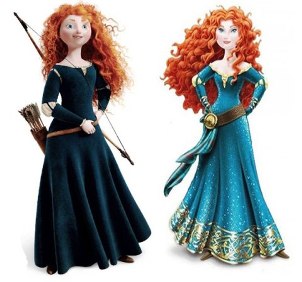
Left: Merida as she appeared in Brave (2012) and
Right: a  promotional image from Merida's induction
into the Disney Princess range.
Why would over 240,000 people feel compelled to sign a petition asking a multi-national, mass media corporation to alter the design of an animated film character as she appears in their merchandise, including clothing and dolls? In the past three weeks, A Mighty Girl, a site that promotes books, movies and toys that celebrate "smart, confident and courageous girls", has promoted the "Keep Merida Brave" campaign. Those  who have signed the petition are disappointed that an unconventional girl heroine, who is confident wielding a bow and arrows yet uncomfortable in a fancy dress, has been homogenised in order to enter the Disney princess stable. (The Disney princesses are a lucrative merchandising phenomenon, until now based on the characters of Ariel [The Little Mermaid], Aurora, [Sleeping Beauty], Pocahontas, Snow White, Mulan, Rapunzel, Belle, Jasmine [Aladdin], Cinderella and Tiana [The Princess and the Frog].)

Everyone from Jon Stewart to Brave writer and director Brenda Chapman  has criticised aspects of Merida's makeover, including her noticeably thinner build, her dress's lower neckline (indeed the very choice to place her in the more formal dress that she despises in the film), the use of make-up, taming of her unruly hair, and, most significantly of all, the removal of her bow and arrows. Here is one "princess" heroine who does a little more than wait for her prince to come, and yet in her leap from film to Disney's merchandise machine, she has lost most of the qualities that made her distinctive.

Merida merchandise in the Disney store,
Manchester, England
It is astonishing to see so many people mobilise, even if only via an online petition, to preserve what they see as a more inspiring role model for girls in popular culture. There will always be comments that call debates about the representation of girls and women a "first-world problem". However, the view that endless depictions of passive girls and women in fiction plays at least some part in limiting options for them in reality has gained widespread acceptance.

While Brave was not quite a Disney production, in that it was produced by Pixar Animation Studios, Disney has owned Pixar since 2006. Though Pixar may have found a way to present a heroine who breaks convention (although in some fairly typical ways, such as through her fiery red hair, the signifier of "different" yet beautiful girl heroines since Anne of Green Gables), it is unthinkable that the homogenising force of the Disney Princess entity would not take some steps to make Merida conform to its brand.

Merida as a baby-face doll for young girls and sparkly
gold sandals from the range
The photograph above, which I took yesterday in the Manchester Disney store, shows a shirt that depicts something closer to the film's original image of Merida. The slogan that accompanies it describes her as "boldly beautiful". The adjective that describes Merida is "beautiful": her appearance is her most important quality. She is unique in that, as the adverb indicates, she is beautiful in a way that is bolder than the likes of Cinderella or Belle, but she's not sufficiently different to be "beautifully bold". Like other princesses in the range, Merida needs to be adapted to sell items like wigs (also available for Rapunzel) and shoes (like the sequinned sandals shown above). These items relate to transforming a girl's appearance in a way that a Merida set of bow and arrows do not. Merida's bow and arrows were not available in the store I visited in England, yet they are currently sold out at the Disney online store for America. The Merida tiara, puffy, sequinned pale blue dress, which bears no resemblance to Merida's preferred dress, and gold gladiator sandals (intended for girls to "embark on a courageous fashion adventure") seem to be in plentiful supply.
Merida dolls in two styles of dress.
Though Merida dolls in both the plain and more ornate dress are available in UK stores packaged with sets of bows and arrows, the overwhelming direction of the Disney princess juggernaut has been toward a particular vision of princesses, even as it has made superficial moves to accommodate diversity. Mulan and Pocahontas may have been granted admission into the pantheon of princesses, yet there are no costumes for these princesses to be found on the US Disney site (however problematic they might be if they did exist there). You can find a Mulan headband, complete with orchid leaves, and a Pocahontas jewellery set, but there is no way for girls to emulate these characters in the same way as they can dress as Cinderella or Rapunzel (who has several costume dresses, both regular and "wedding" edition).

It is still clear that a Disney princess means one particular model or ideal of being feminine, which originated with Snow White in 1937. Individual characters in recent films may break convention in some ways, such as The Princess and the Frog's Tiana, who aspires to own her own restaurant, yet the Disney princess- as an object to be consumed- minimises difference and unique qualities as an integral part of maintaining a brand.

While Disney has clearly been taken by surprise by this social media campaign, it is hard to imagine that the world of Disney princesses will ever expand to fully embrace a natural-faced girl heroine with a drab dress and messy hair. An average appearance and focus on skill rather than beauty is not the dream that Disney sells to small girls and, presumably, their mothers. While the campaign to keep Merida as she appears in Brave shows strong public support for different fictional role models for girls, the ongoing popularity of the generic Disney princess shows that she will be hard to dislodge from her throne.

Friday, December 14, 2012

Why Toys Matter: The Doll and Oven Debate


The new model of Hasbro's Easy-Bake Oven
Even if the end of the Mayan calendar cycle doesn't bring forth the apocalypse, a shopping centre in the days just before Christmas resembles something close to the end times. Many poor souls are buying up toys for their children or child relatives, the happiness of their innocent hearts depending on the right purchase. The world toy market in 2010 was worth over 83 billion US dollars, with 2.6 billion spent in Australia alone. 

Last month I gave a talk at Melbourne Free University about sexism in popular culture. In one brief sentence I mentioned the popular Lego Friends range for girls. The question time of almost half an hour afterwards was almost entirely consumed by debate about the girls' Lego. I talked about Prime Minister Gillard's media representation and popular culture's fixation on women's appearance and sexual desirability, but the audience was most fascinated by toys. We  have all played with toys as children and continue to interact with them if we have our own children or grandchildren: toys are ubiquitous. They are also often seen as having no broader significance or importance (i.e. not important enough to warrant serious discussion). Yet attempts to influence the kinds of toys that are sold, their colours and marketing so as to minimise gender stereotyping always attract negative responses about social engineering that seeks to upend innate gender differences.

The 'old-school' Easy-Bake Oven in its Betty
Crocker incarnation
In the past month, an American girl named McKenna Pope has petitioned Hasbro to manufacture an Easy-Bake Oven that her four-year-old brother, Gavyn, who likes to cook, can use without feeling like a traitor to his sex. The Easy-Bake has been sold since the 1950s and enables children to actually cook small treats, formerly through a light bulb that generated heat and now via an electrical element inside. Though it has always been explicitly marketed to girls, as advertisements and packaging from past models make clear, the oven used to look much like a regular household oven. The new model gives up verisimilitude for pink and purple colouration, giving off the signal, along with the girls featured on the packaging, that this oven is not a toy for boys. McKenna's petition now has 43,000 signatures and some leading chefs have put together a video in support of the cause, all championing the idea that cooking is something that both boys and girls should be able to enjoy. And so should Gavyn feel able to whip up some cookies, but the total saturation of male chefs featured in the support video suggest that perceptions about home cooking being a role for women has not impacted upon the prevalence of men in the more respected realm of professional chefs. With this employment reality in mind, the pinkified Easy-Bake Oven seems more about hemming girls in than stultifying the ambitions of boys.

While many seem supportive of the idea of toy ovens for both sexes—after all most chefs are men, and many celebrity chefs are quite coarse, like Gordon Ramsey, so it's not as if cooking is seen as inducing effeminacy—a Swedish toy chain's recent gender-neutral catalogue has been reported with a greater degree of scepticism. Sweden is the model nation with its aims to minimise the effects of gender stereotyping, and not to mention its progressive laws on prostitution, which criminalise the buyers of sex, not the sellers. The Egalia pre-school in Stockholm caused an international fuss when news of its aims to reduce the effects of social expectations of gender were reported in the media.The school encourages children of both sexes to play with all kinds of toys and the teachers do not use gender-specific pronouns, but refer to children as "friends" or use a gender-neutral term borrowed from Finnish, "hen".
A page from the Swedish Toys R Us catalogue
Top Toy, the franchise holder for Toys R Us in Sweden, was given training and guidance by the country's advertising watchdog for the gender discrimination it perpetuated in its catalogues, which replicated the standard segregation of toys along gender lines. This nudge encouraged the chain to produce their latest catalogue with a girl shown deftly working a Nerf gun, a small boy nurturing a baby doll, and both a boy and girl playing with a doll's house (though the boy is perched precariously near the end of the house where a male doll appears to be luxuriating in a spa). When the UK's Daily Mail reported on the catalogue, it placed "gender-neutral" in scare quotes, presumably to emphasise the ridiculousness of such a concept, and described the toy retailer as "forced" to show boys and girls playing with all kinds of toys, as if such representation went against all that is logical and natural.

Unlike the Easy-Bake Oven, which may prove a gateway to an acceptably male career in the male-dominated restaurant industry, boys cuddling baby dolls and rearranging the furniture in a doll's house were presumably seen as perverting the natural order, in which girls are meant to desire these things because they will become mothers and homemakers. Though young boys seem equally attracted to dolls, as Cordelia Fine's Delusions of Gender explains with reference to studies that have measured young children's reactions to them, they are taught that it is only girls who may play with them. "Action figures" like G.I. Joe are distinguished from "dolls" that are about fashion and make-up, like Barbie and Bratz, and mothering, like Baby Born and Baby Alive.
'Lottie', Arklu, 2012
'Black Barbie', Mattel, 1980
 
As  Dolls are understood as central to girls' play alone, and hence some parents and professionals are concerned by the unnatural proportions of the likes of Barbie, who was modelled on the German Bild Lilli (an adult novelty, moreso than a children's toy). A new doll named Lottie, who resembles a nine-year-old girl, rather than an adult woman or a baby, has been released by a UK company, Arklu, and has been praised as "a healthy alternative" to Bratz, Barbie and Monster High. Lottie has a flat chest, does not appear to be wearing make-up, has normally proportioned legs and wears typical girls' play clothing, rather than focusing on high fashion or a sexy appearance. Lottie is probably not the type of nine-year-old who is going to grab hold of a Nerf gun, however. In addition to two dolls dressed for playing in the garden, two of the incarnations come clothed in ballet and horseriding outfits, while another is wearing a party dress to wear to a masked ball. "Lotteville Festival Lottie" has black skin, though as with Barbie's "Colored Francie" who debuted in 1967 and "Black Barbie" of 1980 and onward, her features are still those of a white girl. (Colored Francie was made using the head mould of the regular white Barbie.)

As the examples of the Easy-Bake Oven and boys playing with dolls show, we place great strength in the idea that what kinds of toys that children play with helps to determine the kind of adults that they will become, especially in terms of how appropriately masculine or feminine they will be. Another clincher for this argument is the recent release of "Breast Milk Baby", a doll that enables girls to play at breastfeeding and which comes complete with a function that enables it to make suckling sounds. Predictably, some have seen the idea of breasts being used for their primary function of feeding children through doll play as "sexualising" girls while others have emphasised that we should be normalising breastfeeding to girls to ensure that breastfeeding rates do not continue to fall.

Wednesday, February 1, 2012

Lego Friends Video

It's heartening to see that the criticism of the Lego Friends range for girls is rolling on. The following video, produced by Feminist Frequency, draws together some intriguing Lego ads from the 1980s onward that show the company's attempts to produce a range to entice girls to enter the world of Lego. It is dispiriting to realise that the collective picture of these attempts is that girls want to make jewellery, click together simple pieces that have pre-determined outcomes and fantasise about princes.

I'm looking forward to part two of this series, which promises to take us on a historical tour of advertisements for Lego featuring boys, including Zack the Lego Maniac.

Monday, December 26, 2011

Lego Makes Sure That Boys Will Be Boys and Girls Will Be Girls

I have an opinion piece in today's Age newspaper on the new Lego 'Friends' range for girls, which was produced in order to attract girls to the Lego brand.

Understandably, there is some debate on the issue in the comments already. Authors do not choose article titles in newspapers, so this would not have been my choice for a headline, but they are written to invite readers in with a bit of controversy. I guess the point of the article is that what we think girls and boys are is really a bit of a fiction.

Maybe a little girl is the best authority on the subject. And this girl's toy store complaints sum it up quite simply.

Tuesday, August 12, 2008

Olympic Girl Singer "Flawed" in Appearance

Today brings us the news of a Chinese Milli Vanilli scenario. "The girl in the red dress", Lin Miaoke, actually mimed the song “I Sing for My Motherland” at the Beijing Olympics opening ceremony to a recording of the voice of another girl, Yang Peiyi. If we revisit our repressed memories of the spandex-panted Milli Vanilli, the group was comprised of two fit, attractive young men who lacked abilities in the vocal department but were the media front for significantly less-marketable (yet talented) R&B singers.

The difference in this instance is that there was no commercial imperative to relegate the authentic singer to the background of the event. While not “right”, it was understandable that pop music sold to teenagers had to come in an attractive package that could be featured in magazines, included on fold-out posters and salivated over in video clips. Now we are witness to a scenario where it is in the “national interest” for the child performer of a song to be perfectly attractive.

If China could have found its own Nicky Webster, who was considered to have the right combination of voice and appearance for the Sydney opening ceremony, we’d not be commenting on the need for beauty to accompany talent in another area. We could also think of other examples relating to the Olympics to confirm that this is not a peculiarity of Chinese attitudes toward girls and women. Remember the Australian swimmer Petria Thomas and how her endorsements paled in comparison with “more attractive” athletes such as Susie O’Neill, who was admittedly more successful when they were competitors, and Samantha Riley.

The specifics of the choice of the “right” girl in Beijing make some telling points about how we think of girls. Reports suggest that initially a ten-year-old girl had been chosen to perform the song. She was ditched for being “too old”. Yet at seven, our real singer, Yang was evidently too young. One of the key reasons she was not deemed attractive enough to sing in person was because of her “uneven” teeth. Most children go through the same process whereby their baby teeth fall out and adult teeth grow through at an uneven rate until they settle several years later. China did not want a “cute” child with endearing uneven pearly whites, but a child who had the features almost of a woman (in terms of adult teeth), but was still supremely youthful in appearance. Like girlish porridge, ten was too old, seven too young, but nine was just right. 

The girl chosen for her appearance also necessarily had feminine long hair in comparison with Yang’s shorter but practical (and cute) bob. Lin also seems to have more of a wide-eyed look which may not only be about a marker of innocence but privileging of a slightly western visual aesthetic.

Intriguingly, we’ve not had a boy fulfil the role of singer and representative of national identity at an Olympic opening ceremony in recent times from what I can recall (although a boy springs to mind for the Melbourne Commonwealth Games in 2006). Would we value a boy for the qualities of his voice alone? Is it only girls who must look good while they excel at singing and swimming?

While there is some suggestion that Lin did not know it was not her own voice on the recording that was played at the ceremony (both girls purportedly sound "similar", but not similar enough it seems), her media comments about the event are telling. She was delighted with the performance because "I felt so beautiful in my red dress". Like consumers who demand perfect red, shiny apples that turn out to have little flavour, we seem to be applying visual standards over substance in how we think of girls too.

Friday, June 20, 2008

Bindi Irwin's 10th Birthday: The Jungle "Girl" (for how long?)

There are more signs of something wrong in the marketing of Bindi Irwin as a commodity than the mere presence of snowflakes in an advertisement for a winter event in sunny Queensland. Bindi has taken on a major role in promoting Australia Zoo, recorded her own television program and launched a clothing line since the death of her father, Steve. There is no doubting that she's popular. She has won a Logie award for Best New Talent. Last week, she even beat out the voice of Elmo for a Daytime Emmy for the most oustanding performer in a children's series for her work in Bindi the Jungle Girl.

Whether Bindi is being exploited has been the subject of some public discussion in the past year. The questions and complications surrounding children in the entertainment industry are surely the same whether a child is a film star, musical prodigy or next-in-line to a native zoo throne. It was other things that got me musing on the subject of Bindi, though. She was purportedly named after the Aboriginal word for "little girl". However, as a Queenslander in my childhood, that term just means prickly-thing-that-grows-in-the-grass-in-summer-and-gets-embedded-in-your-bare-feet. Anyway, as I said, it was other things.

The most significant was walking past her line of children's clothing in a department store. The second, while frivolous, still baffles me. So I'd best deal with that first. The crimped hair. To take the style of a '90s comedian: what's with that? I had no idea whether I'd missed the revival of crimping among children (I still have my '80s crimper, mind you), or whether she was sadly behind the times.

The naivete of crimped-hair-Bindi appears to have disappeared, however, with the arrival of an Emmy and the marketing of her clothing line. The recently-launched line includes ranges named "Urban Cowboy", "Warrior" ["incorporating naive graphics, bright colours and a grunge mix of '70s and '90s meets modern vintage"], "Green is the New Black" and "Jungle Safari". Among the environmental calls to arms printed on a number of the shirts is one that is a little troubling. It reads: "Crikey... What an Adventure".

The use of this definitive phrase seems to suggest the way in which Bindi is standing in as a de-facto Steve Irwin in order to ensure the continuation of the "brand" which her father created. While her mother, Terri, has taken on a significant role in promoting Australia Zoo and ensuring the legacy of Steve and continuation of his good works, she cannot, with her American heritage, be a credible image of "Australianess". Bindi's young sibling, Bob, has been spared this role by virtue of his limited linguistic skill, but we can be assured if he were older than Bindi that he would have been the child in this role--a young double for his father and measure for the continued sale of the idealised, broad-accented Aussie bloke.

While Bindi is often shown with snakes around her neck and a story even circulated that she would venture to swim with the same stingray that killed her father, it will be interesting to see whether she is permitted to wrestle crocs as she enters adulthood or whether she will remain in the safe space of song-and-dance edutainment videos, spreading her message of animal conservation. Bindi is presented as a "wildlife warrior", but the word "princess" often accompanies this phrase in Australia Zoo promotional material. There's even a photograph of her wearing a princess crown on the website. Is she just warming this throne for the ascension of baby Bob?