I have an co-edited collection entitled Young Adult Gothic Fiction: Monstrous Selves, Monstrous Othersabout to be published in June by University of Wales Press. It's packed with wonderful essays from children's literature friends old and new. I've written a chapter with my co-editor Kristine Moruzi on the intersection of fairy tale with YA Gothic, which I think is one of the first takes on the intersection of these three areas.
This collection is the first to focus exclusively on twenty-first-century young adult Gothic fiction. The essays demonstrate how the contemporary resurgence of the Gothic signals anxieties about (and hopes for) young people in the twenty-first century. Changing conceptions of young adults as liminal figures, operating between the modes of child and adult, can be mobilised when combined with Gothic spaces and concepts in texts for young people. In young adult Gothic literature, the crossing of boundaries typical of the Gothic is often motivated by a heterosexual romance plot, in which the human or monstrous female protagonist desires a boy who is not her ‘type’. Additionally, as the Gothic works to define what it means to be human – particularly in relation to gender, race, and identity – the volume also examines how contemporary shifts and flashpoints in identity politics are being negotiated under the metaphoric cloak of monstrosity.
TABLE OF CONTENTS
1. Introduction: Kristine Moruzi and Michelle J. Smith
Section 1: Genre Trouble: Gothic Hybrids
2. Zombies Vs Unicorns: An Exploration of the Pleasures of the Gothic for Young Adults – Patricia Kennon
3. Genre Mutation and the Dialectic of YA Gothic Dystopia in Holly Black’s The Coldest Girl in Coldtown – Bill Hughes
Section 2: Rewriting the Historical Gothic
4. ‘Vanguard taste and fashion spirit’: Feminist Responses to Twenty-First Century, Western Zeitgeist in Vampire Romeo and Juliet texts – Sarah Olive
5. The Pre-Monstrous Mad Scientist and the Post-Nerd Smart Girl in Kenneth Oppel’s Frankenstein Series – Sean P. Connors and Lissette Lopez Szwydky
6. Rock Star Rochester and Heartthrob Heathcliff: The Problematic Redemption of the Byronic Hero in Recent Young Adult Retellings of Brontë Novels – Sara K. Day
Section 3: Gothic Places
7. Monstrous Islands: Spatiality and the Abjection of Motherhood in Gothic Young Adult Fiction – Cecilia Rogers
8. Adolescence Adrift: The Lost Child in Contemporary Australian Gothic YA Fiction – Adam Kealley
Section 4: The Human and the Non-Human
9. Accepting Monsters: The Visual Gothic in I Kill Giants and A Monster Calls – Debra Dudek
10. Unhuman Entanglement: Onto-Ethics and the Fiction of Frances Hardinge – Chloé Germaine Buckley
11. Black and White and Read All Over: Miss Peregrine’s Peculiar Children, Gothic Imagery and Posthuman Publishing – Jen Harrison
Section 5: Gothic Femininities
12. Testimony from Beyond the Grave: Comparing Girls’ Narratives of Sexual Violence and Death in Gothic Fiction – Lenise Prater
13. Young Adult Gothic Fairy Tales and Terrifying Romance – Michelle J. Smith and Kristine Moruzi
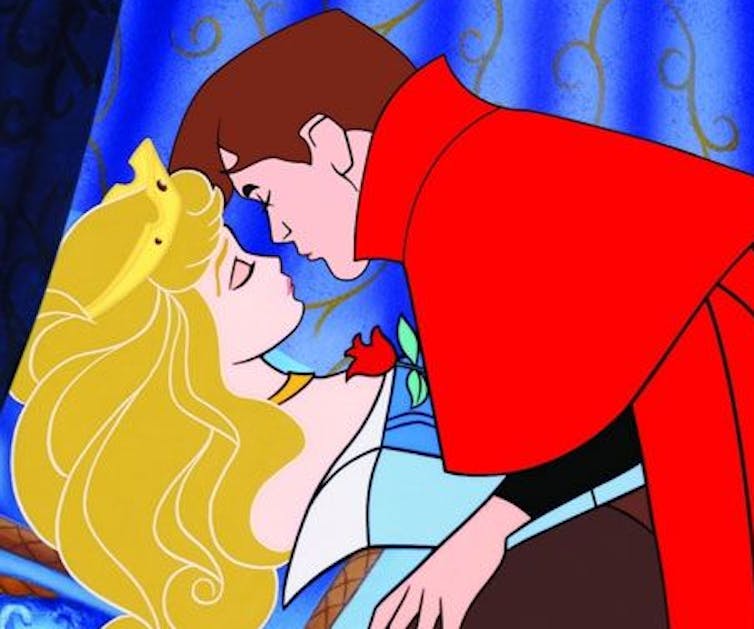
The famous kiss scene from Sleeping Beauty. Disney
Recently, an English mother, Sarah Hall, prompted worldwide media coverage in response to her suggestion that Sleeping Beauty should be removed from the school curriculum for young children because of the “inappropriate sexual message” it sends about consent.
It’s not the only time fairytales have come under scrutiny recently. They are increasingly being targeted for “banning” within schools or avoidance by parents because of their perceived sexism, passive princesses, and reinforcement of marriage as girls’ ultimate goal. But can fairy tales actually be harmful as their critics believe?
Fairy tales were once told – and then written – by adults for adult audiences. Early versions of many tales were often bawdy, salacious and replete with sexual innuendo. Since the Grimm Brothers removed these elements to reconfigure the fairy tale for children in the early 19th century, fairy tales have been seen as ideal, imaginative stories for young people. Almost all of us know the most popular stories from childhood reading or Disney films.
Tradition is not reason enough to continue a cultural practice that has become outmoded. Nevertheless, there are a range of reasons why these calls to restrict children from reading fairy tales such as Sleeping Beauty are misguided.
Children’s literature needn’t model ‘ideal’ behaviour
Initially, most children’s literature was didactic and preoccupied with instructing children in correct morals and drilling them with information.
Adult readers today would struggle to find any pleasure in children’s literature prior to 1850, let alone today’s kids. In order to provide “delight” as well as “instruction”, children’s books represent a range of behaviour, including, in the case of fairy tales, the attempted murder of children, and punishments such as feet being severed and birds pecking out human eyes.
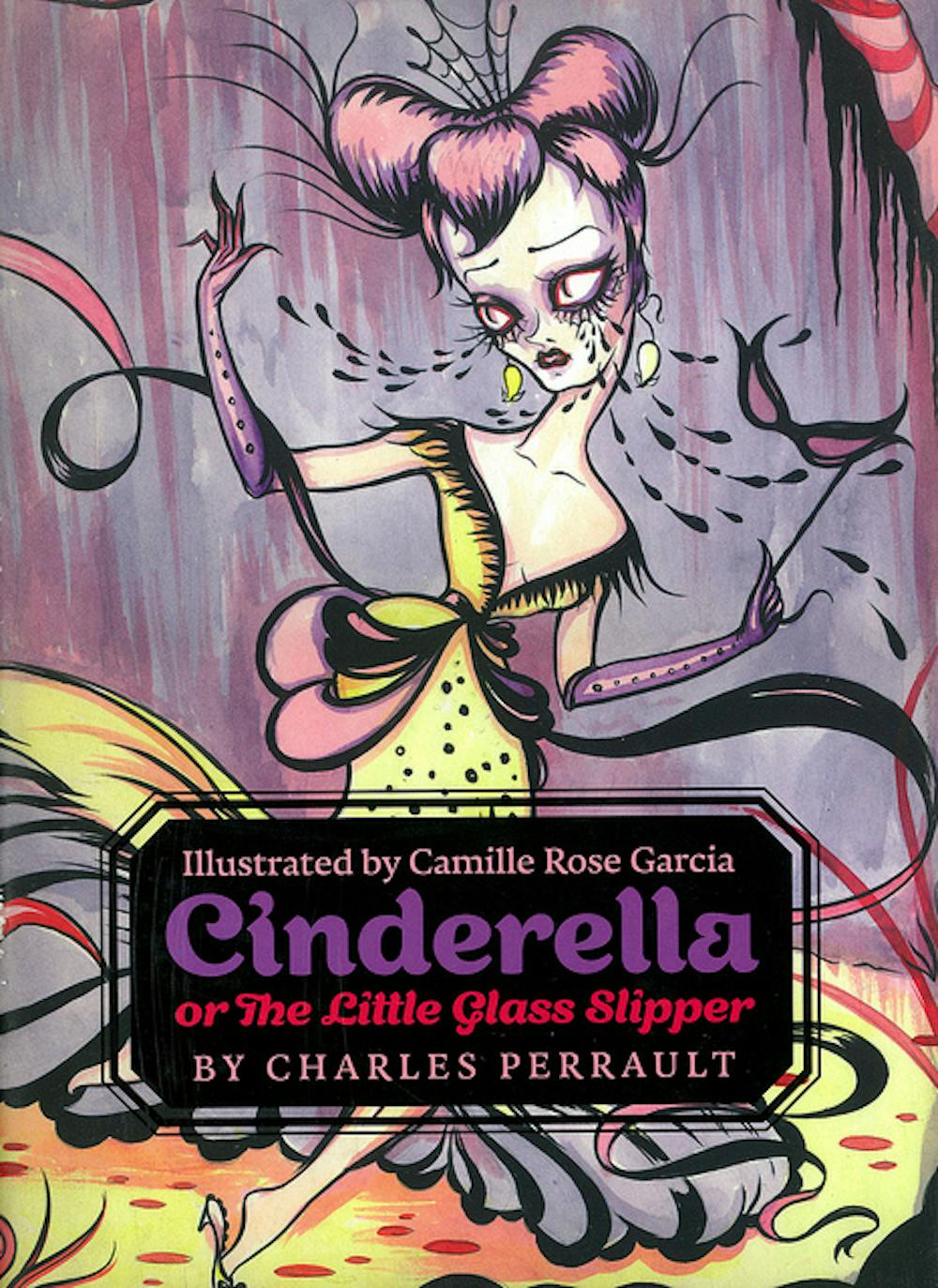
Charles Perrault was the French author who added the famous motifs of the glass slipper and pumpkin coach to the Cinderella tale. In his version of Sleeping Beauty, after the Princess and the Prince marry in secret and have two children, the Prince’s mother is entirely unimpressed. Unsurprisingly within a fairy tale, the Prince’s mother is descended from ogres and she demands that the two children be killed and eaten for dinner by the whole family, with the macabre detail that the boy is to be served with Sauce Robert.
As in Snow White, in which the Huntsman refuses to kill the heroine and substitutes an animal heart for that of Snow White’s, no actual harm comes to the princess or her children but not before the ogress has prepared a tub full of vipers in a typical last-ditch attempt at villainy.
When we consider the norms of evil and violence in fairy tales – most of which are usually punished – it is bizarre to imagine every detail serving as a behavioural model for children. If we insisted that every character in children’s literature behaved precisely as we wish to teach children to behave then we would likely be presenting bland stories that no child would actually read.
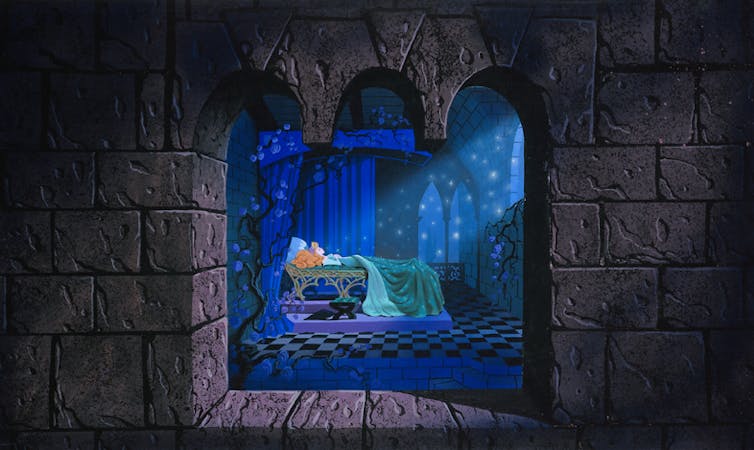
Maleficent’s curse came to pass on the Princess’ 16th birthday… but the good fairies changed the curse so the Princess would not die, but sleep ‘til awakened by true love’s kiss.Flickr CC
Considering plot points in context
If we focus on one plot point, like the kiss in Sleeping Beauty, we can overlook the overall narrative context.
Within the tale, it becomes legend that the sleeping spell that has been cast on the Princess will only be broken after one-hundred years by the kiss of a king’s son. The narrative premise includes a premonition about how the magic will unfold and demands the resolution of the prince’s kiss to “save” the princess who must wait to be returned to consciousness.
While we might critique the emphasis on romance and passivity from a feminist perspective, the idea that the tale is promoting the equivalent of a Steubenville scenario in which an unconscious young woman is sexually assaulted ignores the magical logic of the fantasy world.
By that measure, we might see Prince Charming as a maniacal stalker as he demands all women in the kingdom try on the glass slipper in order to track down the attractive girl who failed to slip him her address before running off from the ball.
In Sleeping Beauty, it is significant that the Prince is told about the Princess being doomed to sleep until she is awakened by a king’s son. The Prince recognises that he is one of few people who can end the curse and resolves to tackle the brambles and thorns that surround the castle in which she is trapped in slumber.
Significantly, in the Grimms’ version, Little Brier-Rose, numerous young men try to push themselves through the thorny hedge and die miserably in the attempt. However the hedge turns into flowers for the Prince and allows him through. Only the right man, with the right motivations, and the one who can release the Princess from the curse – is permitted through.
Rather than being a parallel to a kiss taken without consent, the Sleeping Beauty kiss is akin to a paramedic giving mouth-to-mouth resuscitation to an unconscious person who would most usually want to be revived.
Many versions of every fairy tale
The version of Sleeping Beauty targeted in the UK is part of the “Biff, Chip and Kipper” series designed to teach children to read. These books aim to educate children in the mechanics of reading and, as such, some of the literary nuance, symbolism, and visual artistry present in many fairy tales and picture books based upon them are no doubt lacking.
It is important to recall that there is no definitive version of a fairy tale. Calls for “bans” of a particular tale ignore variations between, say, Perrault’s Sleeping Beauty complete with cannibalistic, viper-wielding ogress and the Grimms’ less violent adaptation.
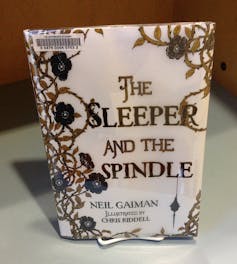
Rather than eschewing fairy tales entirely, parents and educators would be better placed to look to quality adaptations and retellings by outstanding children’s authors, such as Neil Gaiman’s The Sleeper and the Spindle, which merges Snow White and Sleeping Beauty.
In this tale, the Queen sets out on a journey armed with a sword to save the Princess and is the one who rescues her through a kiss.
There is even a picture book version called Sleeping Bobby in which the gender roles are entirely reversed. Numerous parodies such as John Scieszka’s The Frog Prince Continued, in which the Princess’s married life with the frog is far from “happily ever after”, can also be a way for older readers to begin to question and play with the conventional gender expectations of some fairy tales.
Reweaving old stories into new
Fairy tales have been undergoing a continuous process of being rewoven into new stories for hundreds of years.
Just as many old tales have fallen out of favour and are no longer known, so too might some contemporary favourites eventually stop being told to children, potentially replaced by reworked versions or entirely new stories.
This storytelling method of old wine being poured into new bottles has a rich tradition and does not require our intervention. After all, the people who ban books in stories are always the villains, not the heroes. This article was originally published on The Conversation. Read the original article.
It’s 150 years since an Oxford mathematics don published the most important work of children’s literature and one of the most influential books of all time.
The origins of Alice’s Adventures in Wonderland in a story that Charles Dodgson told 10-year-old Alice Liddell and her two sisters while rowing along the Thames in 1862 are well known. What is less understood is why it has become such an enduring cultural touchstone across the globe.
Many popular stories can be distilled to the basic structure of a male hero undertaking a quest. In 1949, Joseph Campbell described the common features of the “monomyth” or hero’s journey that are evident in stories from those of Buddha and Jesus to Luke Skywalker.
In W.W. Denslow's illustrations and L. Frank Baum's original text, Dorothy is a much younger girl (with
silver shoes instead of ruby slippers).
Contrary to the dominance of heroic tales of men, there are several iconic narratives of pre-pubescent girls journeying through dream-like fantastic realms that have become enduring phenomena.
Like the ubiquitous Alice, Dorothy Gale from The Wizard of Oz has gained a life of her own beyond L. Frank Baum’s books. The Kansas orphan’s journey into Oz is, if anything, better known through the MGM film starring Judy Garland. The film transforms Dorothy’s journey into nothing but a dream— like Alice’s— inspired by a cyclone-induced blow to the head.
The stories of Alice, Dorothy and more recent girl protagonists in popular fantasies, such as Sarah’s encounters with the Goblin King in the 1986 film Labyrinth, are strongly inflected by fairy-tale tradition. Campbell himself later acknowledged that he “had to go to the fairy tales” in order to bring any semblance of female heroism into The Hero with a Thousand Faces.
As fairy tale scholar Rebecca-Anne Do Rozario explains throughout her work, fairy tales are most often about girls on the cusp of maturation and marriage.
Alice Liddell photographed as a
"beggar maid" by Carroll
In their original book incarnations, however, both Alice and Dorothy are very young girls: Alice is just seven and Dorothy is estimated to be eight. Carroll was notoriously fascinated by pre-pubescent girls, whom he often photographed in staged poses.
The young ages of Alice and Dorothy free them from involvement in a romance plot. In girls’ fiction from the early twentieth century, it was common for adventurous heroines become hastily engaged in the final pages of a novel.
Even more importantly, as girls, Alice and Dorothy occupy a transitional borderland between childhood and adulthood. This also seems to make them more attuned to crossing the boundaries between fantasy and reality.
Whether this capacity derives from the combination of negative assessments of children and females as less rational in comparison with adults and males, or marks girls out as more perceptive and empathetic, is debatable.
What is clear is that these girl heroines take different paths to characters on the typical male hero’s journey. Even within fantastic literature, where anything is possible, there are clear gendered distinctions for protagonists.
As my Deakin colleague Lenise Prater pointed out to me in an important scholarly dialogue on this topic (a Facebook chat thread), female hero quests in fantasy tend to encompass an internal quest that takes place in a dreamscape. In contrast, male heroes enter into literal fantasy worlds; their adventures are supposed to be “real” with the space of the story.
The dreamy adventures of Alice work through or play with some of her waking interests and anxieties. As in Carroll’s text, Tim Burton’s film adaptation explicitly signals that Wonderland is a purely imaginary place. Alice suffers from nightmares about Wonderland as a child, and her father reminds her that dreams cannot harm her and she can “always wake up”.
Judy Garland in a publicity still from 1939
The MGM Oz film changes Dorothy’s journey into a dream through its casting of the same actors in roles in both sepia-toned Kansas and Technicolor Oz. (Farmhands Hunk, Hickory and Zeke appear as the Scarecrow, Tin Man and Cowardly Lion, while neighbour Almira Gulch proves all dog-haters must surely be green-skinned witches.)
As lone questers, girl characters are the most vulnerable and physically weak. Despite their powerlessness in conventional respects, heroines such as Alice and Dorothy are able to survive the dangers posed by people and supernatural beings who possess advantages that are not available to them (adult authority and magic chief among them).
The lives of both Alice and Dorothy beyond their original books by Carroll and Baum suggest a cultural investment in stories about the most vulnerable of people. Alice and Dorothy experience the most amazing of journeys, in which they triumph over the highest forms of authority and power, from queens to witches.
It is reassuring that these stories about girls, who are often overlooked because of their age and gender, are almost universally known. Nevertheless, imagine the possibilities if our most iconic girl characters did not always have to “wake up” at the end of their adventures. Michelle Smith will be chairing the Making Public Histories seminar on “Melbourne’s Alice” at the State Library of Victoria on 26 November 2015.
To coincide with the release of Disney's new Cinderella film, I was a guest on Radio National's 'Life Matters' last Friday. I joined host Natasha Mitchell in a talkback session on the subject of girls and princess culture, along with Samantha Turnbull, author of the Anti-Princess Club series of books and children's author and school principal John Marsden.
Listen in to the podcast for a variety of perspectives on what wanting to be a princess means, not only for girls, but for boys too.
A few months ago, I was invited by ABC Melbourne's Libbi Gorr to record five short segments on fairy tales. The aim was to talk about how earlier versions of the tales, prior to their revision for children in the nineteenth century, had more salacious and gruesome origins than most people know about from their own childhood reading.
I gathered together some of the most fascinating and unusual elements of some of the most popular tales as they have been told and recorded across time and place. The five "Scary Fairy Stories" that I discussed were Beauty and the Beast, Goldilocks and the Three Bears, Little Red Riding Hood, Rapunzel and Cinderella.
Fairy
tales are badly misunderstood. When we talk about 'fairy tale' romances, as Chloe Angyal did in The Age recently, we ignore the darker
and more subversive history of these ubiquitous stories and the essential part
of the women who originally told them. If you only know fairy tales from the
simpering princesses in Disney films, then you're missing out on cross-dressing
swordswomen, defecating girls and sexually active maidens.
While
it is 200 years since the Grimms collected fairy tales as an academic exercise
to preserve the folklore of Germany, the passing of time has made us forget
that it is not the Grimms who invented them. Fairy tales were usually told by
the fireside in the evening as people, mostly women, worked at essential chores
such as spinning. It is no surprise then that the tales the women spun, such as
Rumpelstiltkin, often included the spinning wheel as a symbol of their labour.
These oral tales were not specifically intended for children and early versions
are frequently crude and highly sexual. In one version of 'Little Red Riding
Hood' collected by the Grimms, but later made wholesome when the second edition
of their Children's and Household Tales was
published for a wider audience, the heroine escapes the wolf by telling him she
has to go outside to "make a load". Before the Grimms removed references
to sex, the witch who keeps Rapunzel imprisoned in a tower knows her not-so-innocent
prisoner has been letting down her hair for a man when her clothes become too
tight because she is pregnant.
'Rapunzel', Wanda Gag, 1936
Various
cultures have their own variants of these tales that are perhaps not 'as
old as time' as Disney suggested in their 'Beauty and the Beast', but which
have a far longer history than we afford them. The Chinese equivalent of
Cinderella, Yeh-hsien, dates from AD 850. In place of a fairy godmother, a
ten-foot long fish rewards her with gold, pearls, dresses and food.
In seventeenth century France, it was women who pioneered the literary fairy
tale that adapted oral tales for educated adult salon audiences. History has
erased these women from public view, such as Madame d'Aulnoy who coined the
term contes
de fées (fairy tales) and wrote several volumes of them. We tend to only acknowledge Charles
Perrault, who wrote the version of 'Cinderella' (minus Walt Disney's pumpkin) that we know today.
French fairy tale writers created many stories that did not survive the
process of sanitising fairy tales for children that the Grimms began in the
nineteenth century. Women were not helpless princesses waiting for Prince
Charming in these fairy tales. In Marie-Jeanne LʼHéritier's 'Marmoisan' (which I read recently at the Monash Fairy Tale Reading Group), the heroine, Leonore, dresses as her twin brother,
Marmoisan, to take his place in war and distinguishes herself in battle.
Marmoisan died in disgrace after he attempted to scale a rope ladder to rape a
married woman and was impaled upon her waiting husband's sword.
These literary fairy tales and many of the oral versions do not
show women as victims and men and heroes as we expect today. Passive and
obedient heroines have been gradually introduced by male collectors and re-tellers
of the tales across the past two-hundred years, especially as they have sought
to socialise children into masculine and feminine roles. The glittery Disney
collection of princesses obscures the way that fairy tales often showed girls
as mentally or physically strong. They also criticised and punished men for
their exploitation of women.
While Little Red Riding Hood can kill the wolf in a pot of boiling sausage
water in one early version, by the time of Perrault's first written adaptation in
1697, she is relegated to his dinner. The Grimms then transformed what was
often a bawdy story to one entirely about female dependence. Their version
introduces the figure of the huntsman who saves Red by cutting the wolf open
with a pair of scissors.
The Grimms also excised all traces of sexuality from their heroines and instead
promoted stifling ideas of feminine innocence and purity. While this is
partially understandable given their intent to revise the tales for children,
at the same time as deleting the sex, they ramped up the gory violence in ways
not present in the oral tales they were supposedly recording. In their second
edition of tales, they decided to punish Cinderella's step-sisters by having
their eyes pecked out by birds.
Paradoxically, if we want our culture to present
girls and women with empowering models of femininity, in the main, the
seventeenth century versions of fairy tales are better candidates than those of
recent times. Some literary writers such as Angela Carter have already
rewritten fairy tales in a way that returns power to their heroines. Yet the
current crop of film and television fairy tale adaptations, such as Mirror, Mirror and Once Upon a Time, have the potential
to overturn the popular trend of passive heroines in fairy tales in the past
two centuries on a wider scale.
If we look to the history of fairy tales, we can see amid the hundreds of variants
of each tale how much they have changed across time and place. The pink
princess culture that absorbs many girls today is something that they have internalised
from more recent conservative, sanitised versions of fairy tales that suggest
that a woman's greatest achievement is to be innocent and beautiful. If we
returned to telling the fairy tales of old, aspiring to be a fairy tale
princess wouldn't necessarily be such a bad thing.
As part of the Glen Eira Storytelling Festival, the Monash University
Fairy Tale Reading Group is hosting a fairy tale salon inspired by those of
17th Century France on 23 June at Monash Caulfield.
Today was the first day of the Fairy Tales Re-Imagined symposium at the Australian Centre for the Moving Image. This morning I was surprised to find a cinema full of several hundred eager participants.
The first session described a spectacular online documentary project from the ABC called Re-Enchantment. There were two sessions involving the author and director Sarah Gibson- also a Jungian analyst (can't say I've met one before)- who brings amazing psychological insight to readings of fairy tales. I'm now keen to see her three-part documentary series Myths of Childhood.
The second session focussed on the Little Red Riding Hood story, particularly wolves and the idea of devouring and being devoured. I was spellbound by the artwork and history presented by printmaker Jazmina Cininas, who undertook the Girlie Werewolf Project as part of her PhD at RMIT. Her striking images appear in this blog post.
According to Jazmina's research, there were numerous girls and women who rode wolves from the 16th century, which was a crime when practiced by females. These records flowed through to some lesser known examples of purported female werewolves, with Jazmina's own works taking much from the historical circumstances of women's imagined devious relationships with magic (for instance, imagery of particular plants and flowers, such as hemlock, associated with she-wolves and witches). It was a revelation to find girl werewolves almost five centures before the Ginger Snaps films.
The final session concentrated on the Cinderella story and its place in contemporary culture. Meredith Jones from The University of Technololgy Sydney read the tale into contemporary makeover culture, from reality television trainwrecks like The Swan to Michael Jackson and Lad Gaga. I was intrigued by the connection between Meredith's argument that makeovers foreground the process of becoming, just as fairy tales give us pleasure through the process of the heroine becoming the princess (rather than how wonderful the prince might be as a husband, the children that may issue as a result etc.). What happens during "ever after" is not important.
This session also included an absolutely fascinating and rich paper by Peter Mitchell (also from UTS) on the significance of the "light shoe" for women, to shed light on ubiquitous glass slipper. I haven't spared much thought about the evolution and importance of footwear, apart from footbinding and the repercussions of high heels on poor feet and the ability to remain upright, but I was humbled into the realisation that the history of dress has major implications for the construction of gender. I really had no idea that men also wore high heels at court, and that they did symbolise power in terms of adding height to the wearer.
Tomorrow promises sessions on the use of fairy tales in creative works and the enticingly titled "The Forbidden Room: From Bluebeard to CSI". It was suggested today that the contemporary crime drama is a modern way of confronting death in the same way as the fairy tale did in the past, so I'm keen to hear Catherine Cole's paper "Death as Entertainment". I think my enthusiasm perhaps proves the point already.
Yesterday I visited Disney's 'Dreams Come True' exhibition at the Australian Centre for the Moving Image. It was a different experience to the recent Tim Burton exhibition in that it was not packed to the point of queueing to view display cases. In fact, I was surprised by how few people were wandering about the exhibition on the Thursday late-night opening given Disney's domination of children's entertainment in the 20th century.
I know all that is wrong with Disney, from the sweatshop clothing to the dubiousness of the race, class and gender politics of many films. And then there's the pinkified Princess commercial juggernaut. I know that traditional tales have been plundered from a range of cultural traditions and have had the complexity and challenging elements vacuumed right out of them. I know that The Little Mermaid really ends sadly with her turning to foam on the sea. I know that fairy tales are not always about dreams coming true. But in Disney animated features dreams do come true and gruesome story elements are neatly traded for anthropomorphosised animal helpers.
The exhibition focuses on the fairy tale features from Snow White and the Seven Dwarfs (1937) to the most recent adaptation of Rapunzel, Tangled (whose heroine seems to take more visually from a Bratz doll than the traditional Disney princess). Despite all of the critical lenses I could wear, I was still a helpless victim of nostalgia from the first section of cels from Snow White. (I always preferred her because she was dark-haired, unlike the usual parade of fair-haired virtuous maidens.)
There were some surprising snippets of information revealed throughout the exhibit, including unused sketches of Maleficent from Sleeping Beauty with an ominous pet panther and footage of a deleted scene from Snow White in which she instructs the seven dwarfs in the most polite way to eat soup, like an animated June Dally-Watkins.
Apart from a few sections of video (such as the soup sequence and an intriguing look at the multi-plane camera used to add depth to painted backgrounds presented by Walt himself) and some maquettes, it was a largely "wall-based" exhibition. Well, apart from the welcome presence of fairy tale books sourced by Disney in Europe that were used as visual references by his animators. A broader exhibition encompassing other animated films and shorts and the Disney theme parks would no doubt have appealed to a larger audience, but perhaps it could never be contained within any viable exhibition space.
With physical progress through the exhibit, which was ordered chronologically, came a sense of declining magic in the animation process. Cels were no longer hand-inked by the 1990s and the laborious and fascinating techniques of old are gradually being superseded by computer animation. It seems telling that this change in production coincides with the decline in popularity of the Disney-fied earnest fairy tale musical. Disney has signalled its intent to leave fairy tales aside in future animated features, but perhaps rather than a turn away from these stories, Disney might be wise to return to more authentic versions of them, complete with enough shock and awe to compete with contemporary children's entertainment that does not promote the Disneyfied idea of childhood innocence, dreams always coming true, and the homogeneity of 'dreams' as simply a desire for a girl to be married.