Showing posts with label children's literature. Show all posts

Monday, January 28, 2019

From The Getting of Wisdom to Heartbreak High: Australian school stories on screen


File 20190123 135136 1fnm1pl.jpg?ixlib=rb 1.1
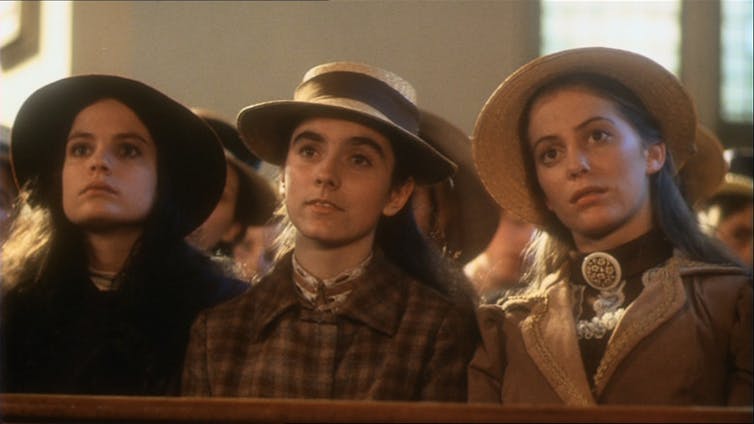
Bruce Beresford's 1977 film, The Getting of Wisdom
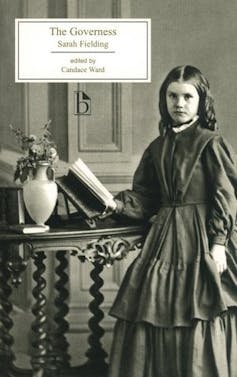
Going to school is one of the few life experiences almost everyone shares. From the time children began to be educated in small groups in Britain, there were school stories in popular culture, beginning with what many consider the first novel for children, Sarah Fielding’s The Governess; or, The Little Female Academy (1749).

The emphasis in early school stories was on moral and intellectual learning, which the reader was supposed to absorb. However, as school became a universal experience, stories about school elevated peer acceptance, sporting success, and friendships to the main sources of drama. This has remained true from the crucial cricket match of Tom Brown’s School Days (1857) to the quidditch tournaments of the Harry Potter series.

School stories appeal to children and adolescents because they represent a world comprised largely of other young people, with adult teachers relegated to the periphery. However, they also mark changes in the kinds of ideals and goals we want young people to aspire towards.

Conformity and obedience were measures of a protagonist’s success in early school stories. However, as the genre has evolved in film and television, school stories have celebrated characters who transgress adult expectations, emphasising the importance of individuality.

Nerds, jocks and popular kids

North American film and television from the 1980s embraced stories about high school in particular, with earnest considerations of the dilemmas faced by teenagers forced into almost familial relationships with each other.

John Hughes’s The Breakfast Club (1985) was among the first films to treat the experience of high school with seriousness and empathy. In what became a template for the genre, it explores the unique forms of social stratification found in schools between the popular kids, the nerds, the jocks, and outcasts who sprinkle dandruff on their artworks.
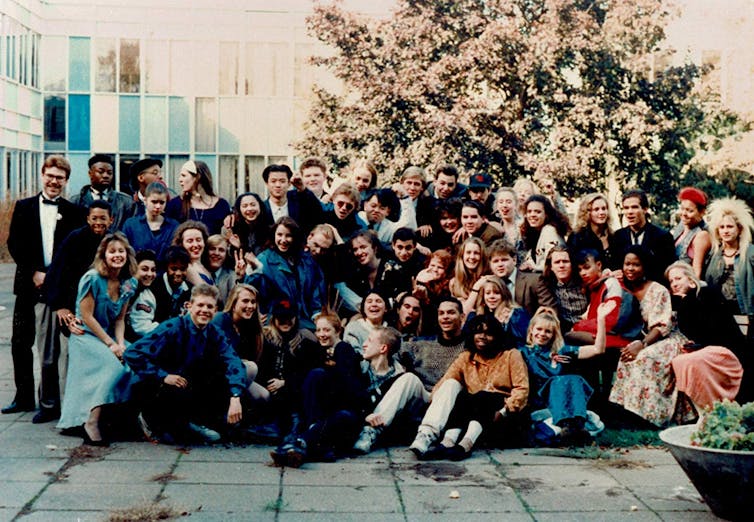

Canadian series Degrassi Junior High
Canadian series Degrassi Junior High (1987-89) and Degrassi High (1989-1991) were pioneering in their focus on teenagers and willingness to confront mature topics including drug use, teen pregnancy, racism, and sexuality. The ultimate dark and vindictive side of school friendships were most memorably fictionalised in 1988’s Heathers, which darkly satirised teen suicide. Reflecting a significant transformation in real-world schools, the recent television reboot of Heathers had its premiere delayed for almost a year because of the Parkland, Florida school shooting.

Some of the longest-running American TV series set in schools in the 1990s nevertheless idealised beautiful, popular, and often wealthy students. Both the Saturday-morning comedy Saved by the Bell (1989-1993) and the prime-time drama Beverly Hills, 90210 (1990-2000) were largely told from the perspective of fashionably dressed and perfectly coiffed characters at the zenith of the social hierarchy.


Outsiders and underdogs

Australian school stories have differed from their British and American counterparts from the outset. Henry Handel Richardson’s classic novel The Getting of Wisdom (1910), which was adapted into a film in 1977, is the story of poor country girl, Laura Tweedle Rambotham, who is sent to an exclusive Melbourne boarding school.

While the usual arc of the school story was to teach the outsider appropriate lessons about how to conform and contribute to school spirit and sporting success, Laura lies in an ill-fated attempt to be liked, cheats to pass her final exams, and finishes school without having found peer acceptance. It is her very inability to change herself to fit stifling gender and class expectations that has made her an enduring and beloved character for the past century.


Read more: The case for Henry Handel Richardson’s The Getting of Wisdom


Such irreverence toward authority figures is a frequent attribute of Australian stories about school. In its early years, teen soap Home and Away (1988-present) built many dramas around conflict with high-school principal Donald Fisher, who the students privately referred to as “Flathead”.


With conscious efforts to present a grittier and more realistic depiction of school life, Heartbreak High (1994-1999) not only included a cast that aimed to represent Australia’s increasingly multicultural society but depicted teachers as less authoritarian, and heavily invested in their student’s welfare.


In a reworking of the opposition between student and teacher, it has become common for Australian stories about school life to retain a focus on the underdog but to draw out its comedic potential. Hating Alison Ashley (2005), based on the novel by Robin Klein, cast pop darling Delta Goodrem as the beautiful, superficially perfect student, but presents the story from the perspective of friendless hypochondriac Erica Yurken.

Rather than a disciplinarian setting in which the teachers and principal have ultimate control, Barringa East high school exhibits a loss of adult order, with graffiti and rubbish covering the campus.

The film opens with the explanation that three teachers have retired due to the trauma of teaching at the school, with two institutionalised and one escaping to join the Hare Krishnas. While the overall culture of underachieving students allows Erica to shine academically, she does not feel comfortable in herself until she makes an unlikely friend in her imagined rival, Alison. A happy ending for Erica is found not in changing herself and achieving popularity, but in finding a supportive friend to join her outside the mainstream.


The trailer for 2005 film Hating Alison Ashley.

Chris Lilley’s Summer Heights High (2007) at once adopted the perspective of an underdog in the form of Jonah Takalua (a Tongan character controversially played by Lilley), and a queen bee in the form of Ja’mie King, a private school girl “slumming” at a state school.

Rather than glamorising the wealthy, image-obsessed Ja’mie, the series positions viewers to laugh at the shallowness of her manipulations to gain the approval of teachers and the few students she deems worthy of her attention. While many of the teachers at the school do care for student welfare, the infamous Mr G is the ultimate demonstration of the way teachers and authority figures are often depicted as flawed and ineffectual.
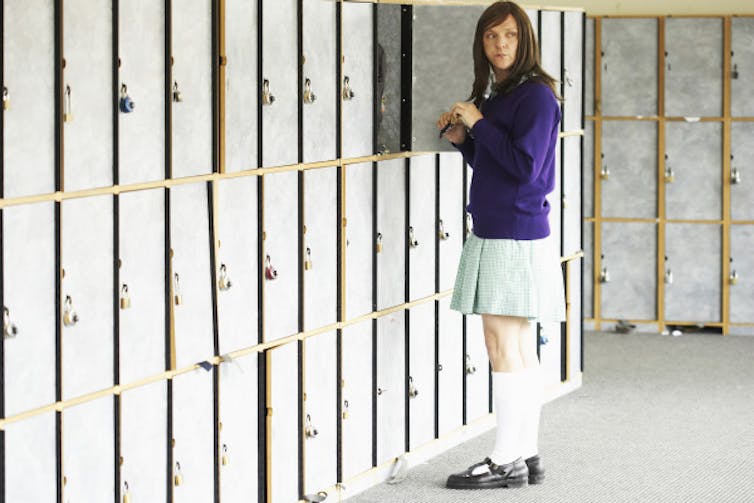
Chris Lilley as Ja'mie

Across time, Australian stories about school have more in common with the narratives of outsiders like Napoleon Dynamite than those of inspirational teachers as in Dead Poets Society or the beautiful students of Riverdale.

Attributes such as wealth, attractiveness, and family connections and status often distinguish the protagonists of American and British stories. Similarly, working hard and behaving correctly often brings success and popularity to these characters.

In contrast, Australian stories about school days are more likely to question structures of authority and social status. And anyone who wants to suck up to the popular kids or teachers can just, in the words of the students of Heartbreak High, “Rack off!”The Conversation


This article is republished from The Conversation under a Creative Commons license. Read the original article.

Wednesday, January 3, 2018

From sleeping beauty to the frog prince – why we shouldn't ban fairytales


File 20171213 31706 1k3e5cs.jpg?ixlib=rb 1.1
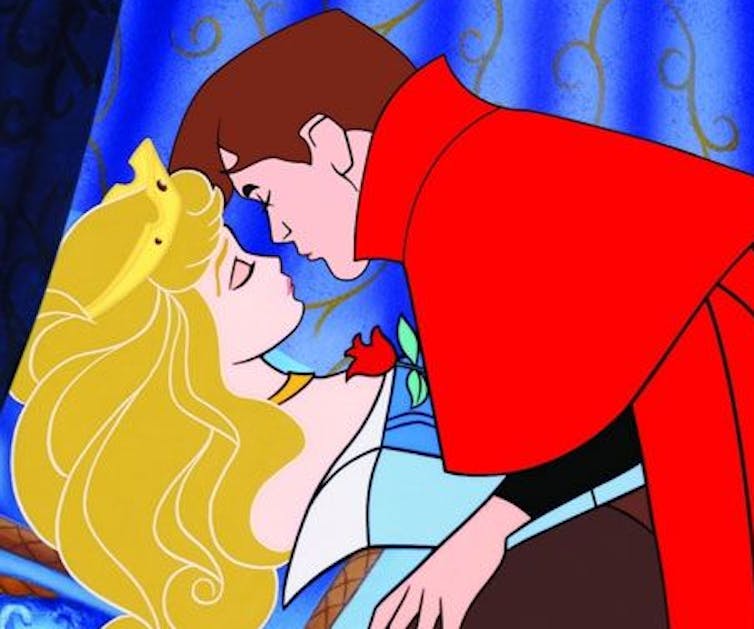
The famous kiss scene from Sleeping Beauty. Disney
Recently, an English mother, Sarah Hall, prompted worldwide media coverage in response to her suggestion that Sleeping Beauty should be removed from the school curriculum for young children because of the “inappropriate sexual message” it sends about consent.

It’s not the only time fairytales have come under scrutiny recently. They are increasingly being targeted for “banning” within schools or avoidance by parents because of their perceived sexism, passive princesses, and reinforcement of marriage as girls’ ultimate goal. But can fairy tales actually be harmful as their critics believe?

Fairy tales were once told – and then written – by adults for adult audiences. Early versions of many tales were often bawdy, salacious and replete with sexual innuendo. Since the Grimm Brothers removed these elements to reconfigure the fairy tale for children in the early 19th century, fairy tales have been seen as ideal, imaginative stories for young people. Almost all of us know the most popular stories from childhood reading or Disney films.

Tradition is not reason enough to continue a cultural practice that has become outmoded. Nevertheless, there are a range of reasons why these calls to restrict children from reading fairy tales such as Sleeping Beauty are misguided.


Children’s literature needn’t model ‘ideal’ behaviour

Initially, most children’s literature was didactic and preoccupied with instructing children in correct morals and drilling them with information.

Adult readers today would struggle to find any pleasure in children’s literature prior to 1850, let alone today’s kids. In order to provide “delight” as well as “instruction”, children’s books represent a range of behaviour, including, in the case of fairy tales, the attempted murder of children, and punishments such as feet being severed and birds pecking out human eyes.

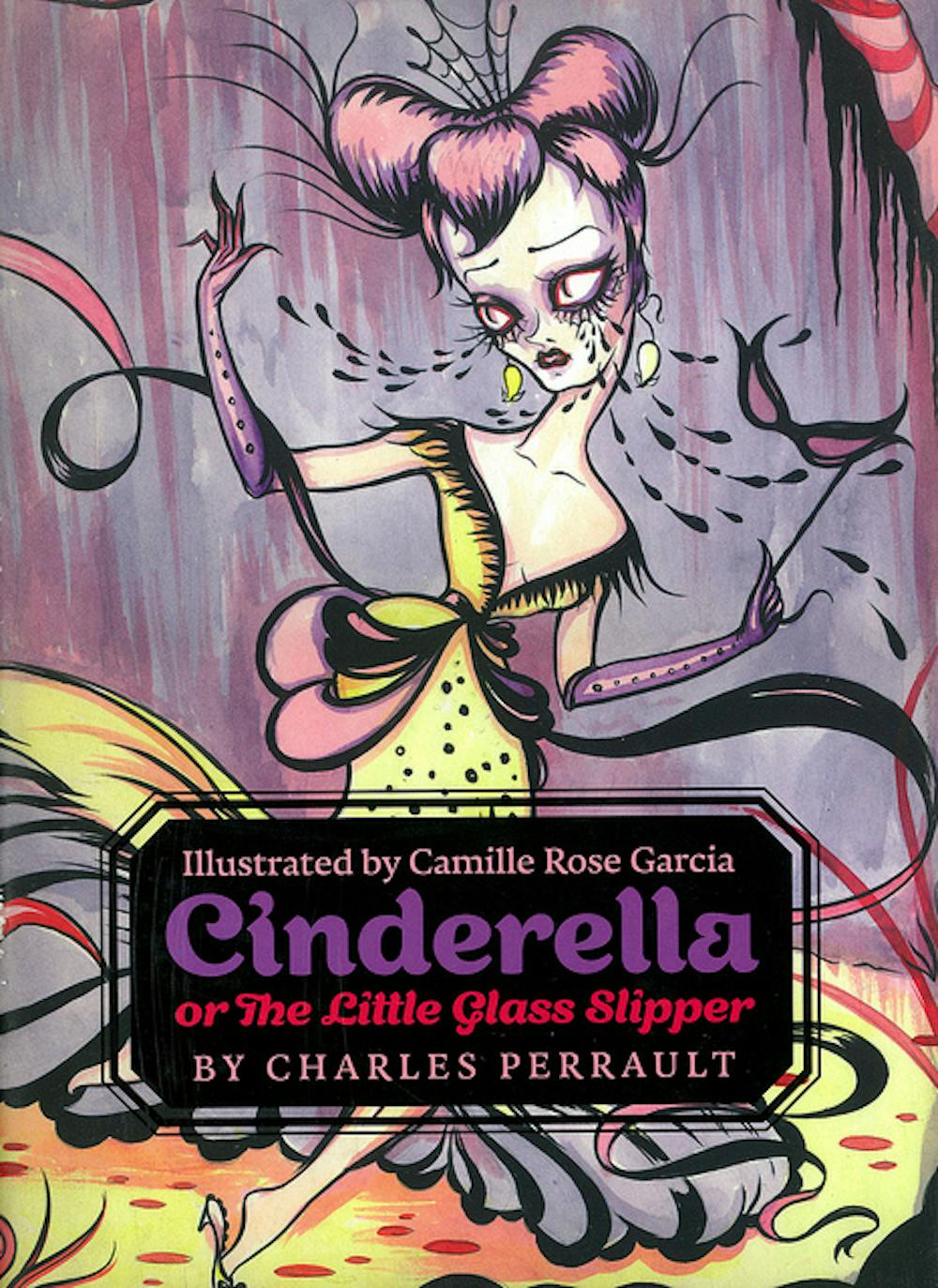
Charles Perrault was the French author who added the famous motifs of the glass slipper and pumpkin coach to the Cinderella tale. In his version of Sleeping Beauty, after the Princess and the Prince marry in secret and have two children, the Prince’s mother is entirely unimpressed. Unsurprisingly within a fairy tale, the Prince’s mother is descended from ogres and she demands that the two children be killed and eaten for dinner by the whole family, with the macabre detail that the boy is to be served with Sauce Robert.

As in Snow White, in which the Huntsman refuses to kill the heroine and substitutes an animal heart for that of Snow White’s, no actual harm comes to the princess or her children but not before the ogress has prepared a tub full of vipers in a typical last-ditch attempt at villainy.

When we consider the norms of evil and violence in fairy tales – most of which are usually punished – it is bizarre to imagine every detail serving as a behavioural model for children. If we insisted that every character in children’s literature behaved precisely as we wish to teach children to behave then we would likely be presenting bland stories that no child would actually read.


Maleficent’s curse came to pass on the Princess’ 16th birthday…
but the good fairies changed the curse so the Princess would not
die, but sleep ‘til awakened by true love’s kiss.
Flickr CC

Considering plot points in context

If we focus on one plot point, like the kiss in Sleeping Beauty, we can overlook the overall narrative context.

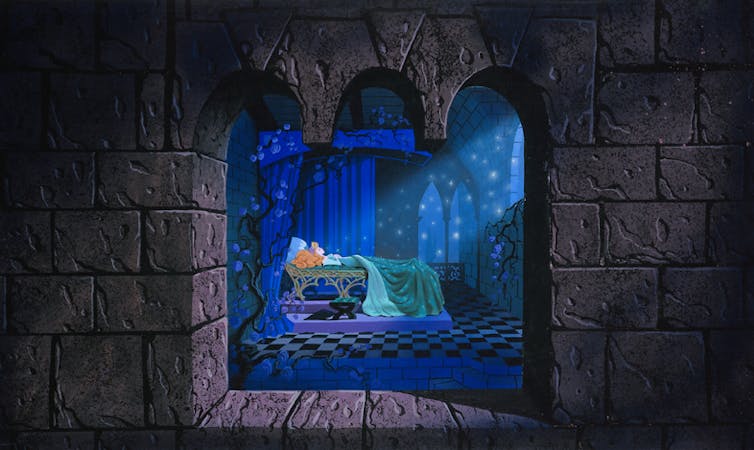
Within the tale, it becomes legend that the sleeping spell that has been cast on the Princess will only be broken after one-hundred years by the kiss of a king’s son. The narrative premise includes a premonition about how the magic will unfold and demands the resolution of the prince’s kiss to “save” the princess who must wait to be returned to consciousness.
While we might critique the emphasis on romance and passivity from a feminist perspective, the idea that the tale is promoting the equivalent of a Steubenville scenario in which an unconscious young woman is sexually assaulted ignores the magical logic of the fantasy world.

By that measure, we might see Prince Charming as a maniacal stalker as he demands all women in the kingdom try on the glass slipper in order to track down the attractive girl who failed to slip him her address before running off from the ball.

In Sleeping Beauty, it is significant that the Prince is told about the Princess being doomed to sleep until she is awakened by a king’s son. The Prince recognises that he is one of few people who can end the curse and resolves to tackle the brambles and thorns that surround the castle in which she is trapped in slumber.

Significantly, in the Grimms’ version, Little Brier-Rose, numerous young men try to push themselves through the thorny hedge and die miserably in the attempt. However the hedge turns into flowers for the Prince and allows him through. Only the right man, with the right motivations, and the one who can release the Princess from the curse – is permitted through.

Rather than being a parallel to a kiss taken without consent, the Sleeping Beauty kiss is akin to a paramedic giving mouth-to-mouth resuscitation to an unconscious person who would most usually want to be revived.


Many versions of every fairy tale

The version of Sleeping Beauty targeted in the UK is part of the “Biff, Chip and Kipper” series designed to teach children to read. These books aim to educate children in the mechanics of reading and, as such, some of the literary nuance, symbolism, and visual artistry present in many fairy tales and picture books based upon them are no doubt lacking.

It is important to recall that there is no definitive version of a fairy tale. Calls for “bans” of a particular tale ignore variations between, say, Perrault’s Sleeping Beauty complete with cannibalistic, viper-wielding ogress and the Grimms’ less violent adaptation.

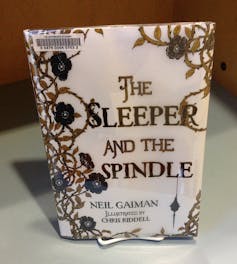
Rather than eschewing fairy tales entirely, parents and educators would be better placed to look to quality adaptations and retellings by outstanding children’s authors, such as Neil Gaiman’s The Sleeper and the Spindle, which merges Snow White and Sleeping Beauty.

In this tale, the Queen sets out on a journey armed with a sword to save the Princess and is the one who rescues her through a kiss.

There is even a picture book version called Sleeping Bobby in which the gender roles are entirely reversed. Numerous parodies such as John Scieszka’s The Frog Prince Continued, in which the Princess’s married life with the frog is far from “happily ever after”, can also be a way for older readers to begin to question and play with the conventional gender expectations of some fairy tales.


Reweaving old stories into new

Fairy tales have been undergoing a continuous process of being rewoven into new stories for hundreds of years.

Just as many old tales have fallen out of favour and are no longer known, so too might some contemporary favourites eventually stop being told to children, potentially replaced by reworked versions or entirely new stories.

This storytelling method of old wine being poured into new bottles has a rich tradition and does not require our intervention. After all, the people who ban books in stories are always the villains, not the heroes.

This article was originally published on The Conversation. Read the original article.

Sunday, November 5, 2017

Rethinking Harry Potter Twenty Years On

File 20171102 26426 xezk3g.jpg?ixlib=rb 1.1
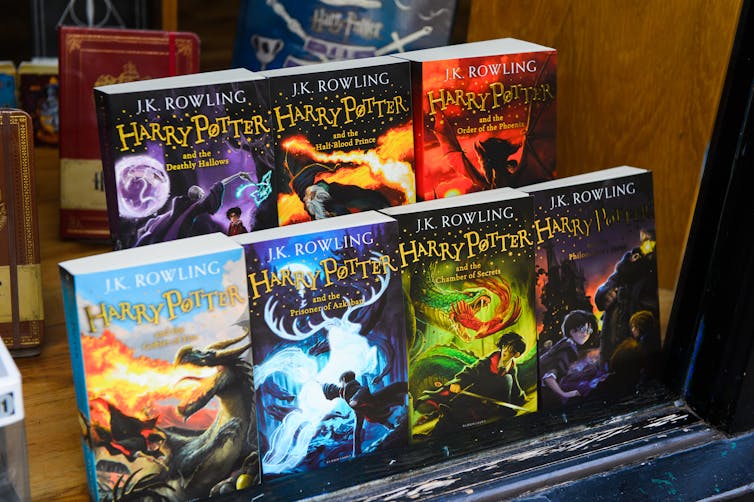
The Harry Potter series on display in Windsor, England. Anton Invanov/
Shutterstock.
The twentieth anniversary celebrations of the highest-selling book series of all time are now coming to a close. 2017 has been a milestone year for Harry Potter fans in their twenties and thirties, who spent much of their youth in anticipation of the release of each new book or film.

Last week’s Wheeler Centre event Harry Who? The True Heroes of Hogwarts brought together writers, comedians and musicians to celebrate the series. While Harry and his broken glasses predominate at most Potter tourist sites and film screenings, Harry Who? asked the audience to consider who really is the true hero of J.K. Rowling’s stories.

As readers contemplate the long-term legacy of the Potter universe and whether it will endure, it’s also important to consider the overarching messages of Rowling’s series as the most popular example of children’s literature to date.

Harry embodies the key characteristic of some of the most memorable protagonists of classic children’s literature. From centuries-old stories of Cinderella onwards, child and youth characters who are orphans not only foster the reader’s empathy, but are also freed from the expectations and restrictions that biological parents impose.

Melanie A. Kimball explains the twin effects of child orphans in literature:
Orphans are at once pitiable and noble. They are a manifestation of loneliness, but they also represent the possibility for humans to reinvent themselves.
Without the tragedy of Harry’s parents being violently killed by the evil Lord Voldemort, Harry would have had no compulsion to go beyond the “typical” experience of a child with a witch and a wizard for parents.

At Harry Who?, writer Ben Pobjie pointed out that Harry is not exceptional, but that it is his nemesis, Voldemort, who propels Harry to importance. With reference to his dubious celebrity, Pobjie joked that if Voldemort was in Australia, he would “be on Sunrise every morning”. As with the importance of Harry’s lack of parental influence and constraint, the extreme adversity of being Voldemort’s inadvertent nemesis establishes a heroic scenario for Harry to inhabit.

One of the repeated claims throughout the event was that Harry is not much of a hero at all, particularly as he relies on other people to succeed. In the first book of the series especially, Hermione Granger possesses most of the personal attributes and knowledge required to defeat the ever-present threat posed by Voldemort. She is clearly the most intelligent of the Harry, Ron and Hermione trio, and works hard where her male counterparts often attempt to shirk the effort required.

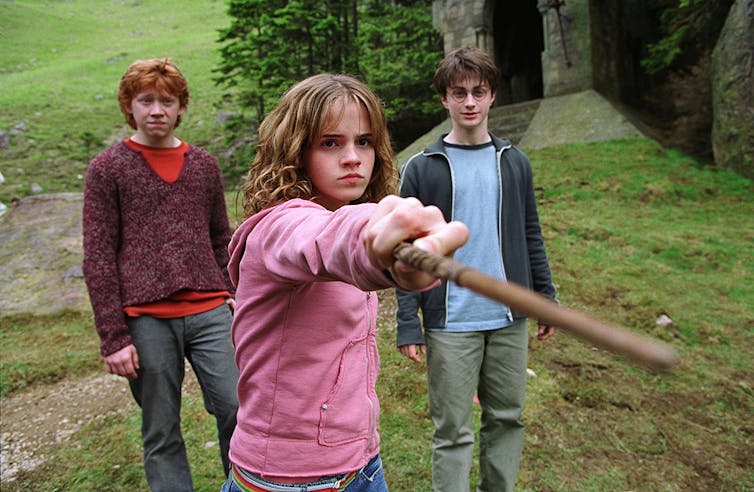
Hermione (Emma Watson) takes the lead in a scene in Harry Potter
and the Prisoner of Azkaban (2004). Warner Bros
While Hermione’s heroism is important, she clearly plays a supporting role to Harry: the series is, after all, named after him. The emphasis on Harry is reflective of the deep gender bias in children’s literature throughout the past century.

A 2011 study of twentieth-century children’s books found that, on average, in each year, no more than a third of children’s books featured central characters who were adult women or female animals. In contrast, adult men and male animals usually featured in 100 per cent of children’s books.

Though the Harry Potter series does depict some strong and beloved female characters including Professor Minerva McGonagall, it is reflective of an era in which protagonists in children’s literature are usually male unless a book is specifically marketed at a girl readership. In addition, the series is also lacking in the depiction of queer characters, regardless of J.K. Rowling’s post-book declaration that Hogwarts’ headmaster Professor Albus Dumbledore is gay.

With the rapid changes in attitudes toward social and cultural issues including same-sex marriage and children with non-normative gender and sexual identities, the Harry Potter series — as a product of the 1990s and early 2000s – might not endure as well as some might imagine.

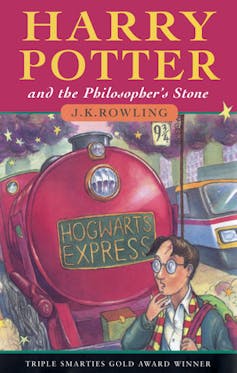
Harry Potter and the Philosopher's Stone
(1997). Bloomsbury Publishing/Goodreads
Indeed, the issue of changing social norms means that very few children’s “classics” continue to be read by children as decades and even centuries pass. It could be that the series is eventually understood as somewhat outdated and more about producing nostalgia for adults in the same way as the once ubiquitous books of Enid Blyton are viewed today.

One crucial part of the Harry Potter legacy, however, is its effectiveness in encouraging readers, viewers, and now theatre goers with Harry Potter and the Cursed Child, to embrace fantastic stories about young people once again.

Adults in the late 19th and early 20th centuries delighted in children’s stories and made up a significant segment of the audience for plays such as Peter Pan. The dual audience of children’s literature, for both adults and children, was once the norm and one that did not bring any shame or embarrassment with it.

The ConversationTwenty years on, today’s adults are still gathering to talk about and celebrate the Potter novels they enjoyed as children and have continued to re-read. In addition, other series such as Twilight, The Hunger Games and Riverdale, show the continuing popularity of stories about young people for adults. In 2037 we will be able to tell if the Potter-effect has lasted or if its magic only worked for a brief spell.

This article was originally published on The Conversation. Read the original article.

Saturday, January 28, 2017

Goodbye Horses (and Transphobia): Transgenderism in Film and Literature

In Laurie Frankel’s new novel This is How it Always Is, an American family grapples with prejudice about transgender children. Youngest child of five boys, Claude, in addition to wanting to be “ a chef, a cat, a vet, a dinosaur, a train, a farmer” when he is older, tells his parents that he wants to “be a girl”.
This Is How It Always Is, Laurie Frankel (2017).
Flatiron Books

The Walsh-Adams family readily embrace his difference, but the world beyond is less capable of processing the gender non-conformity of a five-year-old child. At kindergarten, Claude is permitted to wear dresses, but is castigated for using the boys’ bathroom. After his decision to become Poppy, a school friend’s parent threatens violence in the face of Poppy’s imagined queer contaminating effect upon his son.

Coupled with a transgender woman being shot on a local college campus after a sexual encounter, the family decides that Madison, Wisconsin is an inhospitable environment for Poppy and moves to more progressive Seattle. Nevertheless, they still find it easier to start again without explaining that Poppy is transgender.

Frankel’s novel was inspired by her own experience raising a transgender child. Western culture is currently facing the challenge of understanding transgenderism and the first generation of openly transgender children.

John Phillips, author of Transgender on Screen, suggests that “the crossing of genders will prove to be the most significant single cultural challenge” of our era “because of the redefinition of sexes and sexualities that necessarily accompanies it”. Practical issues such as preferred pronouns, bathroom usage, eligibility to participate in sports, and hormone treatment for young people remain contentious.

A gender neutral bathroom sign. John Arehart/shutterstock
In attempting to reshape our understanding of sex and gender, it is helpful to look back at how we have represented – or, most commonly, omitted – transgender people in popular culture. The historical lack of understanding of transgender people is evident in a cultural tendency to depict them as objects of comedy, or, most often, as freakish or monstrous.

Sensational freaks and psycho killers

Ed Wood’s cult film Glen or Glenda (1953) was designed to shock and is primarily about a man who cross dresses. The film’s final section “Alan or Ann”, comprised largely of stock footage, is more specifically about a transgender (and potentially intersex) character.

Alan was born a boy, but raised as a girl and then served as a man during World War II. While recovering from combat in hospital, Alan learns about gender reassignment surgery and becomes a “lovely young woman”. The “Alan or Ann” section of the film was reportedly added to meet distributor calls for a sensational “sex change” film, implicitly suggesting that transgender people were a freakish spectacle who would increase ticket sales.


While Wood was sympathetic to the practice of cross-dressing, categorising himself as a transvestite, most horror films and thrillers that followed situated transgender characters as villains. The list of transgender murderers is extensive and persistent from the 1960s to the 1990s.

Homicidal (1961) features a murderous woman, Emily, who wears a wig and prosthetic teeth to conceal that she is, in fact, Warren. Nevertheless, Warren was actually born a girl, but raised as a boy by her mother because his father desired a male child and would have harmed a girl. In keeping with the sensational representation of transgender killers, the film was screened with a “fright break” at its climax, in which audience members could leave the theatre and seek a refund if they were too scared.


Hammer Horror’s 1971 film Dr Jekyll and Sister Hyde makes the famous splintered personality tale more disturbing by motivating Jekyll to concoct an elixir of life serum with female hormones from murdered corpses. The serum transforms Jekyll into an evil woman, who eventually kills girls in order to obtain more hormones to maintain the transformation.

The 1983 slasher film Sleepaway Camp has an infamous final scene in which the serial killer is revealed. The character of “Angela” stands naked, smeared with blood, with her penis clearly visible to onlookers who scream, “Oh my God! She’s a boy!” Angela was originally a boy named Peter, but was forced by his mother to assume the role of his twin sister after her death.


Being forced into a particular gender role is clearly traumatic, as in the well publicised case of David Reimer who was raised as a girl after a failed circumcision. However, the implication of Sleepaway Camp and other films with serial killers who are arguably presented as transgender, such as Silence of the Lambs (1991) (and even Psycho [1960]), is that gender non-conformity is frightening and unnatural. As Phillips suggests, revelations of transgender murderers not only make the killings bizarre and monstrous but also “trade on the otherness of transgender to engender fear and loathing”.

Life in pink: transgender children

It is only recently that transgender children have begun to be overtly represented in literature and film. This is indicative of shift from demonising transgender people to greater attempts to understand them and represent them positively, as in mainstream films such as the award-winning Transamerica (2005).

One of the first representations of a transgender child was the Belgian film Ma Vie En Rose in 1997. It playfully blurs the line between fantasy and reality in order to show the thoughts of a seven-year-old boy, Ludovic, who wants to be a girl.

Georges Du Fresne as Ludovic in Ma Vie En Rose. Canal+

Despite its arthouse aesthetic and the fact that Ludovic, as reviewer Roger Ebert suggests, exhibited “no sexual awareness in his dressing up”, the film was given an “R” rating in the United States. The rating suggests that two decades ago there was still significant discomfort with the idea of a boy who might not “grow out of” his femininity. It also signals that young people should not be exposed to the reality of transgender children.
L. Frank Baum’s Ozma of Oz (1907)


This sensitivity explains why there were only a handful of stories intended for children — usually fantasies — that included characters who might be understood as transgender until very recently.
The most notable of these is Princess Ozma, who appears in every book in L. Frank Baum’s Oz book series (1900-1920) apart from the first. Princess Ozma is born a girl, but transformed into a boy named Tip by the witch Mombi, in order to prevent her becoming the ruler of Oz. Tip has no recollection of being a girl when Mombi is compelled to revert him to his original form as the girl Ozma.

Children’s books have historically been willing to show boys and girls who “play” as the other gender (often categorised as “sissies” and “tomboys”), but the expectation is that these characters will mature into cisgender, heterosexual men and women.
Julie Anne Peters, Luna (2004)

It was not until the new millennium that a young adult novel featured a transgender protagonist. Julie Anne Peter’s Luna (2004) depicts a teenage boy, Liam, who progresses from only assuming his true self, “Luna”, at night to eventually making the decision to publicly transition.

Victoria Flanagan, in her study of cross-dressing in children’s literature , explains that contemporary Young Adult fiction has begun to recognise that “cross-dressing has implications that relate to sexuality and sexual/gender identity”. These ideas were previously cordoned off into the realm of adults only, as culture was largely uncomfortable with children reading and viewing stories about queer or gender non-conforming characters.

The next wave of representation

This is How it Always Is is symbolic of the next wave of representations of transgender people. In novels and films for adults, psycho killers who were forced into the “wrong” gender by a parent, or tragic figures such as trans man Brandon Teena, whose real-life rape and murder is dramatised in Boys Don’t Cry (1999), are being replaced by more positive depictions of transgender people.

We are beginning to see stories of young people who are being supported by friends or parents to live as the gender with which they identify – such as transgender boy Cole in The Fosters – and of teens learning to accept a parent’s transition, as in Australian film 52 Tuesdays.


The newfound ability for transgender children to begin their transition or at least delay puberty means there could be a transgender boy or girl in almost any school classroom. Rightfully, novels for young people are also beginning to represent transgender children.

Nevertheless, as with the continued challenges to depictions of gay and lesbian characters in fiction for young people, transgender characters are still rare and sometimes considered inappropriate.
Now it is not the threat of the freakish transgender monster, but the threat of disrupting long-held ideas about gender binaries that has the most potential to send transphobic people to the fright room
The Conversation

This article was originally published on The Conversation. Read the original article.

Monday, September 1, 2014

'Offensiveness' and children’s books: censoring ‘slut’ from a Roald Dahl classic


A collection of Roald Dahl books

I’m fixated on scanning Aldi’s general merchandise offerings in its weekly catalogue. From big-screen TVs to tortilla warmers, Aldi will place almost any consumer good haphazardly in the middle of its grocery aisles.

Last week, the supermarket’s decision to stock Roald Dahl’s Revolting Rhymes drew the book to the attention of at least one shopper who was perturbed by its use of the word “slut”. Aldi responded to a Facebook complaint by removing the title from sale.

The book of six poems, which parody fairy tales, was first published in 1982. Like most of the Dahl canon, it has remained in-print and popular with child readers ever since.

In the poem that prompted the complaint, the Prince says to Cinderella: “Who is this dirty slut? Off with her nut.” The book delights in gruesomeness (decapitated heads roll across the floor, and cannibalism features), violence (Red Riding Hood packs heat), and irreverent humour.

As the title warns, the book inserts all things “revolting” into stories that we’ve come to associate with happy endings, for an audience whom we believe to be innocent and vulnerable.

Though Aldi acted to prevent potential parental backlash, the reaction to the removal of Dahl’s book has been overwhelmingly negative. Over 90% of respondents in a Fairfax media poll believe Aldi acted wrongly, and there have even been calls for a boycott of the supermarket.

Many parents are concerned by inappropriate products being marketed toward minors, as when youth-oriented jewellery outlet Diva was criticised for selling a Playboy range of jewellery in 2011. However, adults also don’t like the cultural touchstones of their own childhoods being tampered with.

When original 1970s episodes of Sesame Street were released on DVD in 2007, they were sold with an adults-only warning label indicating that they “may not suit the needs of today’s pre-school child”. Adults who had been raised on a Cookie Monster who did not know the meaning of a “sometimes” food were offended that their childhood viewing could be considered harmful.
1940s children’s magazines containing stories by Enid Blyton 
Enid Blyton books, most of which were originally published between 1930 and 1960, have been subject to frequent revisions.

Golliwog characters were removed from editions of the Noddy series in the 1980s. References to the titular character and Big Ears sleeping in the same bed have also been expurgated. In the mid-1990s, the Faraway Tree books saw the spank-happy schoolteacher Dame Slap sanitised into Dame Snap, and characters Dick and Fanny can no longer prompt sniggering fits as Rick and Frannie.

As with the complaints about the use of “slut” in Dahl’s rhyme, many people mocked the notion that Blyton’s simply written and ubiquitous childhood books could suddenly be regarded as offensive or inappropriate.

Indeed, when it comes to children’s books, almost any form of content could be considered unsuitable to somebody, somewhere in the world.

Dahl’s James and the Giant Peach, for example, appears on the American Library’s Association’s list of the 100 Most Frequently Challenged Books of 1990-2000. The novel is at number 56 on the list and reported complaints, to school boards in particular, are as numerous as they are bizarre. James and the Giant Peach has been challenged because of its depiction of magic, use of the word “ass”, references to tobacco and alcohol, and for alleged promotion of communism.

As we view children’s books as having an educative role, it makes sense that we want them to be in accord with the values of our time and place. In the present moment, we are particularly attuned to screening out racism and sexism that was the historical norm in periods in which authors like Blyton and Dahl wrote.

The first edition of Dahl’s Charlie and the Chocolate Factory (1964) depicted the Oompa-Loompas as black pygmies from Africa who work for a meagre wage of cacao beans while happily chanting.
Subsequent criticism and debate in the 1970s lead Dahl to sympathise with those who found the characterisation offensive. In the second edition of 1973, the Oompa-Loompas were rewritten as dwarves with “rosy-white” skin from Loompaland. (The orange-skinned, green-haired monstrosities of the film came in between in 1971.)

Dahl’s response suggests that it is not unreasonable to change small aspects of creative works in light of shifting social norms. However, we also have to be mindful that the concepts of offence and unsuitability for children potentially have no bounds.

If millions of parents have read a deliberately grotesque and provocative book like Revolting Rhymes with their children over the course of three decades, should the offence of a handful of adults limit the sale of the book, or even prompt the removal of the word “slut”? Or is it time that a word that is typically used to demean women no longer passes as acceptable in a poem for children?

Whether or not we believe that we should reclaim “slut” from its negative connotations, and regardless of any concern as to whether children will understand the word to mean slovenly or sexually promiscuous, it is troubling when isolated claims of offence have the power to remove a book from sale from any retailer.

This article was originally published on The Conversation. Read the original article.

Thursday, June 19, 2014

Reading Children's Literature is Not Embarrassing

Kevin Dooley/Flickr
This post was published in my Conversation column on 17 June.

When the Harry Potter series became a global phenomenon, adult editions were published that replaced the brightly illustrated covers with dignified photographs of inanimate objects on a black background.

Publishers presumed there was a need to cater to adults who wanted to read a fantasy series about a boy wizard, but who didn’t want fellow train commuters to judge them as juvenile or unintelligent.

A recent Slate article suggests that adults should be embarrassed to read books marketed as young adult fiction. Regardless of the problems with the suggestion that any kind of reading should be embarrassing, why should the intended age of a book’s readership determine whether reading it is “shameful”?

For one, just how do we distinguish between books for young people and books for adults? Many popular classics for young adult readers, such as J.D. Salinger’s The Catcher in the Rye, were originally written for adult audiences. While canonical works in their own right, including Charlotte Brontë’s Jane Eyre and Charles Dickens’s Oliver Twist and Great Expectations, have attracted young readers since their publication in the Victorian era.

Children’s literature evolved to fulfil didactic aims. John Newbery, a pioneering publisher of children’s books in the early 18th century, aimed to provide “instruction with delight” in the books he published. (He’s responsible for Goody Two-Shoes.)

 Education was seen as integral to reading as a leisure activity for children. The concession to entertainment or “delight” was relatively recent. Much early children’s literature is tedious to the modern reader because of its moral and educative focus.

 From the “golden age” of children’s literature in the second half of the 19th century, didacticism decreased and the boundary between books for adults and books for children became permeable. Books – and plays, such as J.M. Barrie’s Peter Pan – often satisfied a dual audience of children and adults.

Is Lewis Carroll "embarrassing"?

While Alice’s Adventures in Wonderland was originally presented by Lewis Carroll to 12-year-old Alice Liddell as a gift, on publication it found a lasting audience with both adults and children.

Robert Louis Stevenson’s Treasure Island and Kidnapped were first published in Young Folks magazine and were seen as “boy’s books”. Yet both Henry James and Arthur Conan Doyle published reviews or commentary on both novels, in a way that the dismissal of children’s books would probably preclude today.

 In 1905, two of Mark Twain’s novels were challenged as inappropriate for child library patrons. In response, Twain claimed that he wrote “Tom Sawyer and Huck Finn for adults exclusively”. Yet he pointed out that the unexpurgated Bible should also be removed from the children’s room lest it “soil” young minds, mocking the very notion of shielding children from literature that features characters “no better than Solomon, David, Satan”.
velo_city/Flickr

If a book “for adults exclusively” is a faintly ridiculous concept, then so too is a book “for children exclusively”. Adults are the authors of children’s books and quite often they write to please and entertain adults too. The possibility of a dual audience is readily accepted in successful children’s animated films in which jokes and references that only adult viewers would understand punctuate the storyline.

Adults are now buying young adult fiction in such great numbers that the primary readership for these books might not actually be young people. Yet at the same time as adults are reading The Fault in Our Stars, Twilight and The Hunger Games, there remains incredulity at the idea that young people and adults can both be entertained and satisfied by the same book.

Instead there is guilt associated with reading children’s literature. This shaming is baseless when literature for young people that is well-written and intellectually challenging, such as the work of Philip Pullman and Sonya Hartnett, is dismissed wholesale. Yet cliched, formulaic and poorly written “adult” fiction does not carry the same weight of embarrassment.

Arguments against adults reading children’s or young adult titles often present life as an opportunity to absorb a limited number of books, with time spent on “lesser” literature destroying the chance to read Proust or defiantly finish Ulysses. Yet this claim about time being wasted in reading children’s books is infrequently applied to popular bestsellers such as Fifty Shades of Grey or The Da Vinci Code.

The truth is that a sophisticated reader will want to sample the most compelling, imaginative and lasting books of the past and the present. Some of these will be difficult and full of complex allusions. Others will be pleasurable genre fiction that follow a predictable, but satisfying, formula.

But there should always be a place for Alice, Peter, Dorothy, Anne, Holden, Katniss, and the March sisters alongside them.

Sunday, September 6, 2009

The history of children’s literature and girls’ books


Comment on Seth Lerer’s Children’s Literature: A Reader’s History from Aesop to Harry Potter from a girls’ literature perspective

I remember stumbling upon Seth Lerer’s at-the-time new history of children’s literature in a library catalogue search last year. I have since read critique of the book that asks why those outside the field of children’s literature feel that they possess sufficient knowledge and authority to attempt to write definitive histories. I believe Lerer is both a Medieval and Renaissance literature scholar, which cannot alone discount the value of his contribution to the field. One of the most renowned children’s literature scholars, Professor Clare Bradford, was a medievalist originally. Until children’s literature is well entrenched at undergraduate and postgraduate level at more universities, it’s going to be a common occurrence for some scholars to traverse from other areas to children's books. Professor Mavis Reimer and Professor Perry Nodelman began as scholars of the Victorian era, just as I have begun my foray in the field looking at books largely no longer read, and unaware of the wide reach of the discipline in contemporary texts.

While it is perhaps impossible to imagine a children’s literature scholar doing an about-face and setting out to write a history of Renaissance literature mid-career, some part of me was pleased that a scholar in “serious” literature would enter the realm of children’s literature. In my fantasy of it all, while there are methodological specificities to children’s literature and generic conventions to children’s texts, it should be no different to move between Romanticism and Victorianism as from Modernism to children’s literature. You’re going to be beginning behind the eight-ball with the switch, but we’re not talking a move from geology to social work.

And so I went to Lerer’s book, taking no offence that he was willing to swan in to the field and publish a history of children’s books that probably outsold the works of the best-known established children’s literature scholars.

I have spent several weeks revising a book proposal based on my PhD thesis on girlhood and the British Empire. The motivation behind this research was further galvanised upon reading Lerer’s history. In the time period relevant to my own work, he refers to boys’ periodicals, including The Boy’s Own Paper, boys’ school stories, the Boy Scouts and has a dedicated chapter on Robinsonades. None of the girls’ equivalents of these aspects of print culture are mentioned.

Actually, there was a little white lie in that last sentence, because The Girl’s Own Paper is mentioned in the chapter devoted to “female fiction”. It comes up because Harry Potter’s Hermione “owes” much to the Paper, but we’ll never now why, as we hear no more detail about what the girls’ periodical actually contained. That the chapter begins by discussing a book that celebrates male achievement is not a good start (Harry Potter and the Prisoner of Azkaban) even if Lerer uses it to make the point that Hermione is not central to the action and only becomes so in the filmic version.

The core argument of this chapter is that “girls are always on the stage; that being female is a show” (228-229) and that girlhood produces a tension between this external staging and finding “inner virtue” (229). I wouldn’t disagree with the ideas of femininity as performance, but conceptions of hegemonic masculinity no doubt identify performative aspects to masculinity as well. The feeling that some of the ideas in Lerer’s book were familiar, and have been much further developed elsewhere, came over me several times. While Lerer does cite many sources in his notes, the weight of the body of children’s literature scholarship does not seem to impact substantially on the content. He writes on fairy tales: “It is as if the girl’s body is itself a kind of forest for the fairy-tale imagination: something dark and inexplicable, something in need of management, of clearing, of cleansing”. While neither masculinities nor fairy tales are within my area of specialisation, ideas like these seemed to present well-worn ground as new observations.

I was surprised to see a book from 1851, The Girlhood of Shakespeare’s Heroines, described as the first “work of literature (not simply of advice) designed for readers in their girlhood...” Now perhaps the word “literature” is what might save this assertion, but, while it’s earlier than the period I ordinarily work in, there are definitely novels written for girls prior to 1851 that are not simply conduct manuals. The next section of the chapter is devoted to Anne of Green Gables, leaving behind the entire development of girls’ literature in the late nineteenth century in Britain, with only the abovementioned work on Shakespeare’s heroines rating a mention. While Lerer is telling a tale about performance, and selecting texts that best suit his study of girls as actors, his book seems to continue the trend of dismissing girls’ literary genres as unworthy of mention. After four pages devoted to Anne, we move to the American Little Women, and finally back to Britain with the canonical The Secret Garden. Wonderful Wizard of Oz rates a mention for the theatricality of Oz, but I find it strange that a book that has a girl protagonist but is not specifically a work of girls’ literature enters into this dedicated chapter. Oh wait, outside of fairy tales, books with male protagonists are “children’s literature” and ones with girl protagonists are “female fiction”? The history of girls’ literature is summed up in six books. The chapter closes with an analysis of Charlotte’s Web. Clearly not a lot happened in the world of girls’ reading in almost half a decade until then.

While Lerer’s book seems more useful for pleasurable reading than research purposes, I am in some ways glad that girls’ books are given short shrift once more. That there is an entire chapter on Robinsonades that does not mention girls’ versions; that boys’ adventure novels and periodicals warrant discussion while girls' equivalents or alternatives are not; that boys’ school stories are analysed in ways that make the schoolboy out to be a Crusoe-figure and we'll never know about what girls' books do beyond the six, questionably "girls'" books that are included. These omissions leave a little space for me to flesh out at least one aspect of children’s literature that is glossed over all too often.

Friday, July 10, 2009

The Embarrassment of Children's Literature

We hide things because we are ashamed of them. Because we know that the norms of our culture will say that there is something embarrassing about a particular act or belief. And so it is a welcome thing that we do not have to hear about the health benefits of adopting a nudist lifestyle from the person we happen to sit next to on a long-haul flight. The bounds of the cultural norm serve some function to keep the majority comfortable. There are nonetheless areas where the cultural norm inexplicably relegates something outside the realm of acceptable adult behaviour. Neither breaking sexual, religious or political taboos, children's literature nevertheless must be discarded as we reach adulthood or our enjoyment of it concealed. Beyond the perils of the train commuter who feels compelled to buy an edition of Harry Potter with an "adult" dustjacket, in the academic realm, children's literature is flat out even convincing scholars of literature more broadly that it is a valid area of academic inquiry.

If you would accuse me of being overly-dramatic, I would direct you to an article in the English Telegraph about the release of the most recent Harry Potter film. Bryony Gordon, who has tired of the series' marketing hype, extends her criticism to adults who might enjoy reading children's books: "Anyway, it won't surprise you to learn that I don't understand grown adults who like Harry Potter, especially when there are so many other great books out there. It's a bit sinister, actually. In my mind, you may as well sit on the tube reading a Thomas the Tank Engine picture-book making choo-choo noises."

This is meant to be a blog on girls' literature and culture and Harry Potter isn't an exemplary text in its portrayal of girls, with an unattractive, annoying swot as its leading female character (in the first book especially). The assumption that Gordon makes, however, is that adults are wasting their time reading children's books because children's books cannot be "great books". While Harry Potter may not constitute the most innovative or brilliantly written series of books, it's a very wide sweep of the critical broom to discount an entire genre of literature with centuries of history as devoid of literary merit. Her final sentence touches on the perceived need to strictly separate adulthood from childhood. Any dalliance with children's books, films or games might reverse your intelligence to the point of pre-literacy. Or before you know it you'll be erecting a statue of Peter Pan in your sprawling ranch, just a moonwalk away from your replica of a Disneyland train station. The "sinister" aspect is the idea that there is indeed something perverted and warped about adults still finding entertainment in books written by adults for a child audience.

The comments in response to the article also bear out the idea that there is something wrong with adults who read children's books: "Why would an adult raed or attempt to red a book such as Lord of The Rings or Harry Potter. They are childrens' books." Ignoring the assaults on grammar in those sentences, the sentiment is clear, children's books should only be read by children. There is no benefit to be had in reading Neil Gaiman, Oscar Wilde's fairy tales, Lewis Carroll, J.M. Barrie, C.S. Lewis, Maurice Sendak or Philip Pullman. And what did anyone ever get out of young adult fiction like The Catcher in the Rye? It's clearly more adult to have a copy of a gossip magazine in hand that poses such elevated intellectual questions as "has Jordan had her breast implants downsized?" than to read works that might also be enjoyed by children. I suppose this is why all of the thirtysomething men who are obsessed with Star Wars films are also labelled "sinister"? Despite some disturbing uses of lycra on middle-aged spread, I don't see too many articles in major newspapers suggesting that men in Storm Trooper outfits are reverting to toddlerhood.

Friday, May 23, 2008

Cherry Cake and Ginger Beer


If food is the sex of children's literature, then Cherry Cake and Ginger Beer: A Golden Treasury of Classic Treats is the equivalent of the Kama Sutra. My childhood favourite lands at the top of Enid Blyton's Faraway Tree were the ones that provided an unending supply of edible delights. Anything was possible. Even Connie's sardine-flavoured ice-cream.

This forthcoming book by Jane Brocket promises to bring us recipes to recreate our favourite treats from the pages of children's literature. The focus is on early twentieth century novels, so we'll be spared an ingredient's list for Bertie Bott's earwax flavoured jelly beans. However, on a disturbing tangent, prompted by the last sentence's assertion, I have just discovered that Jelly Belly has manufactured beans to correspond with the Bott's brand represented in the Harry Potter books. Would you prefer vomit or earthworm flavour?